I Built an AI Schema Architect to Make Structured Data Less Painful
Structured data is one of those SEO tasks that sounds simple until you actually have to implement it.
You need to figure out the right schema type, understand the required properties, write valid JSON-LD, keep the data accurate, and then validate everything before pushing it to production.
If you're building websites, SaaS products, ecommerce stores, or client projects, doing this repeatedly can become a surprisingly tedious part of the workflow.
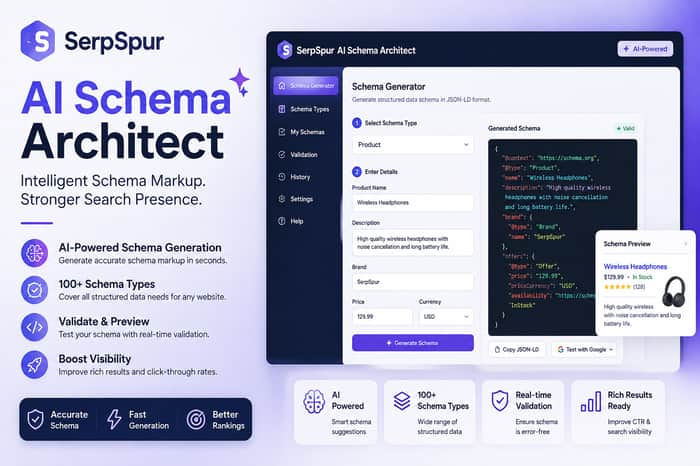
That’s why I built SerpSpur AI Schema Architect.
What is SerpSpur AI Schema Architect?
SerpSpur AI Schema Architect is a tool for creating structured data without starting from an empty JSON-LD file.
The idea is straightforward:
Choose → Add information → Generate → Validate → Implement
Instead of manually constructing every property, you can use a guided workflow to create schema that corresponds to the content you're working with.
It’s designed for:
Indie hackers
SaaS founders
SEO freelancers
Developers
Agencies
Ecommerce owners
Content publishers
Small businesses
The workflow I wanted to simplify
A typical schema implementation can involve a lot of back-and-forth between documentation, your webpage, a code editor, and validation tools.
SerpSpur brings the core process together.
- Pick the appropriate schema
Start by selecting the framework that actually represents the page.
For example, a product page has different structured information from an article, local business page, recipe, or video.
The goal isn't to add schema everywhere.
The goal is to describe the page correctly.
- Add your information
Enter the relevant details about your content, product, business, article, or other page.
Accurate input matters because structured data should reflect what users can actually see and understand on the page.
- Generate the markup
The AI-assisted workflow turns the information into structured markup, so you don't have to manually construct every JSON-LD property.
This is particularly useful when you're working on several pages or projects at once.
- Validate before shipping
Generated code shouldn't automatically go straight into production.
Review it.
Validate it.
Check that the properties make sense.
Make sure the information matches the actual page.
SerpSpur includes validation functionality to help with this part of the workflow.
- Copy and implement
Once everything looks right, the Copy Code functionality makes it easy to take the generated markup and add it to your website.
Magic URL Import
This is one of the features I find particularly useful for existing websites.
Instead of starting completely from scratch, you can provide a webpage URL and use the imported information as the starting point for schema creation.
The workflow becomes:
URL → Import → Select Schema → Generate → Review → Validate → Copy
For an indie hacker managing their own product website, this can save repetitive manual work.
For an SEO consultant or agency, it can make working across multiple client pages more efficient.
What types of schema can you create?
SerpSpur AI Schema Architect supports several common structured-data use cases, including:
Article — blog posts, guides, and editorial content.
Product — ecommerce and product pages.
Local Business — relevant business and location information.
FAQ — genuine question-and-answer content.
Recipe — appropriate food and recipe pages.
Review / Rating — eligible review-related content.
Search — relevant website search functionality.
Video — pages containing meaningful video information.
The important part is choosing a schema type that genuinely fits the content.
More markup isn't automatically better markup.
Why I built it
The problem isn't that structured data is impossible.
The problem is that it can be unnecessarily repetitive.
If you're a developer, you probably don't want to spend your afternoon manually assembling JSON-LD for dozens of similar pages.
If you're an SEO freelancer, you probably don't want every schema task to become a mini development project.
And if you're an indie hacker, you probably have better things to build than another 200-line structured-data block.
SerpSpur AI Schema Architect is built to reduce that friction.
It doesn't remove the need for judgment.
It removes some of the repetitive work.
One important thing: schema isn't a ranking shortcut
I don't think structured data should be marketed as a magic SEO button.
Adding schema doesn't guarantee higher rankings or rich results.
Search engines ultimately decide how they use structured information.
The better approach is to combine accurate structured data with:
Helpful content
Strong technical SEO
Good internal linking
Crawlable pages
Correct indexing
Fast performance
A solid user experience
Think of schema as a way to communicate clearer information about your content—not as a shortcut around good SEO.
Built for people shipping websites
If you're an indie hacker, you probably want tools that help you ship faster without adding unnecessary complexity.
That's the philosophy behind SerpSpur AI Schema Architect.
Instead of:
Documentation → Manual JSON-LD → Debugging → Validation → Repeat
You can work through:
Choose → Generate → Review → Validate → Ship
And when you're managing multiple websites, that difference can add up quickly.
🚀 Try SerpSpur AI Schema Architect
If you're building a SaaS, ecommerce store, content site, local business website, or client project and want a simpler way to handle structured data, give it a try.
Build less boilerplate. Spend more time building your product.
👉 SerpSpur AI Schema Architect — structured data creation for people who'd rather be shipping.
#IndieHackers #BuildInPublic #SaaS #SEO #StructuredData #SchemaMarkup #AI #WebDevelopment #Productivity #Bootstrapped #Entrepreneurship

Use it for Rich Google Results: https://serpspur.com/tool/schema-markup-generator-json-ld