I built an AI that ruthlessly roasts your competitors based on their 1-star reviews.
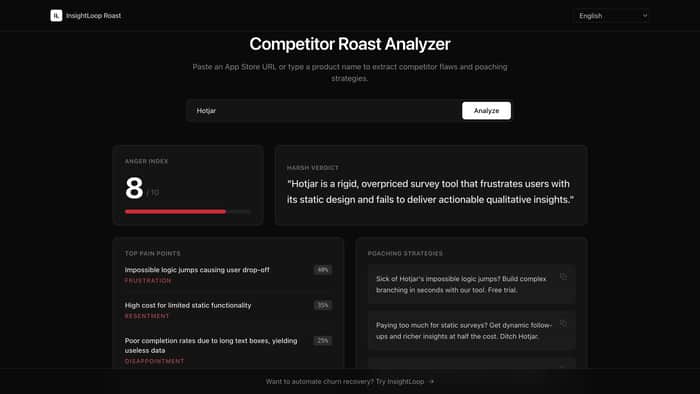
As founders, we all know how important it is to read competitor reviews to find their weaknesses. But honestly? Scrolling through endless App Store pages or Reddit threads is exhausting.
So this weekend, I decided to scratch my own itch and built the Competitor Roast Analyzer.
Here is how it works:
You drop an App Store URL or type a product name.
It scrapes their most negative 1-star reviews.
An AI (DeepSeek/GPT) ruthlessly extracts their top pain points and gives you 3 aggressive ad copies/poaching strategies to steal their angry users.
I just added it as a free, no-login little gadget on my main site. Really hope I don't get roasted to death for this... 😅
You can play with it here: [ https://insightailoop.com/en/competitor-roast ]
I intentionally kept it completely free without any signup walls because I just want to see if other founders find this as fun and useful as I do.
Try typing your biggest competitor's name in it. Would love to hear what harsh verdict the AI gives them! 👇

This is actually a pretty clever use of something most founders already do manually but hate doing at scale. Turning 1-star reviews into structured positioning angles and ad ideas makes it way more actionable than just reading feedback.
The only concern I’d have is signal quality — angry reviews can be pretty extreme or emotionally biased, so the real value will depend on how well the tool separates real product issues from noise. If it can filter that properly, it becomes much more useful than just a “roast generator.”
Still, as a quick way to understand competitor weaknesses and test messaging, this feels genuinely useful and kind of fun at the same time.
Thank you! 'Automating what founders hate doing manually' was exactly the goal here. And you are spot on about the signal quality concern. Another commenter just brought up the exact same point about noise vs signal in 1-star reviews. To address this, I'm currently working on adding recency weighting (to filter out old/fixed bugs) and explicit clustering (to find recurring structural themes rather than emotional outliers). That should make it much more of an actionable tool and less of just a fun roast. Really appreciate the thoughtful feedback!
Fun build, and mining 1-star reviews for the angry-user angle is a good instinct.
One methodology thing worth baking in so the output is actually trustworthy: 1-star reviews are a biased sample. The angriest reviewers are often edge cases, people on old versions, or sometimes competitors, so a raw "top pain points from 1-stars" can point you at noise.
The signal gets real when a complaint recurs across many reviews and lines up with why people churn, not just the loudest single rant.
Two cheap upgrades if they are not already in there: weight by review recency and app version, because a lot of 1-stars are bugs the competitor already fixed, and cluster the complaints so you see the top 3 recurring themes instead of scattered outliers (someone above asked about clustering too).
The roast is the fun hook, but the recurring-and-recent cluster is the part a founder would actually act on.
Wow, this is top-tier product feedback. You completely exposed the 'noise vs signal' blind spot in relying purely on 1-star reviews. The recency/version weighting to filter out fixed bugs is a genius 'cheap upgrade', and combining that with clustering is exactly what I need to do next to make the output truly trustworthy. I'm taking this advice straight to the codebase this weekend. Thank you!
Mining 1-star reviews for the angry-user angle is such a fun idea, that's where the honest pain always hides. The no-login bit makes it way more likely I'll actually go play with it.
Could not agree more. People are never more brutally honest than when they are angry enough to leave a 1-star review! That's where the real product roadmap lives. Glad you appreciate the frictionless entry—have fun playing with it!
One thing I'd be careful with:
The interesting question may not be whether founders enjoy the roast.
It may be what decision they make after reading it.
Those sound similar, but they can lead to very different conclusions about what part of the product is actually creating value.
I'd be careful assuming the most engaging signal is automatically the most useful one.
That is an incredibly sharp observation, and you've hit on the exact product tension here. I'm essentially treating the 'roast' as a Trojan Horse—it’s the high-engagement hook that gets founders through the door, but the actual utility is the pain points they discover to drive their next decision. You're completely right though, I need to be careful not to optimize only for the laughs when the real value is in the actions it drives. Great insight!
Possibly.
The reason I'd still be careful is that I don't think the interesting part is whether the roast gets people through the door.
I think it's the decision that gets made once they're inside.
That's one of those things that can quietly determine whether the roast is a hook, a feature, or the product itself.
I wouldn't try to unpack that properly in a thread.
If you're curious, drop your email and I'll put together the tighter version.
You're making total sense. The distinction between a hook, a feature, and the core product is exactly the existential strategic question I need to answer right now. I'd absolutely love to read your tighter version. My email is [hdd_aye@163.com] — really looking forward to it. Thanks for being willing to share this!
Appreciate it.
I sent you a note by email.
The thing I'd be most careful with is assuming the most engaging part of the experience is automatically the thing creating the most value.
Fun framing, but the real gold here is quieter than the "poaching" angle: a
competitor's 1-star reviews are basically a list of what to build next. The angry
users are telling you exactly where the gaps are. I'd run my own competitors
through it just for that. One ask: does it cluster the complaints so you see the
top recurring pain, not just scattered 1-stars? That's where the signal is. Nice
job keeping it free and no-login.
You nailed it—the 'poaching' angle is just the hook, but building exactly what their angry users are begging for is the real strategy. Great minds think alike! I really like the idea of visualizing the clustered pain points by frequency, definitely exploring that for the next iteration. Thanks for checking it out!