I built an alarm clock that charges me when I snooze — the money goes to charity, not to me
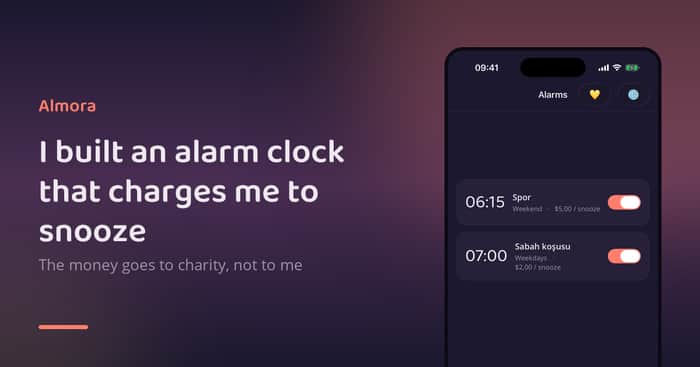
I have a bad relationship with 7am. I know exactly what I should do, and I do the other thing. The reason alarms lose that argument every single morning is simple: pressing snooze costs nothing.
So I gave it a price. Almora is an alarm clock where every snooze pledges an amount you set to a charity you picked. Nine more minutes, and you owe two dollars to the organisation you chose while you were awake enough to mean it. You send the accumulated amount when you're ready, in one payment.
The decision I want to talk about
Almora takes zero commission on donations. Not a percentage, not a "platform fee". The donor pays on our donation partner's own page and 100% reaches the charity.
That was not obvious, and I went back and forth on it. A 3% cut on donations is the model a lot of giving apps use, it scales with usage, and nobody would call it outrageous. I built it, the field is still in the code, and I set it to zero.
The reason is that the app's entire pitch is "snoozing costs you something." The moment I skim a percentage off that, the sentence becomes "snoozing costs you something, and some of it is mine." I could not find a way to say that out loud that I liked. So the only revenue is an optional subscription — more alarms and the wake-up checks — and giving stays free forever.
The uncomfortable part: that means the subscription is the whole business. There is no fallback line. If Pro does not convert, there is nothing else.
What Pro actually sells, honestly
Free covers one alarm. Pro adds more alarms and the wake proofs — before the alarm stops you solve a few maths problems, photograph something outside the bedroom, or walk a set number of steps.
I am aware that is the weaker half of the product. The emotionally interesting bit — the giving — is deliberately free. I priced accordingly rather than pretending otherwise.
What was harder than expected
Not the donations. Not the payments. The alarm. An alarm clock is a deceptively hostile thing to build: it has to fire exactly on time, from cold, through a Focus mode, on two platforms with completely different ideas about what an app is allowed to do while you're asleep. Apple's real answer for this (AlarmKit) is unreachable from .NET, so the iOS side rides on local notifications and their limits — including a cap of 64 pending notifications per app that silently drops the rest.
Roughly 80% of my debugging time went into "does it ring", and about 5% into "does the money move".
What I'd like your read on
Monthly vs annual. Alarm apps have brutal monthly churn: people fix their mornings or give up within weeks. My instinct is that annual is where the actual revenue is and monthly is mostly a trial. Does that match what you've seen in habit-shaped apps?
Did I leave money on the table by zeroing the commission, or is "we take nothing" a strong enough trust story to be worth more than the 3%?
Guilt as a mechanic. Almora works by making a bad habit cost something. I have a real worry that it attracts people once and then feels punishing. Has anyone shipped something in this shape and watched what happens after week three?
Happy to go into detail on any of the technical bits — the giving ledger, the settlement batching, or why the iOS alarm path took three rewrites.
Apple & Google Play Links
Apple: https://apps.apple.com/tr/app/almora-ertele-i-yilik-yap/id6795276577?l=tr
Almora: Ertele, İyilik Yap
Google: https://play.google.com/store/apps/details?id=com.mebasoft.almora

The zero-commission decision is probably more interesting than the 3% itself.
Curious whether users actually see “we take nothing” as part of why they trust the product, or whether they mainly care about the behavioral mechanic.