I built an enterprise AI chatbot platform solo — 6 microservices, 7 channels, and Claude Code as my co-developer
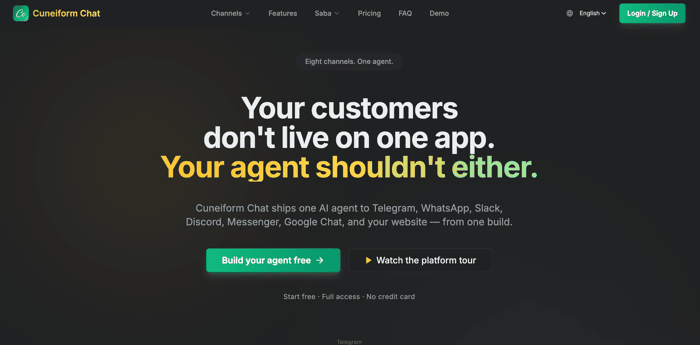
Hey IH! I'm Bikash, and over the last 4 months (started late October 2025) I built Cuneiform Chat — an AI agent platform that lets businesses deploy knowledge-base chatbots across Telegram, WhatsApp, Discord, Slack, web widgets, and more. It's live in production now.
I want to share the real story — architecture, mistakes, and what it actually looks like to build enterprise software with an AI coding partner.
What I built
The system is 9 repos — 6 backend services, 2 frontends, and a shared SDK:
Backend services:
- API Gateway + Auth — routes traffic, Firebase auth, user/org management
- Agent Service — the brain. Agent config, conversations, AI orchestration, all 7 channel integrations, website widget backend, playground
- RAG Service — document upload, chunking, embeddings, hybrid search. The most complex service by lines of code
- Billing Service — subscriptions via Polar.sh, quota enforcement, credit tracking
- Tracing — centralized trace storage, LLM cost tracking across every operation
- Eval Service — automated RAG quality scoring using RAGAS framework.
Frontends:
- Admin Panel — Next.js for customer and platform admin
- Widget Frontend — Preact embeddable chat widget, <11KB gzipped, Shadow DOM isolation
Shared:
- Shared SDK — library used by every service (DB helpers, Redis, LLM utilities, tracing,logging)
6 MongoDB databases, Redis isolated by DB number per service, Pinecone for vectors with per-tenant namespace isolation, S3 for document storage.
The multi-tenant bet
I made it multi-tenant from day one. Every query filters by organization. Every S3 path, every Pinecone namespace, every Redis key — all scoped to the tenant.
Cost: every feature takes longer. Every test has to verify isolation. Every AI-generated code change needs to understand the pattern.
Value: any organization's data is physically impossible to access from another org's context. For B2B, this is table stakes. Building it in from the start was far cheaper than retrofitting.
Building with Claude Code
Claude Code is my primary development partner. Not autocomplete — a collaborator that reads my codebase, understands the architecture, and writes production code.
I maintain ~30 reference docs in a .claude/ directory — architecture decisions, service patterns, API conventions, feature specs.
A solo developer with an AI coding partner can maintain a 6-microservice architecture that would normally need a team of 5-8. The tradeoff is heavy investment in documentation — not for humans, but for your AI to maintain context across sessions.
Mistakes I wouldn't repeat
Not marketing from day one. I spent months building in silence when I should have been talking to customers and creating content from the start. The product was production-ready long before anyone knew it existed. If you're a builder, the instinct is to keep building. Fight that instinct. The best time to start marketing was the day I wrote the first line of code.
Skipping integration tests early. Unit tests caught logic bugs. But the production bugs were integration bugs — wrong field names between services, mismatched Redis keys, routes that worked in isolation but failed with auth middleware. Write integration tests from the start.
Over-engineering billing before having paying customers. I extracted billing into its own microservice with quota enforcement, credit tracking, and webhook handlers — before a single customer had paid me anything. That entire service could have been a simple Polar.sh checkout link and a boolean flag for months.
Not building in public sooner. I had a compelling story the entire time — solo dev, 6 microservices, AI coding partner — and I told nobody. Every architectural decision, every production bug, every late night debugging session was content I never published. Starting this now, months after launch, instead of from day one.
Decisions I'd make again
Multi-tenant from day one. Already said it. Worth repeating.
Building a custom tracing service. Every LLM call, every RAG query, every API request across all services gets traced to a centralized dashboard. When you're solo, you can't afford to spend hours hunting bugs across microservices. The tracing service with its cost tracking (24 recording points) paid for itself within the first week of production debugging. I can see exactly which step in a multi-service pipeline failed, what it cost, and how long it took. Same thinking led me to build a test dashboard that orchestrates and monitors test runs across all repos from a single UI — when you don't have a QA team, you build one. If I were starting over, these developer tools would be among the first things I'd build.
Config-as-code for tier limits. All subscription tier configs live in YAML files in the shared SDK. No database queries, view only on platform admin panels. Change YAML, deploy, done. Every service reads the same config, so they can't disagree about what a "Plus" plan includes.
Building Saba — the platform's own AI assistant. Saba is a meta-feature: an AI assistant that knows the platform itself. It answers customer questions about their account, usage, billing, agent configuration — using the same agent and RAG infrastructure that powers the customer-facing chatbots. It composes tools dynamically (subscription lookup, usage stats, knowledge search, configuration help) based on the question. Essentially, the platform eats its own dog food. Customers get instant self-service support, and I don't have to be available 24/7 for basic questions. For a solo founder, that's not a nice-to-have — it's survival.
Fire-and-forget for secondary operations. Tracing, analytics, audit logging — none of these block the user's request. Try the operation, log a warning if it fails, move on. User experience is sacred.
Where I am now
The system is live in production. The focus has shifted from building features to finding customers and creating content. The backlog has things like a public REST API and CRM integrations, but those are driven by customer requests, not my desire to build more things.
The hardest part of building a SaaS alone isn't the code. It's the context-switching — code, infrastructure, support, content, growth — all in the same day, every day. The system is the easy part. The business is the hard part.
Try it out
If you want to see what a solo-built enterprise AI platform looks like:
- Website: cuneiform.chat
- Docs: docs.cuneiform.chat
- Chat with Saba — the platform's own AI assistant is live on the logged in user's homepage. Ask it anything about the product. It's served via the same RAG infrastructure I described above.
There's a free tier if you want to spin up an agent and test it yourself.
What's the hardest architectural decision you've faced as a solo developer? The one where both options seemed reasonable and you just had to pick? Would love to hear your stories.

Full disclosure: I'm Avery Lin (avrlin). I've been packaging a DFY Live Agent Setup (get a working OpenClaw/Hermes-style agent live without the weekend yak-shave) with AI assistance, so take this as adjacent interest, not neutral advice.
Most "I'll self-host this weekend" plans die in auth, secrets, and one flaky webhook. A done-for-you pass that leaves you with a running endpoint + a short ops note beats another half-finished clone.
Curious — are you still fighting the setup yourself, or would a clean live handoff actually unblock shipping?
The .claude/ directory approach is interesting. I've been using something similar — keeping architecture docs that the AI can reference across sessions — and it makes a massive difference vs starting from scratch every time. Without it you spend half your session re-explaining the codebase.
Your mistakes section is the most valuable part of this post honestly. The over-engineered billing thing is such a common trap. I did something similar with a permissions system once — built this whole RBAC thing with hierarchical roles before I had more than 3 users. Could've been a simple if-statement for months.
The fire-and-forget pattern for tracing/analytics is smart. I've seen too many apps where a logging failure takes down the actual user request. Seems obvious but tons of people get it wrong.
Curious about the Claude Code workflow specifically — how do you handle when it generates code that doesn't match your multi-tenant patterns? Do you catch that in code review or do the reference docs prevent it most of the time?
This was a real problem early on. The .claude/references/ docs help a lot, but the biggest fix was adding explicit rules in CLAUDE.md: "Every database query MUST include org_id filter" and "Use TenantAwareRepository from shared SDK." When Claude still misses it, the pattern is usually in a new endpoint where it copies from a non-tenant-aware example. I catch those in review. The RBAC parallel is spot on — I built a full permission system before anyone needed it beyond basic admin/member roles.
Hey Bikash — saw your Cuneiform Chat post,
impressive solo build. You mentioned tracking
LLM costs across every operation — I built
something that might help cut those costs
60-80% via semantic caching + smart routing.
Drop-in replacement for OpenAI, 2-line switch.
It's called VibeCore — just search it or
reply here and I'll share the link directly.
The architecture point about the claude directory is exactly what changed things for our stack too.
The shift: stop treating AI context as something you configure per-session, and start treating it as part of the repo. Project architecture decisions, forbidden patterns, testing contracts — all versioned in CLAUDEmd alongside the code.
Practical difference: a new team member (or a new AI session) opens the repo and gets the same context everyone else has been working with. No onboarding call needed to explain why the codebase looks the way it does.
We've been building CLAUDEmd templates for different stacks — Node, Python, microservices, multi-agent setups. The multi-agent one specifically handles the orchestration problem you mentioned: each agent gets its own scoped instructions, the root file defines what they all agree on.
What's your current structure for the claude directory across 6 services — one root file or per-service files?
Glad it resonated. That folder ended up being the real product — .claude/references/ is curated navigation Claude reads on-demand, and CLAUDE.md holds the non-negotiable rules. The code is downstream of getting that right.
The call to go multi-tenant from day one is bold given the solo time cost. How did you stop AI-generated code from quietly leaking cross-org queries during refactors? Did tests catch it, or review?
Three layers: (1) "every DB query filters by org_id" is a top-3 always-apply rule in CLAUDE.md, (2) repos extend a TenantAwareRepository base class so the tenant filter is structural, not remembered, and (3) cross-service data is HTTP-only — never direct DB reads. The rule being architectural rather than disciplinary is what makes it survive refactors.
Claude Code as co-developer for 6 microservices is bold. How did you handle the context between services? That's where most AI-assisted builds break down.
Each repo carries its own CLAUDE.md, plus a shared .claude/references/ set of feature/architecture docs that act as a map — Claude reads the relevant one before touching code. Services never share a DB; they talk over HTTP. So "context" is really just good docs + hard service boundaries.
Saving this thread. I'm a solo dad of 3 building @getkeptapp entirely with Claude (started as one HTML file on Hostinger, now on Supabase). The "Claude as co-developer" part is so real. it casually suggests a better architecture after I've already sunk days into the old path.
How do you handle those gotcha moments where Claude throws out a whole new approach mid-project? Any prompting tricks that keep the context tight when you're deep in features like reminders and user data? Vibecoding this from the couch and trying not to get derailed.
This hits close to home. I'm also building solo with Claude Code as my primary development partner, and your "mistakes I wouldn't repeat" section is basically a list of things I'm actively trying to avoid.
The "not building in public sooner" point is the one I keep coming back to. You had a
compelling story the entire time — and so did I. The instinct to keep building in silence is strong when you're a developer.
One thing I'd add to your list: the hardest architectural decision for me wasn't technical.
It was deciding what NOT to build.
I'm building DunnAI — a recovery tool for failed Stripe payments — and the temptation to keep adding features instead of talking to potential users was constant. Still is.
Your point about the business being harder than the system is exactly right. The code is the easy part.
Good luck with Cuneiform — the multi-tenant from day one decision sounds like it paid off.
Enterprise chatbots across 6 channels is a serious eval problem. How are you tracking output quality when the same query hits different channels and gets different responses?
The channel is just a delivery adapter — Telegram, widget, Slack all hit the same agent runtime underneath. So quality is tracked per-conversation, not per-channel, via a centralized tracing service that captures every LLM call + cost. There's also a separate RAGAS eval service for the RAG pipeline.
The line that landed for me was that the expensive part is not building the system, it is staying able to trust and operate it once it gets real.
That is where I keep feeling the gap with AI coding too. Good docs and review help a lot, but once the tool can actually execute in a live repo, I keep wanting one visible plan and one real gate before local mutation instead of hoping process survives the speed.
Curious whether you feel that as part of the same platform problem, or as a separate boundary layer.
Exactly that. Building it is a weekend; being able to trust it at 2am six months later is the whole job. That's why observability and the reference docs got as much attention as the features.
Impressive solo build!
Thanks, appreciate it!
One pattern I’ve seen with solo-built platforms:
the architecture often evolves toward enterprise complexity long before the business reaches enterprise scale.
Microservices, tracing layers, evaluation services, tenant isolation — all reasonable decisions individually.
But every new service also increases the operational surface area.
For a solo founder the real constraint usually isn’t building the system.
It’s maintaining and operating it while also trying to grow the product.
Fair critique, and I watch for it. The split wasn't about scale — it was deploy isolation and threat models (a public embeddable widget vs. an admin panel can't share a blast radius). But you're right that it's a real risk; some of this is a bet, not a need.
this is a seriously impressive solo build. 6 microservices, multi tenant, RAG pipeline and all those channel integrations is a lot for one person to manage.
the part about documentation being for the AI more than for humans was really interesting. feels like a new dev workflow where maintaining context for the agent becomes part of the architecture itself.
also agree on the multi tenant decision from day one. ive seen teams try to retrofit that later and its honestly painfull.
curious what pushed you to go with microservices that early though. was it mainly because of the multi channel setup ?
anyway respect for shipping something this complex solo.
Mostly the multi-channel + multi-surface mix: a public widget, an admin panel, and webhook endpoints have genuinely different threat models and deploy cadences. It was separation of concerns, not anticipated load.
Massive respect for tackling a 6-microservice architecture solo, Bikash. Claude Code is a beast for velocity, but orchestrating the state and memory across 7 channels is where the real engineering happens. Out of curiosity, how are you handling the data ingestion and state persistence across those microservices? In the enterprise pipelines I architect, we usually have to route all that raw interaction data through a Medallion architecture (typically on Databricks) just to keep the LLMs from hallucinating on stale context. Brilliant work getting this live.
Thanks! Each service owns its own MongoDB database — no shared state. Services communicate through HTTP APIs via the gateway, and Redis handles caching per-service (isolated DB numbers). For RAG specifically, documents go through a processing pipeline (parse → chunk → enrich → embed → Pinecone), all within the RAG service. The key to avoiding stale context is that each service is the single source of truth for its domain — no cross-service DB reads.
Using Claude Code as a co-developer is incredible until you hit the rate limit mid-session and lose your flow state entirely.
That's been my biggest pain point with the multi-AI-tool workflow. Claude Code for complex architecture, Cursor for quick edits, Copilot for completions — each has different limits and none of them warn you before you hit the wall.
I built TokenBar (tokenbar.site) specifically because of this problem. It sits in the macOS menu bar and shows remaining capacity across Claude, Cursor, Copilot, Gemini, and 15+ other providers. The key feature is pace intelligence — it tells you if you're burning through your Claude allowance too fast so you can switch to another tool proactively instead of reactively.
$4.99, one-time purchase. Saved me from at least 3-4 rage-inducing mid-session rate limit hits per week.
Impressive that you built an enterprise platform solo with AI tools though. The leverage is insane right now.
The rate limit mid-session pain is real — losing context on a complex multi-file change is brutal. I've mostly adapted by structuring work into smaller, self-contained tasks and using Claude Code's memory files to persist context across sessions. Appreciate the kind words on the solo build — the leverage is genuinely wild right now.
Very interesting! Did you validate your idea at any point during the development or trying to validate it now?
Not validating actually, sharing for feedback.
Would love to hear how the solution feels if you could manage time for a quick review.
Incredible breakdown, Bikash. Your 'Multi-tenant bet' is spot on, retrofitting isolation is a nightmare, so doing it from day one is the only way for B2B. I'm following a similar path with my "Agentfarm", focusing heavily on that same 'sovereignty-first' architecture. Your point about 'AI-coding documentation' (the .claude/ directory) is a game changer for solo devs. Launching on Product Hunt tomorrow and I've definitely felt that 'fighting the instinct to just keep building' you mentioned. Thanks for the transparency!
Thanks! Multi-tenant from day one saved us countless headaches — it's non-negotiable for B2B. The .claude/ directory is basically our second brain — reference docs, CLAUDE.md instructions, and custom slash commands that give Claude Code full context across 10 repos. Good luck with your Product Hunt launch tomorrow!
Impressive solo build! Managing 6 microservices with multi-channel support is ambitious. How do you handle debugging when issues span multiple services? Curious about your monitoring setup.
Great question. We use OpenTelemetry with correlation IDs that propagate across all service calls — every request gets a trace ID at the gateway that follows it through auth, agent service, RAG, tracing, and billing. For monitoring, we run a Grafana LGTM stack (Loki for logs, Tempo for traces, Mimir for metrics). When something breaks, I can trace a single user request across all 6 services in one view. The tracing service also records LLM costs per-span, so we know exactly where time and money are spent.
This is really impressive architecture! Managing 6 microservices and 7 channels as a solo founder is no small feat. I'm curious about how you handle context management with Claude Code when jumping between different services - do you use any specific techniques to help it understand the cross-service dependencies? Also, what's your latency like when routing messages across multiple channels to the AI backend?
Context management is the key challenge. We solve it with a layered .claude/ directory: CLAUDE.md has the architecture overview + decision tree ("RAG-related → indi-rag-service/"), then detailed reference docs per feature that Claude reads on-demand. Custom slash commands handle common workflows. For cross-service dependencies, the gateway is the single entry point and services communicate via HTTP with shared SDK abstractions — Claude understands this from the reference docs. Channel latency is surprisingly good — messages hit the gateway, route to agent service, which streams back via SSE. Most of the latency is LLM inference, not routing.
This is wild — 6 microservices solo with Claude Code as your co-dev is exactly the kind of story more people need to hear. The multi-tenant isolation from day one was a smart call. Retrofitting security and data isolation later is always 10x harder.
The point about documentation being for your AI, not for humans, is something I've been thinking about a lot too. Context management across sessions is the real bottleneck with AI-assisted dev.
Curious about the secret/credential management side — with 6 services + multi-tenant, how are you handling API keys and secrets across the stack? That's one of the thorniest parts of multi-service architectures IMO.
Spot on — documentation for AI is a paradigm shift. We write docs that are LLM-friendly (structured, with file paths and code references) rather than human-friendly narratives. For context across sessions, we use a persistent memory directory + session checkpoints stored at natural breakpoints. Secrets management: each service has its own .env, and the shared SDK handles credential access patterns. Services never share databases directly — always HTTP calls through the gateway. Keeps the blast radius small if one service is compromised.
And what about Compliance, GDPR, legally etc. Did you kept this in mind when building with Claude? Is this an important topic for you?
Definitely important. Multi-tenant isolation is the foundation — every DB query filters by org_id, so data never leaks between customers. We have RBAC with permission enforcement on every write endpoint (not just UI-level). For GDPR specifically, the org-level data isolation means we can wipe all data for a single organization across MongoDB, S3, and Pinecone with one operation. It's something we'll formalize more as we scale, but the architecture was designed with data sovereignty in mind from day one.
The over-engineered billing mistake resonates hard. I built a full multi-currency invoicing system for a bookkeeping tool before I had a single user. Could've been a Stripe checkout link for months.
Your config-as-code approach for tier limits in YAML is something more people should steal. I've seen so many SaaS apps where pricing tier logic is scattered across the codebase in random if-statements, and when it's time to change plans it's a terrifying deploy. Having one source of truth in a shared config is such a simple win.
The "fire-and-forget for secondary operations" pattern is the right call but I'd add one nuance from my experience: make sure you have a dead letter queue or at least a daily summary of those swallowed errors. I ran fire-and-forget on my analytics pipeline for 3 months before realizing 15% of events were silently failing due to a schema mismatch. The user experience was fine but my analytics were lying to me.
To your closing question: hardest solo dev decision for me was whether to keep everything client-side (for privacy) or add a backend for better features. Went client-side, which became a moat — small business owners processing financial data love that nothing leaves their browser. But it severely limits what you can build. Still not sure it was the right call long-term.
Great point on the dead letter queue — we actually do have failure tracking on the fire-and-forget events for some cases (the worker retries only on failure). But your 15% silent failure story is a good reminder to audit that regularly. On client-side vs backend: privacy as a moat is underrated, especially for financial data. The constraints force creative solutions.
The part about not building in public hit me. You had the most compelling story the whole time - solo dev, 6 microservices, AI as a coding partner - and nobody knew. I'm making the same mistake right now with my own build and this is the reminder I needed to just start talking about it.
Appreciate that! Yeah, building in silence for months was comfortable but a mistake in hindsight. The feedback from posts like this is already shaping the roadmap. Start sharing — even a "here's what I built this week" post goes a long way. What are you building?
Hi, I'm Ritesh, a student from India learning AI and startups. I'm here to learn and help wherever possible.
Welcome, Ritesh! Best way to learn is to build. If you're into AI + startups, pick a small problem and ship something end-to-end — you'll learn more than any course. Good luck!
dude the claude code workflow is genuinely a cheat code for solo devs. ive been using basically the same setup to build 3 ios apps simultaneously and it remembers context between sessions which is wild
the over-engineering billing mistake is SO relatable. i built this whole subscription management system for my apps before i even had 10 users. stripe checkout + a boolean wouldve been fine for months lol
quick q - with 6 microservices how do you handle the context window? i find it struggles when the codebase gets really big across multiple services. do you work on one service at a time or somehow give it the full picture?
thanks! yeah the context window is the #1 challenge with multi-repo setups.
my approach: i maintain a .claude/references/ directory with curated markdown docs covering architecture, features, and patterns across all services. these aren't auto-loaded — claude reads them on-demand based on what area it's working in. so if it's fixing a RAG bug, it pulls in the RAG pipeline docs; if it's touching billing, it grabs the billing docs. keeps the context focused.
the CLAUDE.md file acts as an index/router — it has a "quick decision tree" that maps task types to repos and a reference docs index so claude knows which doc to read for what. that way it doesn't need the full picture of all 10 repos at once, just the relevant slice.
for cross-service work i'll spin up parallel explore agents to search multiple repos simultaneously, then synthesize. but honestly 80% of tasks are scoped to 1-2 services.
Did you got your first paid client ?
The "documentation for your AI, not for humans" point is underrated. I've seen this pattern too — the quality of AI coding output is directly proportional to how well your codebase context is documented. It's basically prompt engineering at the repo level.
Also +1 on over-engineering billing. It's the most common premature optimization I see on IH. Stripe checkout + a boolean beats a billing microservice until you have actual paying users complaining about actual billing problems.
To your closing question: my hardest solo dev decision was always "build the developer tooling now or ship the feature." Sounds like you'd say tooling first (tracing, test dashboard). Curious — how long did the tracing service take to build, and at what point did it start saving more time than it cost?
Really appreciate the thoughtful comment!
"Prompt engineering at the repo level" — that's a much better way to put it. Stealing that phrase.
On billing — you're right, and I probably fell into that trap myself. The billing service is fairly involved (Polar.sh, quota tracking, credits). A Stripe checkout + boolean would've gotten me to first paying customers faster. Fair point.
On the tooling question — the tracing service took about 2-3 days to build, started paying off almost immediately. First time I had to debug a request flowing through 4 services, having one dashboard showing the full chain with timings and costs vs SSH-ing into logs across containers — night and day difference.
But the real ROI isn't time saved per session, it's confidence. When you're solo and something breaks, knowing you can pinpoint the exact failing step in under a minute changes how aggressively you ship.
That said — I'd still tell someone else to ship the feature first and add tooling when the pain is real. I just felt that pain early because microservices multiply debugging complexity fast.
"Not marketing from day one" - every technical founder's mistake, including mine.
Bikash, the architecture is impressive, but this line hit harder: "The product was production-ready long before anyone knew it existed."
Currently making the same mistake with book-digest.com (AI book summaries). Spent 4 months perfecting the summarization pipeline, adding 6 languages, building admin panels. Started marketing in month 5.
Your multi-tenant-from-day-one decision is the kind of architectural choice that saves you 6 months of pain later. Retrofitting that would be a nightmare.
Ha, glad that line resonated — it's painfully true. 4 months perfecting before marketing is exactly the trap. The engineering brain says "just one more feature" while the market doesn't even know you exist yet.
book-digest.com sounds cool — 6 languages is no joke for a summarization pipeline. Curious what LLM you're using under the hood?
And yeah, multi-tenant from day one was the best decision I made. org_id on every query, tenant-aware repositories, isolated configs — boring plumbing that pays off massively when you onboard your second customer and nothing breaks.
Impressive architecture, Bikash! The 6-service split makes a lot of sense for this kind of multi-channel platform.
Curious about your experience with Claude Code as a co-developer — at what point did you find it most valuable? I have been building a desktop tool for managing AI coding agents (orchestrating Claude Code, Codex CLI, etc. in parallel) and the persistent context / memory aspect has been the biggest unlock. Did you find Claude Code was better at certain types of services vs. others?
Also, the <11KB widget is wild — Preact with Shadow DOM isolation is such a solid choice for embeddables. How is latency on the RAG hybrid search in production?
Thanks!
Claude Code as co-developer: Most valuable on backend/infrastructure — RAG pipeline, billing extraction, webhook handling. It holds full service context while you iterate, which is huge for interconnected logic. Less strong on frontend polish (Next.js), but gets you 80% there. The persistent context via CLAUDE.md files is key — each session picks up without re-explaining the architecture.
Widget: Shadow DOM was non-negotiable for style isolation. Preact + Vite IIFE mode with inlined CSS-in-JS means zero external requests beyond the single script tag.
RAG latency: Hybrid search with reranking typically under 2s end-to-end. Redis caching on similar queries helps a lot. Contextual enrichment during ingestion (chunk-level summaries) was the biggest win — better relevance means fewer chunks per query, which actually reduced latency.
Your parallel agent orchestration tool sounds interesting — would love to hear more!
This is very interesting, I am trying to do something similar. I especially love your idea about cost accounting. I will do that now.
Cheers mate, best wishes.
This is quite impressive.
The thing that i've noticed is that after a launch there is many iterations before customers really stabilizes
What are the most evolving features for you?
Great question. The RAG pipeline has gone through the most iterations by far — started with basic vector search, now it's hybrid search with query decomposition, reranking, and confidence scoring. Every time real users hit it with edge cases, something needed fixing. The agent orchestration layer is second — especially around context window management for long conversations.
I actually just wrote a deep dive on the RAG pipeline iterations specifically — the 7 things that changed from tutorial to production: https://dasbikash.substack.com/p/rag-in-production-is-nothing-like
What's your experience with post-launch iteration cycles?
Impressive build — 6 microservices solo with AI pair programming is no joke.
The "not marketing from day one" and "over-engineering billing before paying customers" hit home. I made the same $20K mistake: built for 3 months, zero sales.
Now I'm focused on validation before code. You mentioned REST API and CRM integrations are backlog items "driven by customer requests" — how are you validating which integration (Salesforce? HubSpot? Slack?) is worth the engineering effort before a customer explicitly asks for it?
I'm testing a method to validate B2B features with video prototypes — show the workflow, test demand, before building the microservice.
Would love to hear how you're tackling prioritization now, or if you'd be interested in testing this approach on your next integration.
Honest answer: I didn't validate well enough before building. The REST API and CRM integrations are sitting there unvalidated. What I've started doing is writing the docs/landing page copy first — if I can't explain why someone would want it in 2 sentences, it probably shouldn't be built yet. Video prototypes sound like a smarter approach. Would be interested to compare notes on what works.
"Docs first" is a good filter, but you're right — video prototypes validate the demand, not just the clarity.
Since you mentioned REST API/CRM integrations are sitting there unvalidated — want to test this?
I can build a 3-minute video showing "Salesforce integration workflow" for Cuneiform Chat (or whichever integration you're considering), you show it to 5-10 prospects, and we see if they'd actually pay for it before you build the microservice.
Takes me 3 hours, costs me €50 (AI video generation), you get the validation data.
If it works, you have proof of demand. If it doesn't, you just saved weeks of microservice architecture.
Interested? Email me: zhongyongxu082@gmail.com and I'll send examples of what this looks like.
Either way, impressive build — 6 microservices solo is serious work.
Appreciate the offer! The video prototype approach is clever for demand validation. I'm not prioritizing CRM integrations right now — focused on core platform and early customer feedback first. But I'll keep it in mind if I need to validate a specific integration down the line.
Cheers!
Totally makes sense — core platform first, integrations later. Smart sequencing.
If you ever hit a point where you're debating "should we build X before Y" for the core platform, happy to help you test that with a quick video prototype. No commitment, just a 3-hour validation sprint.
Either way, following Cuneiform's journey. Good luck with the early customers — that's where the real learning happens!
Cheers
The multi-tenancy decision is fascinating. I love how you articulated the tradeoff: "every feature takes longer" but retrofitting would be "far more expensive." That's the kind of architectural bet that separates production-grade SaaS from side projects.
Your point about building Saba (the AI assistant for your AI platform) is brilliant - dogfooding at its finest. For solo founders, automating tier-1 support isn't just nice-to-have, it's survival like you said.
Hardest architectural decision I faced: whether to build a custom permissions system vs using a hosted auth provider like Auth0. The custom route gave us fine-grained control but cost us weeks. In hindsight, starting with the hosted solution and migrating later might have let us validate the core product faster.
The tracing service you built sounds like it paid for itself immediately. Observability is usually an afterthought for solo devs, but you made it first-class. Smart move.
The permissions tradeoff is real. I went custom too and it delayed getting to market. In hindsight, starting with Auth0 + basic roles and only customizing when a paying customer needed could have been a viable approach. The tracing service has been worth every hour though — when something breaks in a 6-service pipeline, having centralized traces with cost tracking is the difference between debugging for 10 minutes vs 2 hours. What did you end up going with for auth?
This comment was deleted 3 months ago