I built an MVP in 3 days… then spent a week adding payments. Was it worth it?
I’d been looking for an idea for a side project I could build in my spare time. Volunteer work didn’t really motivate me, so naturally I was looking for something that could make money.
At some point I realized: if you want to stay focused on development, it’s better to build something that solves a problem for one person. No social features, no marketplaces, no endless traffic funnels.
I remembered my own pain with learning languages.
Lately I’d been watching movies in English, translating words in ChatGPT, and asking it to generate example sentences. Then I’d manually add everything to Anki. It was repetitive and boring — and clearly automatable.
So I built a quick prototype.
Just a simple input + OpenRouter API. You type a word → it returns a translation + 3 example sentences.
I started using it myself — and honestly, it felt great. Not just useful, but pleasant to use.
That’s when it clicked: this is actually a solid product idea.
So I decided to build it properly.
Cutting scope like crazy
At first, my imagination went wild:
- advanced spaced repetition (better than Anki)
- multiple question types
- pronunciation checks
- multiple languages
- AI-generated images
Then I remembered my previous project — I spent 6 months building it… and nobody used it.
So this time I forced myself to answer a simple question:
What is the core idea of this app?
Learning words with AI, without manually creating flashcards.
Everything else — gone.
For the MVP I kept:
- 2 languages: English and Serbian
- 1 question type: “I know / I don’t know”
- a very basic spaced repetition algorithm (1 → 2 → 4 → 8 days, reset on mistake)
- text-to-speech for words and examples
That’s it.
Building fast and messy
I had a week alone (family was away, I was on vacation), so I just went all in.
I barely read the code. I just kept adding features with AI.
Some parts were ridiculous:
- 1000-line files generated by AI
- error handling for cases that would probably never happen
- zero manually written SQL
But everything worked. And I was moving insanely fast.
Half the code I later threw away. The other half I improved later.
Going “fast and dirty” was absolutely the right decision.
First version on my phone
I installed the MVP via TestFlight.
And the feeling was amazing.
Way better than the web prototype. It finally felt like a real product.
Even if nobody else needed it — I would keep using it myself.
The question that stopped me
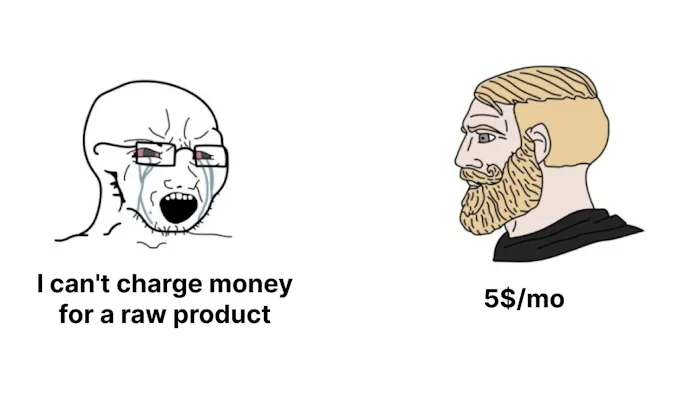
Should I add payments?
On one hand:
- the product was still raw
- adding a paywall might look stupid
On the other:
- what if it works?
- how do I validate monetization without actually charging?
Asking users “would you pay?” is useless.
You need to give them a way to pay and see what happens.
So I decided:
MVP should include monetization.
“It’s just a subscription, how hard can it be?”
I thought it would be easy.
It wasn’t.
Instead of coding, I spent days configuring:
- App Store Connect (products, subscription groups, offers)
- RevenueCat
- sandbox environments
- paywall UI
- edge cases (cancellations, restores, expired subscriptions)
Testing purchases required real device builds.
Then came legal stuff:
- tax forms
- payout setup
- bank issues (my Turkish card didn’t work, had to use a Serbian business account)
The whole payment setup took a full week.
First users and first revenue
I posted about the app in my Telegram channel (~1500 subscribers).
And then it happened:
the first paid subscription
With feedback.
At that moment — it was the only one.
Most feedback came from free users. And honestly, it would have been enough to keep going.
But the key value wasn’t money.
What I actually got
That one payment proved something important:
People are willing to pay for this.
Even if it’s just:
- 1 paying user
- out of 100 free users
That’s already a metric.
And once you have a metric — you can improve it.
Also, I had costs:
- AI usage
- text-to-speech
So monetization wasn’t optional anyway.
The illusion of free products
A free MVP can fool you.
You see:
- growing users
- positive feedback
- engagement
But the moment you add a paywall — everything collapses.
Because the product was only “good” while it was free.
Final takeaway
If your goal is to decide whether to keep building the product:
monetization must be part of the MVP.
Otherwise, you’re testing the wrong thing.
An MVP without payments is not an MVP.
It’s just a free prototype.
If you’re curious, the product is a mobile app called VibeLing for learning vocabulary with AI.
