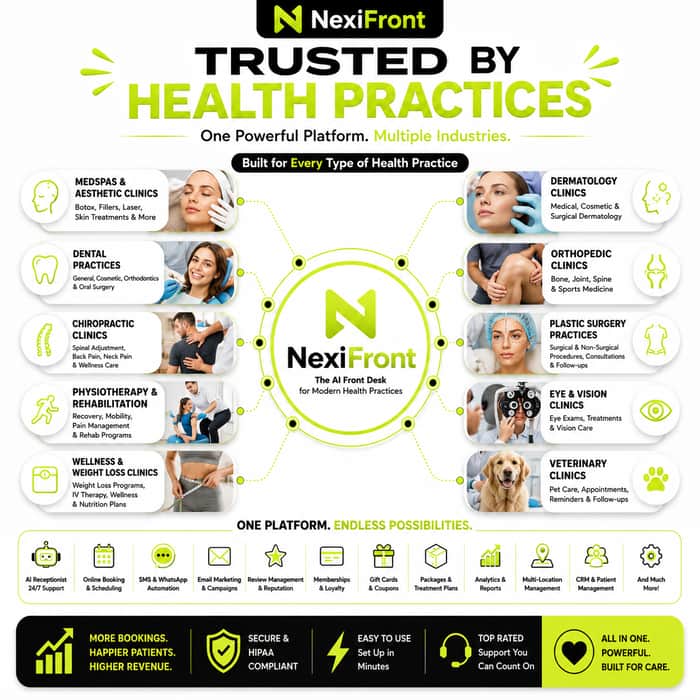
I built NexioFront, an all-in-one AI receptionist for med spas. Here is everything it does.
I want to tell this one as a story, because that is honestly how it happened. The late nights, the doubt, the one win that kept me going. All of it.
It started at SoCal Slim
A while back I picked up a client, SoCal Slim Clinics. The brief sounded simple: get them more leads. But when I actually dug into their setup, I saw the same thing I had seen at almost every med spa I had worked with. Real demand, real reputation, and a website that went completely silent the second the front desk went home.
Someone would land on the site at 9pm asking about pricing or availability, and nothing happened. No reply. No booking. Just silence until the next morning, by which point most of them had already booked somewhere else. It was not a marketing problem. It was a response-time problem, and it was quietly bleeding leads every single night.
So I built them a system: GoHighLevel automation layered with AI follow-up, set up to engage people the moment they showed interest, day or night.
The results over 31 days:
228 leads generated
$32,940 in won pipeline revenue
67.98% conversion rate
I still remember the feeling when those numbers came back. It was not luck. The core idea actually worked: respond instantly, qualify automatically, never let a lead go cold overnight.
Why one good result was not enough
Right after SoCal Slim, two more clients asked for "the same thing." And my stomach dropped a little, because I realized I did not have "the same thing." I had a custom build, stitched together for one specific business, that I would now have to rebuild from scratch for the next client. And the one after that. And the one after that.
That was the moment I stopped treating it as a project and decided to build it as a real product. That decision became NexioFront. I had no idea what I was signing up for.
Rebuilding it properly (the part that nearly broke me)
The first version was rough. A plugin with around 27 features and 2,900 lines of code. It worked, but barely, and it broke in ways that swallowed entire nights. There was one bug where the admin Save button just silently stopped saving. No error, no log, nothing. It took me two full nights, fueled by too much coffee and stubbornness, to trace it to a nested-form issue. There were stretches where I sat at 3am genuinely wondering if I was building something past what I could actually pull off.
But every time I wanted to quit, I went back to the SoCal Slim numbers. They were proof. The concept worked. I just had to grind until the engineering caught up to the idea. So I kept going. Night after night. Module after module.
What it grew into
I recently went back through the codebase to count what is actually there, instead of guessing. The real numbers: 161 PHP files, roughly 41,850 lines of code, more than 100 features across 33 modules. It is a long way from the little chatbot I set out to build.
Here is what it does now:
Core AI and conversation: a RAG knowledge base trained on the business's own content, structured AI actions (not just chat replies), multi-provider AI support, and automatic language detection with localized greetings.
Booking and scheduling: full availability and business-hours logic, Google Calendar sync, no-show risk tracking, multi-provider support, recurring bookings, and a waitlist that auto-matches and notifies people the moment a slot opens.
Lead capture and conversion: a dedicated lead-flow engine with intent detection and routing, custom intake forms, exit-intent capture, A/B testing, and quiz-style lead magnets.
Messaging and notifications: SMS campaigns, email automation with full template management, automated review requests, and an urgent-keyword alert system that instantly texts the business owner when a message looks time-sensitive (built with cases like "no heat" or "burst pipe" in mind, a general urgent-inquiry alert, not medical triage).
Revenue and retention: loyalty points, gift cards, referrals, Stripe-backed memberships, win-back campaigns for dormant contacts, tipping, and birthday offers.
WooCommerce: cart logic, coupons, cross-sell recommendations, and in-chat product Q&A for businesses selling products alongside services.
Security and compliance: rate limiting, SSRF protection, signed webhooks, and HIPAA-supportive infrastructure (encryption plus a PHI access audit log). To be clear, that is compliance-supportive tooling, not a certification. Practices still need their own BAAs and processes.
It is not the plugin I started with. It is the system the SoCal Slim result told me needed to exist.
Who it is actually for
I built and tested most of it around med spas and aesthetic clinics, which is why before/after galleries and membership plans exist. But the architecture is not medspa-specific. The urgent-alert system was literally designed with home service businesses in mind. Realistically it fits any appointment-based business where after-hours inquiries go unanswered: dental, chiropractic, physical therapy, salons, HVAC, plumbing, and similar local service businesses.
Where this leaves me (the honest part)
Right now NexioFront has been built and proven inside my own agency's client work. SoCal Slim is still the clearest real-world result I can point to. It has not been sold as a self-serve product to outside users yet. That is the honest state of things.
But that one client's after-hours problem turned into 41,850 lines of code, a lot of lost sleep, and a decision I am genuinely still wrestling with. See how it works and get a free walkthrough at nexiobit.com.

When a product becomes this feature-rich, the temptation is to explain everything—but buyers usually don’t evaluate depth first, they evaluate risk reduction first.
For a med spa owner, I’d guess the strongest entry point isn’t “AI receptionist” or “replaces 4 tools,” but something even narrower like “turns missed calls and after-hours messages into booked appointments.” Once that lands, the rest of the stack becomes believable instead of overwhelming.