I built Stream Tech to solve my own tech news overload — now looking for feedback from devs
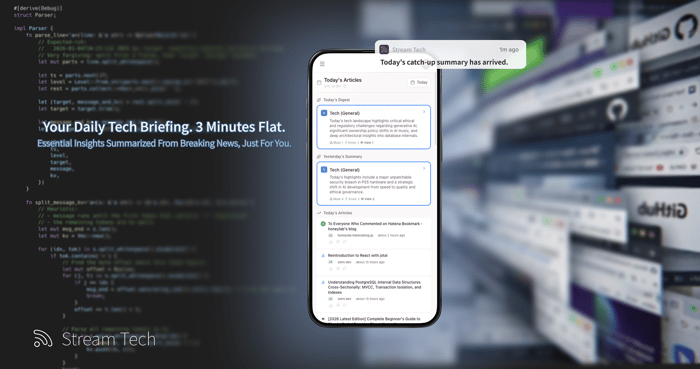
Hey IH 👋
Read less. Know more.
I built Stream Tech — a tech news aggregator where the AI summary is often all you need.
Most “AI summaries” just shrink articles. Stream Tech tells you what actually matters — prerequisites, tradeoffs, implications, and next actions — so you can skip the original entirely unless it’s truly worth your time.
What’s different:
- Decision-ready summaries (not TL;DR) — prereqs, tradeoffs, implications, next actions
- Japanese engineering deep-dives in English — Japan has a strong “share what you built” culture (Zenn/Qiita), with practical implementation write-ups that rarely get translated
- Opinionated daily digest — ~10 must-reads picked from 50+/day (not a firehose)
What I’m looking for:
- Blunt feedback on summary quality — are “prereqs” and “tradeoffs” actually useful?
- Missing sources you’d want
- UX friction points
If you’ve ever wished tech news felt like a daily briefing — not an endless reading list — that’s what I’m building.
Happy to answer any questions.

Really interesting idea and a clean execution so far.
I’m curious how you balance between showing a concise stream of highlights versus avoiding overwhelming the user. Did you test different UI flows or start simple and iterate?
Feedback seems like a key part of this project, so would love to hear more about how you’re collecting and prioritizing it.
Thanks for the kind words!
On balancing highlights vs overwhelming: I started simple — one daily digest with ~10 curated picks from 50+ articles. The key insight was that "fewer, better" beats "comprehensive." Users can always browse the full article list if they want more, but the digest is designed to be completable in 3-5 minutes.
On UI testing: Still iterating, honestly. Right now I'm experimenting with collapsible summaries — show TL;DR by default, let users expand for prereqs/tradeoffs if they want the depth. Early feedback suggests people appreciate having the option to go deeper without being forced to.
On collecting feedback:
What's been most useful is specific feedback ("this summary missed the key tradeoff") rather than general sentiment. Curious if you've found any patterns for getting that kind of actionable feedback on your own projects?
Love this direction — building for yourself always reveals real edges that tools blindly scraping headlines miss. I especially like the focus on prereqs, tradeoffs, implications, and next actions — that’s what turns noise into decision intelligence instead of another firehose.
Indie Hackers
One question I’d explore further: when you curate daily must-reads, how are you measuring whether readers actually act on those insights vs just skim them? Early on that’s often where UX friction or signal-to-noise reveals itself. Founders I work with see huge lift when they tie summary quality back to a first meaningful action — what’s the first thing you want a reader to do after a summary? Then optimize for that metric first.
Also curious about your source mix — there’s a ton of great deep-tech write-ups across non-English blogs and GitHub READMEs that rarely get surfaced; if you crack that, it could be a solid differentiator.
Happy to chat more about feedback loops or UX patterns that get real responses — it’s tricky but rewarding when you get it right.
Thanks for the thoughtful feedback! Your framing of "decision intelligence" vs just another firehose really resonates — that's exactly the gap I'm trying to fill.
On measuring action vs skim: honestly, I'm still in early validation mode. Right now I'm tracking:
Your point about optimizing for "first meaningful action" is sharp. I've been thinking about this — maybe the right metric isn't clicks but something like "saved to read later" or "shared to Slack." Will experiment.
On source mix: this is exactly why I started covering Japanese tech blogs (Zenn/Qiita). There's a strong "build and share" culture there with practical implementation details that rarely cross the language barrier. GitHub READMEs are a great call too — some of the best docs never make it to blog posts.
Would love to hear more about the feedback loops that worked for founders you've worked with. Always curious what early signals actually predicted retention.
This is a really thoughtful validation setup for where you are — especially the CTR-as-a-negative-signal framing. That’s a nuance most people miss early. When lower clicks mean the summary actually reduced cognitive load, you’re already thinking like a systems designer, not a content curator.
You’re spot on that “first meaningful action” usually predicts retention better than raw engagement. In SaaS products I’ve worked on, the early signal that mattered most wasn’t time-on-page but intentful actions — save, share, tag, or follow-up reads within the same session. Anything that says “this changed how I’ll think or act next.”
One pattern that’s worked well is explicitly designing summaries to end with a decision fork:
Act now (try a tool, open a repo, change a setting)
Store for later (bookmark, Slack, Notion) If neither happens, the insight probably didn’t land — regardless of how “good” it felt.
Your Japan-first source strategy is smart. Non-English dev ecosystems often surface implementation truth earlier, before it gets abstracted into thought leadership. If you lean into that and make the why this matters now unmistakable, that’s a real moat.
Curious to see where this goes — you’re clearly optimizing for signal, not vanity metrics, which is rare at this stage.
This is gold — the "decision fork" framing is exactly what I needed.
I've been thinking about this wrong. My summaries currently end with "Key takeaways" which is passive. Your pattern — Act now vs Store for later — creates a forcing function. If neither happens, the insight didn't land. That's a clear signal I can actually measure.
Going to experiment with this in the next iteration:
Re: Japan-first strategy — glad this resonates. There's something interesting about how implementation details surface faster in "show what you built" cultures before getting abstracted into thought leadership. Planning to double down on this as a differentiator.
Really appreciate you taking the time to share these patterns. This thread alone has given me more actionable direction than weeks of solo iteration.
This is a great iteration loop — and you articulated the shift really clearly.
The move from passive “key takeaways” to explicit decision-oriented CTAs is subtle but powerful. What you’re really doing is converting information into operational clarity, which is where most products quietly fail. People don’t struggle with knowing things — they struggle with knowing what to do next without thinking too hard.
One thing to watch as you experiment: different content types often want different default forks.
For example:
Conceptual / trend pieces → optimize for store + revisit
Tactical / implementation pieces → optimize for immediate action
When those get mismatched, engagement drops even if the summary quality is high.
Also, your instinct about “decision-ready” being context-dependent is spot on. In products I’ve seen scale well, clarity wasn’t about being shorter — it was about being situationally precise. The best summaries quietly answer: “Why should I care right now?” without spelling it out.
Doubling down on cultures that surface raw implementation before abstraction is smart. That’s often where real leverage lives — especially if you consistently translate it into implications, not just summaries.
This thread is a great example of why tight feedback loops compound fast when the underlying thinking is sound. Excited to see how this evolves
The content-type / fork mismatch insight is really sharp — I hadn't framed it that explicitly.
You're right that conceptual pieces want "store + revisit" while tactical ones want "act now." I've been treating all summaries the same way, which probably explains some of the engagement variance I'm seeing. Going to experiment with tagging articles by type and adjusting the default CTA accordingly.
The "situationally precise" framing resonates. Shorter isn't better — contextually relevant is better. "Why should I care right now?" is the implicit question every good summary answers, even if it never says it outright.
This whole thread has been a masterclass in thinking about information products. Really appreciate the depth you've brought to these exchanges — it's rare to get this level of specificity in early feedback.
Appreciate the openness in this thread — it’s rare to get this level of thoughtful iteration in public.
If you’re open to it, I may reference this exchange as a short case study on how decision-oriented feedback loops shape early information products. Happy to anonymize or link — totally your call.
I'm appreciative too.
Feel free to use it as you like.
This comment was deleted 7 months ago
This comment was deleted 7 months ago
I like the idea of “decision-ready” summaries.
Once you reach that point, I often find myself wanting to immediately think things through or discuss implications with an AI.
Was the choice to focus only on tech news mainly about maintaining quality, or do you see this pattern extending to other noisy information streams in the future?
Great question — it's both.
Quality first: Tech news has a uniquely high signal-to-noise problem. A single framework release can spawn dozens of "hot takes" that say the same thing. Starting here lets me validate whether "decision-ready" summaries actually work before expanding.
But also — domain expertise matters: Good summaries need context. "This is a breaking change" means something different in React vs Kubernetes. I know tech well enough to catch when AI misses the point. Expanding to finance or healthcare would require either deep domain knowledge or domain experts reviewing output.
On your AI follow-up point: That's actually something I've been thinking about. Right now Stream Tech is "here's what happened, decide if you care." But the natural next step is "here's what this means for your stack" — which requires knowing what you use. Personalization is on the roadmap, but I'm trying not to build too far ahead of validated demand.
Do you see yourself using AI to discuss implications after reading a summary? Curious what that workflow looks like for you.
For me, it often starts outside of tech blogs.
I’ll read a tech-related article on a general news site (like Yahoo News), ask an AI to summarize it, and then naturally want to go one step further:
“What does this actually mean?”
“How might this affect the industry or society?”
The summary helps me decide if it matters, but the real value comes when I can discuss implications with an AI — especially when I’m not deep in the technical details myself.
This is really helpful context — and honestly a use case I hadn't fully considered.
Your workflow (general news → AI summary → implications discussion) makes a lot of sense. The summary is the filter, but the conversation is where understanding happens. That's a different value prop than what I've been building toward.
Right now Stream Tech stops at "here's what matters and why" — but what you're describing is more like "help me think through what this means." That's a natural extension: not just decision-ready summaries, but discussion-ready prompts. Something like "Key questions to explore" or "What this might mean for [your context]."
Curious — when you discuss implications with AI, do you find yourself asking mostly factual follow-ups ("how does X technology actually work?") or more speculative ones ("what happens if this becomes mainstream?")?
For me, it’s rarely about factual follow-ups.
After reading a summary, I usually already accept the facts and instead want to sense-check my own interpretation.
I’ll often start by sharing my read — things like:
“Is there a vendor incentive behind this framing?”
“If I abstract this one level up, is this really about X?”
“What kind of impact might this have on competitors or the broader ecosystem?”
Then I use AI more as a thinking partner to challenge, refine, or pressure-test that perspective — especially when I’m not deep in the technical weeds myself.
So the value, for me, is less answers and more evaluating my own reasoning.
That's a really sharp distinction — "evaluating your own reasoning" rather than seeking answers.
The questions you mentioned (vendor incentives, one-level-up abstraction, ecosystem impact) are exactly the kind of meta-analysis that turns reading into thinking. It's not about what happened but what does it mean and who benefits.
This reframes how I think about "decision-ready" summaries. The best ones might not just answer "should I care?" but also surface prompts like "what framing is this built on?" — making it easier to do the kind of sense-checking you're describing.
Thanks for walking through your workflow. This has been a genuinely useful thread.