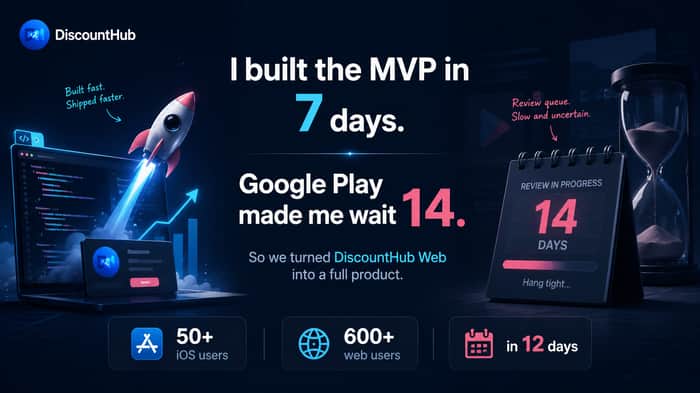
I built the MVP in 7 days. Google Play made me wait 14.
Hey Indie Hackers 👋
I’m building DiscountHub — a product for finding real discounts, promo codes, partner offers, and stores with active deals in one place.
The first MVP took around 7 days to build.
But launching on Android has taken longer than building the first version itself.
The Google Play process delayed us twice, and while we were waiting, something interesting happened:
- the iOS app reached 50+ users
- the website reached 600+ users
- all of this happened in about 12 days
At first, the website was just a simple landing page for the app.
Then I started thinking:
Why are we waiting for Android if people are already discovering the product through the web?
So instead of just waiting, we turned DiscountHub Web into a full product.
Now users can browse:
- real discounts
- promo codes
- partner offers
- stores with active deals
directly from the website.
The iOS app is available now, Android is coming soon, and the web version is now usable as a standalone product.
We also added Partner Offers for founders, indie makers, and online stores who want to share real deals with shoppers.
Honestly, this changed how I think about launches.
A delay in one channel can become a reason to improve another channel faster.
Would love to hear your thoughts or feedback on the web version:

What stood out to me is how a launch delay in one channel became a product pivot in another. The website going from 'landing page for the app' to 'standalone product with 600+ users' in 12 days is a masterclass in reactive product thinking.
A lot of founders treat every channel as just distribution. Sometimes one unexpectedly becomes the product itself. Recognizing that shift early — and actually building for it — is worth more than launching everywhere at once.
Quick question: now that the web version is a standalone product, are you seeing different user behavior between web and iOS? Any insights on which channel converts better for Partner Offers?
That’s a great question — and honestly, we are still gathering enough data to make a confident comparison.
The clearest difference so far is friction. The web version attracts significantly more first-time users because they can open a deal immediately without installing anything. Most of this traffic comes from communities, search, and direct links, so web users tend to browse quickly and click on a specific offer.
iOS users are fewer, but their intent appears stronger. They are more likely to explore multiple sections and return to the product rather than visit only one deal page.
For partner offers, the web currently looks like the stronger acquisition and conversion channel because we can send users directly to a dedicated offer page. However, we have not collected enough partner-offer conversions yet to claim that conclusively.
Our next step is to improve event tracking across both platforms so we can compare not only traffic, but offer views, outbound clicks, returning users, and eventually confirmed conversions.
The interesting outcome is that I no longer see the website as a marketing page for the app. The website and the mobile app may serve two different user behaviours — discovery on the web and retention on mobile.
This is gold — the 'discovery on web, retention on mobile' insight is something I hadn't fully articulated yet, but it makes total sense.
The friction point is especially relevant for my tool (ProfitPulse). Freelancers don't want to install anything to check their profitability. They want to upload a CSV and get answers in 30 seconds.
Your event tracking plan is smart. Are you using something like Mixpanel/Amplitude, or keeping it lean with Google Analytics + custom events?
Right now, we are keeping the analytics stack relatively lightweight.
For the website, we use Cloudflare Web Analytics for overall traffic and behaviour, combined with our own backend events for outbound clicks on deals, promo codes, and partner offers. On iOS, we look at aggregate App Store Connect metrics and track outbound clicks through the same backend.
We have not integrated Mixpanel or Amplitude yet. The next step is to introduce a shared event structure across web and mobile — events such as offer viewed, code copied, outbound click, source, platform, and returning user — so we can compare the two channels properly instead of relying only on traffic numbers.
Your ProfitPulse example fits the same pattern perfectly. Uploading a CSV and receiving an answer within 30 seconds has almost zero commitment, which makes the web the natural discovery and first-value channel. A mobile or installed experience would probably become more useful later for recurring reports, alerts, or ongoing profit monitoring.
That distinction — immediate value on the web, recurring value through a retained product - may be relevant to both of us. Also, take a look at the DiscountHub partner page; you might find it useful.
That distinction — 'immediate value on the web, recurring value through a retained product' — is exactly the framework I needed. I'm stealing that.
You're right about the mobile angle. I hadn't thought about alerts for profit drops or monthly recurring reports, but that's where the real LTV is. Right now, ProfitPulse is a one-time audit, but a 'Profit Monitor' feature with weekly alerts could justify a subscription tier later.
Just checked the DiscountHub partner page — smart setup. Are you open to cross-promotion once ProfitPulse is live? Happy to feature DiscountHub deals in the ProfitPulse dashboard for freelancers looking to cut costs.
Of course, I’d be happy to help—good luck with the release.
Thanks! Really appreciate it. Looking forward to making this happen — good luck with the Android launch!
What stood out to me is that the launch delay ended up revealing where users actually wanted to engage.
A lot of founders treat every channel as a distribution channel. Sometimes one unexpectedly becomes the product itself. Recognizing that shift early can be more valuable than launching everywhere at once.
Yeah, I 100% agree with you.
I'm curious—what surprised you the most about where people naturally started engaging?
I have a feeling that answer says more about the product's future than the launch delay itself.
As a developer, I have encountered this problem several times.