I built TutorGPT — an AI homework helper that solves problems from a photo.
Hey Indie Hackers 👋
I just launched TutorGPT — a free AI homework helper that acts like a personal tutor for every subject.
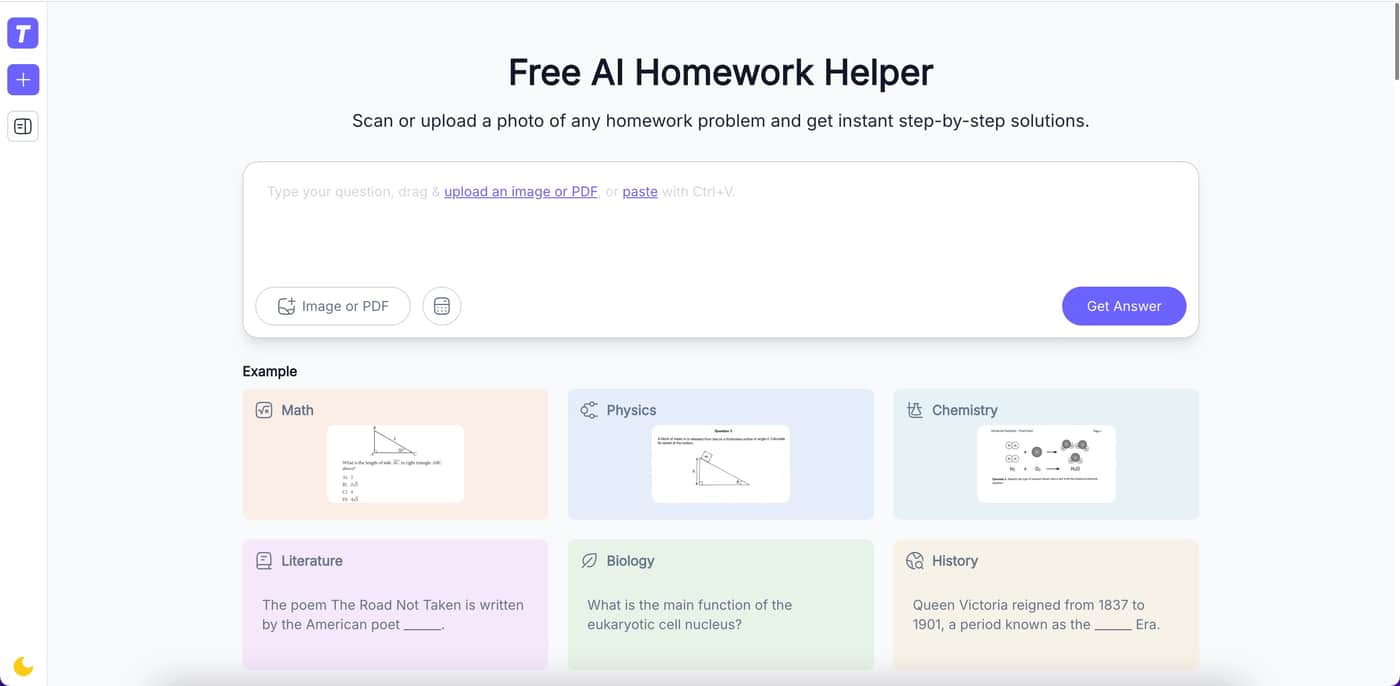
The idea is simple:
Students can upload a photo of any homework problem and instantly get clear step-by-step explanations. No typing, no sign-up required.
I built this because many students get stuck on homework but don’t always have access to a tutor. Searching for answers online often gives incomplete explanations, while AI can guide them through the reasoning process.
What TutorGPT can do:
• Scan homework problems from a photo
• Generate step-by-step solutions
• Help across subjects like math, science, and more
• Work instantly in the browser
The goal is to make AI feel like a tutor that’s always available.
You can try it here: https://tutorgpt.io/
I’d really appreciate any feedback from the Indie Hackers community — especially on the product, positioning, or growth ideas. 🙏


The zero-friction approach is smart for students. No sign-up, no typing, just snap and learn. That removes every excuse not to try it.
I build photo-based AI apps too (one of mine, FaunaDex, identifies animals from photos) and the biggest lesson I've learned is that the camera experience makes or breaks retention. If the photo capture feels slow or the results take too long, people bounce. But when it feels instant, they keep coming back just to try it on different things.
For growth, I think the parent angle is underexplored. Students discover tools like this organically, but parents are the ones who'd actually pay for a premium version. Maybe a weekly "progress report" email to parents showing what topics their kid struggled with could be a strong monetization hook without adding friction for the student.
This is really interesting the “no typing, no sign-up” part makes a lot of sense.I went through something similar trying to learn AI. Consumed a lot of content, but couldn’t actually build anything.That’s actually what led me to start working on NexskillAI more focused on structured, step-by-step learning.Curious how you see this evolving — more like a solver or a real tutor?
This is actually really useful.
The barrier to asking for help is huge for a lot of people, so being able to just snap a photo removes a lot of friction.
Do students actually keep using it over time or is it more of a quick-help tool?
That’s a great point.
I think a lot of these tools start as quick-help, but the real opportunity is turning them into something people come back to consistently.
I felt that myself when trying to learn AI I could solve things, but wasn’t really learning long-term.That’s actually why I started working on NexskillAI, more focused on structured learning instead of just quick answers.Curious if you think students care more about speed or actually understanding over time?
The "no typing, no sign-up" decision is smart for your audience. Students who are stuck mid-homework have zero patience for onboarding friction. The lower the barrier, the faster the aha moment — and for an AI tool, that first moment of "oh, it actually works" is the entire conversion event.
Since you're asking about positioning and growth, a few thoughts from one AI tool builder to another:
The positioning challenge with "AI homework helper" is that it sounds like a category with a hundred competitors. But the photo-first workflow is your differentiator — most students don't want to type out a math equation. They want to point their phone at the problem and get an answer. If the positioning leads with the workflow ("snap a photo, get the explanation") rather than the category ("AI homework helper"), it immediately feels different.
On growth, the interesting thing about student tools is that the distribution is social by default. A student who gets unstuck tells the person sitting next to them. The question is whether your product makes that sharing moment easy. Something as simple as "share this explanation" with a link that shows the solved problem could turn every user into a referral channel without any formal referral program.
The free model with no sign-up removes all acquisition friction, which is great for growth. But it also means you have no way to bring users back. They solve one problem and leave. If there's a lightweight way to capture return visits — even just a "bookmark this for next time" prompt after the first solve — it turns a one-time tool into a habit without adding the sign-up wall.
The hardest positioning question for student tools: are you positioning to students directly, or to parents who pay for education tools? The growth channels, the messaging, and the monetization model are completely different depending on which one you choose.
Love what you’re building here! The photo-to-step-by-step explanation flow is super practical for students who are stuck and under time pressure. I’ll definitely share TutorGPT with friends who could use instant homework support. Curious to see how you evolve it into an even more interactive ‘tutor’ over time—congrats on the launch!
Curious to know, are users valuing the answer most, or the step-by-step reasoning?
Congrats on the launch! The UI looks very clean and easy to use.
One thing I'm wondering: ChatGPT and Gemini already let you upload photos to solve problems. Why would a student prefer TutorGPT instead?
Have you thought about adding features that big AIs don't have?
For example:
- Answer guiding: Guide the student with questions to solve the problem themselves.
- Teacher Feedback: Predicting what a teacher might say about the answer.
- Common Mistakes: Warning the student where they usually lose points.
- Learning heatmap: Even without the sign-up you could use local storage to show students which topics are the most challenging for them (where they fail the most...), so they know where to put attention.
I think adding something like that might make a bit more attractive. Good luck!
it's very helpful for student
it is useful tool to student this is act as mentor also 😁
Love this idea – the photo → step‑by‑step explanation flow feels spot on for students under time pressure.
One thing I’m curious about: how are you thinking about making it feel like a real tutor (guiding the student) rather than just a solution generator?
I like the way you approached this. Starting with a simpler product and then building more complex ones step by step is a smart way to learn the business side.
Also the problem you described is very real. In many organizations a lot of time is wasted just moving information from documents into spreadsheets.
One thing that helped me when building tools is talking with a few real users early. Even 3–5 people who deal with invoices or paperwork daily can give very clear feedback about what matters most.
The photo-to-solution part is table stakes now — Gemini does it, and it's free.
But "tutor" is a different word than "solver." A solver gives you the answer. A tutor notices you've been staring at the same step for ten minutes and knows why you're stuck.
The real question is: does TutorGPT know the difference between a student who doesn't understand the concept, and one who just made a careless arithmetic error? Because a tutor does. And that's the gap worth building into.
Right now this reads like a better UI on top of existing AI. The moat, if there is one, has to come from the pedagogical layer — not the photo scanning.
It is very usefull tool for the students and this tool acts has mentor of a student
It is very usefull tool for the students and this tool acts has mentor of a student
Pretty cool app! I see you're already partnered with several school districts, which is great. This is actually an idea I've had in mind - take it a step further by integrating each school's specific syllabus and pacing guide into the AI. That way kids aren't just solving one-off questions, they're following their actual curriculum and can get ahead on upcoming lessons. Would make it way stickier for both schools and parents.
Very cool. I'm seeing a lot of mobile apps that do something similar. Why not bring it to the web?
Benzer bir site veya uygulama olup olmadığını araştırdın mı?