I Built Yumzy to Turn Scattered Recipes Into One Organized Cooking Space
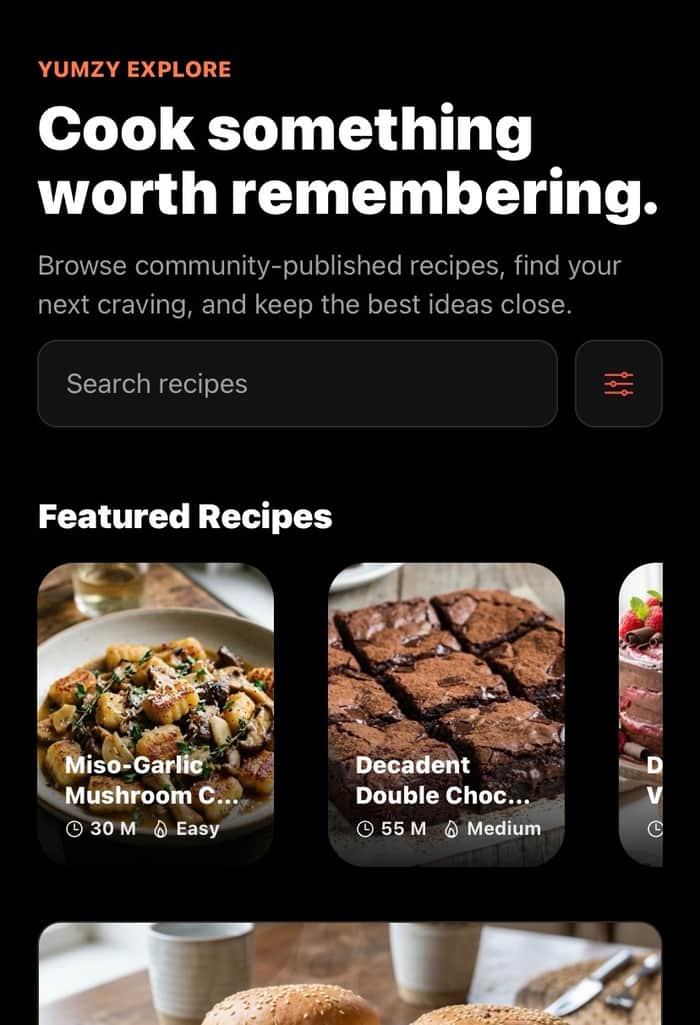
As independent developers, we often start with a simple frustration.
For me, it was recipes.
The recipes I wanted to try were scattered across browser tabs, screenshots, social media posts, notes, and messages. Saving them was easy. Finding them again when I actually wanted to cook was not.
That problem became Yumzy.
Yumzy is a modern digital recipe notebook built to help people discover, save, organize, customize, and share the recipes they love.
You can explore it here:
Building Around a Real Problem
One of the most important lessons I have learned as an indie developer is that a product does not need to begin with a revolutionary idea.
It can begin with a familiar problem that has never been solved in the way you would personally want it solved.
People already had countless places to discover recipes. What I wanted to create was a focused space where discovery and personal organization could live together.
With Yumzy, users can:
- Explore a growing collection of recipes
- Save favorites in a personal recipe notebook
- Create and customize their own recipes
- Organize cooking ideas instead of losing them across different platforms
- Follow clear ingredients and step-by-step instructions
- Share recipes with friends, family, or the Yumzy community
- Access their collection from the web or iOS app
The goal is not to make cooking more complicated with unnecessary features.
The goal is to reduce the friction between finding an idea and actually making it.
From a Web Product to a Mobile Experience
Yumzy started as more than a static recipe website.
I wanted it to feel like a real product: personal, interactive, and useful enough to become part of someone's routine.
Building both a web platform and an iOS application required thinking beyond individual screens. Authentication, recipe creation, saved collections, community content, subscriptions, localization, responsive design, and App Store requirements all had to work as parts of the same system.
The mobile app was especially important because recipes are not only discovered while sitting at a computer. They are checked while shopping, preparing ingredients, or standing in the kitchen.
Turning Yumzy into an iOS app made the product available where it is naturally needed.
The Indie Developer Mindset
Building independently means constantly moving between roles.
On the same day, you might be:
- Designing an interface
- Debugging an API
- Improving onboarding
- Writing App Store metadata
- Preparing screenshots
- Reviewing privacy requirements
- Testing subscriptions
- Creating content
- Thinking about distribution
It can feel fragmented, but it also gives you a complete understanding of the product.
Every technical decision affects the user experience. Every design choice affects conversion. Every line of marketing copy shapes how people understand what you built.
That is one of the biggest advantages of being an indie developer: there is almost no distance between the person building the product and the people using it.
What Building Yumzy Has Reinforced for Me
1. Build the smallest complete experience
A small product should still feel intentional.
It is better to deliver one complete workflow—from discovering a recipe to saving and cooking it—than to launch many disconnected features.
2. Distribution is part of development
Publishing an application is not the end of the development process.
App Store optimization, localization, website SEO, onboarding, content, pricing, and trust are all parts of the product.
A technically strong application that nobody discovers is still an unfinished business.
3. Simplicity requires work
Simple products are rarely simple to build.
The user should not have to think about data structures, synchronization, content management, platform differences, or edge cases. That complexity belongs behind the interface.
4. Shipping creates clarity
You can spend months predicting what users might want, but real feedback only begins after people can use the product.
Shipping does not mean the product is finished. It means the learning process has finally started.
5. Independent does not have to mean small-minded
An indie product can still be polished, global, multilingual, cross-platform, and commercially sustainable.
You may begin with limited resources, but you do not have to build with limited ambition.
What Comes Next
Yumzy will continue growing through better recipe discovery, a richer community experience, improved organization tools, more useful cooking workflows, and continued refinement across web and mobile.
I am also focused on learning from how real people use the product rather than expanding it only based on assumptions.
This is still an evolving product, and that is exactly what makes building it exciting.
Yumzy represents the kind of software I want to keep creating: focused products built around everyday problems, designed with care, shipped into the real world, and improved through iteration.
You can explore the project here:
I would love to hear feedback from other founders and developers:
What was the small, everyday frustration that inspired your latest product?

Looks cool. If you want feedback, we recently launched a loop where you can have designers and PMs look over your app and send you back the feedback they find here: https://tryproduck.com/audit