I compared 7 AI support tools. Most founders are asking the wrong question.
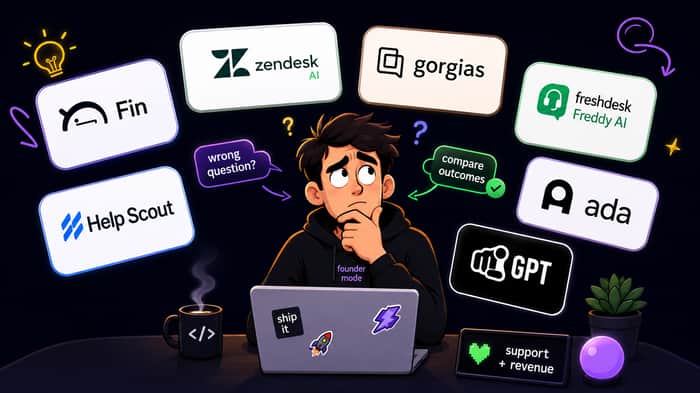
I went down the AI customer support rabbit hole recently.
The question I started with was simple:
What is the best AI chatbot for customer support in 2026?
After comparing Fin, Zendesk AI, Gorgias, Freshdesk Freddy AI, Help Scout, Ada, and YourGPT, I think that question is wrong.
The better question is:
Which tool can actually resolve customer problems without creating more work for me?
That distinction matters.
A chatbot replies.
A resolution engine does the job.
It checks an order.
Cancels a subscription.
Answers a billing question.
Processes a return.
Books an appointment.
Escalates to a human with full context.
And most importantly, it does not make the customer repeat themselves.
That is the difference between AI support and AI theater.
The market is clearly moving in this direction.
Salesforce signed a definitive agreement on June 15, 2026 to acquire Fin, formerly Intercom, for about $3.6 billion. The interesting part is not just the acquisition number. Salesforce described Fin as a customer agent platform that resolves complex customer queries end to end across live chat, email, WhatsApp, SMS, phone, and Slack. Salesforce also cited examples of Fin resolving an average of 76% of support volume end to end.
That changed how I think about this category.
The next support hire for many founders might not be a person.
It might be a workflow.
Here is the founder version of the ranking.
Not best overall.
Not most features.
Just this:
When should you actually use each tool?
- Fin: when you have enough volume to pay for outcomes
Fin is probably the benchmark right now.
Not because it is cheap.
Because it has made resolution the center of the product.
Fin charges $0.99 per outcome, with a $49/month base plan that includes 50 resolutions. An outcome can mean Fin resolved the customer issue or completed a configured procedure that ends in a handoff to a human or workflow.
That is a very different model from paying per seat.
For founders, the question is simple:
Would I happily pay $0.99 to make this support conversation disappear?
Sometimes the answer is obviously yes.
Password reset? Yes.
Refund status? Yes.
Basic account question? Yes.
Angry enterprise customer asking about a failed invoice? Probably not without a human.
My take:
Use Fin when your docs are mature, your support volume is high, and your issues are repetitive enough that paying per resolved outcome makes financial sense.
Do not use Fin just because it is the hot name in AI support.
Use it when the math works.
- Zendesk AI: when your support process already lives in Zendesk
Zendesk is not the exciting indie hacker answer.
But it might be the practical one.
Zendesk says its AI agents can resolve multi-step, multi-intent requests across channels, understand intent, ask clarifying questions, take action across systems, and work across social, web, mobile, voice, and email channels.
The reason to choose Zendesk AI is not that it feels new.
It is that ripping out your support stack is expensive.
If your team already has Zendesk set up with tickets, routing, macros, reporting, help center content, and SLAs, adding AI inside that system may be lower-risk than moving everything to a shiny AI-native tool.
My take:
Choose Zendesk AI if your support operation already runs on Zendesk.
Do not choose it if you are a two-person startup just trying to answer website chat faster.
That is probably too much platform too early.
- Gorgias: when you run ecommerce
Gorgias is one of the clearest fits on this list.
If you run a Shopify or DTC brand, support is usually painfully repetitive:
Where is my order?
Can I return this?
Can I change my shipping address?
Can I get a refund?
Does this come in another size?
Why was I charged?
Gorgias AI Agent is priced per resolved interaction, not per seat or per message. Most plans are listed at $0.90 per resolved interaction, and Gorgias says you only pay when AI fully resolves the conversation on its own.
That model makes sense for ecommerce because the support categories are predictable.
The best ecommerce AI support tool is not the one with the most generic features.
It is the one that understands orders, returns, refunds, shipping, discounts, subscriptions, and product questions.
My take:
If you run ecommerce, shortlist Gorgias early.
If you do not run ecommerce, do not force it.
Specialized tools are powerful only when the specialization matches your business.
- Freshdesk Freddy AI: when you want practical automation inside a helpdesk
Freshdesk feels like the practical middle.
Not as enterprise-heavy as Salesforce.
Not as AI-native as Fin.
Not as ecommerce-specific as Gorgias.
But for many growing teams, that is exactly the point.
Freshdesk’s AI Agent workflows can collect customer details, check conditions, call APIs, transfer conversations to live agents, and automate tasks like order cancellations or subscription updates. Freshdesk describes the difference clearly: knowledge answers questions, while workflows perform actions.
That matters because most support automation fails at the same point.
The AI can answer.
But it cannot act.
Freshdesk is interesting because it sits between a simple support inbox and a heavy enterprise automation platform.
My take:
Use Freshdesk if you want AI plus normal helpdesk fundamentals: tickets, SLAs, routing, reporting, escalation, and workflows.
It is probably not the sexiest option.
But not sexy is often good in support software.
- Help Scout: when support is still part of your brand
Help Scout is interesting because it does not feel obsessed with replacing humans.
That may actually be its advantage.
Some businesses do not want support to feel fully automated. They want faster answers, fewer repetitive tickets, and better self-serve, but they still want customers to feel like a human team is close by.
Help Scout says companies average a 73.19% resolution rate with AI Answers. It counts a resolution when the customer does not escalate, search the knowledge base, or indicate they need more help after the AI response.
That definition matters.
Not all resolution rates mean the same thing.
Some vendors count a customer leaving as success.
Some count only confirmed answers.
Some count workflow completions.
Some count deflections.
Founders should ask every AI support vendor:
Exactly what do you count as a resolution?
My take:
Help Scout is a good fit for small, human-first companies where tone matters.
If support is part of why customers love you, do not blindly automate it away.
- Ada: when support automation is already a serious function
Ada is probably not for most indie hackers.
That is not a criticism.
Ada is built for companies that need AI customer service agents at scale. It describes its platform as AI agents that resolve, act, and continuously improve, with enterprise workflows, open APIs, SDKs, and orchestration across multiple LLMs.
That sounds powerful.
It also sounds like something you buy when customer support is already a department, not a side task you handle between product work and Stripe disputes.
My take:
Ada is for high-volume teams with enough complexity to justify the setup.
For most indie hackers, it is probably too much too soon.
- YourGPT: when you want no-code omnichannel support without enterprise drag
YourGPT is the most indie-hacker-friendly option in this list.
Not because it has the strongest enterprise proof.
It does not.
But because the value proposition is simple:
Launch an AI support agent across web, WhatsApp, Messenger, Instagram, Slack, and more without needing a developer.
The YourGPT WordPress listing describes it as a no-code AI agent builder that can train on WordPress site content, documentation, FAQs, and policies. It also lists support for WhatsApp, Facebook Messenger, Instagram, Telegram, Slack, website chat, voice agents, external API workflows, human handoff, and 100+ languages.
That is attractive for lean teams.
A solo founder does not want a six-week implementation project.
They want to connect docs, add the widget, test the top 20 questions, and see whether support volume drops.
My take:
YourGPT should not be positioned as better than Fin, Zendesk, or Ada.
That is the wrong fight.
The better positioning is:
The fastest way for a lean team to launch no-code AI support across multiple channels.
That is much more believable.
And for many indie hackers, much more useful.
My actual decision framework
If you are a high-volume SaaS company with mature docs, shortlist Fin.
If your support team already runs on Zendesk, shortlist Zendesk AI.
If you run ecommerce, shortlist Gorgias.
If you are a growing team that needs tickets, SLAs, routing, and workflows, shortlist Freshdesk.
If your support experience is part of your brand, shortlist Help Scout.
If you are an enterprise team with serious automation needs, shortlist Ada.
If you are a lean founder who wants no-code omnichannel support, shortlist YourGPT.
But honestly, I would not start by comparing feature pages.
I would do this instead.
Take your last 100 support conversations.
Put them into five buckets:
Simple FAQ
Billing or account issue
Workflow request
Angry customer
Edge case or policy question
Then run those same 100 examples through your top 2 or 3 tools.
Score each tool on:
Did it solve the issue?
Did it hallucinate?
Did it know when to escalate?
Did the handoff include context?
Could a non-technical founder maintain it?
What would this cost at 1,000 conversations per month?
What would this cost at 10,000 conversations per month?
That test will tell you more than any demo.
The biggest lesson for me:
Deflection is a vanity metric. Resolution is the business metric.
A bad chatbot makes your support feel cheaper.
A good AI agent makes your company feel faster.
Big difference.
Curious how other founders are handling this:
Are you already using AI for support?
And if yes, is it actually resolving tickets, or just buying your team a few extra minutes?

The detail that stayed with me wasn't the rankings.
It was how quickly "resolution" seemed to become the lens through which the entire category gets evaluated.
That may end up being exactly right.
But I could also imagine a founder optimizing for resolution rates and accidentally overlooking something that customers value just as much—speed, trust, predictability, or simply knowing when a human should take over.
The interesting question for me isn't whether resolution matters.
It's whether the available evidence justifies making it the primary explanation for what separates the winners from everyone else.