I didn't think about the stages at first.
When Alex Prober and I started shaping Open Room, I was mostly thinking about a feeling I kept hearing on coaching calls and in meetings with founders.
People are building and running businesses mostly on their own, carrying too much in their heads, and want better people around them to think with, talk with, and be honest with.
But after more calls with applicants, it became clear that "building on your own" doesn't look the same for everyone.
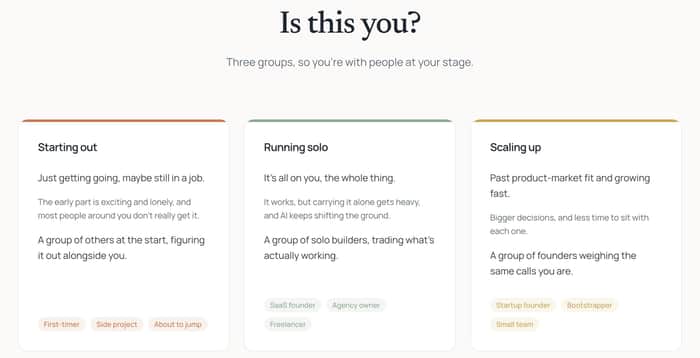
- Starting out is lonely because people don't get it yet.
- Running solo is heavy because everything rests on you.
- Scaling up is hard because the decisions get bigger.
It's the same feeling, just showing up in different ways.
So we decided to start Open Room with three types of groups.
- Starting out
- Running solo
- Scaling up
The point isn't to make it fancy. It's to place people with others who understand the weight and challenges they're carrying right now.
We're starting in July, and applications are Open Room.
A lot of applications have already come in, including some really amazing people. That part has probably made me the most excited :)
If you're one of those people, I'd love to see your application too (we're interviewing each person, so I'd love to see you 💜 ).

Running solo being heavy because everything rests on you is the accurate part. The harder version shows up in what specifically rests on you at any given moment, decisions, follow ups, numbers, all landing on the same person with nobody else scanning for what needs attention next. Having other founders to think out loud with genuinely helps with the weight of carrying it alone. It does not replace the part where someone or something still has to be watching the business itself day to day. FounderFlow is your AI Executive Chief of Staff. It watches your business, identifies what matters, protects your revenue, and tells you exactly what to do next. Different kind of support for the same underlying problem. We are bringing in the first 30 founding members personally right now.
I like that you segmented by the problems people carry rather than by company size or revenue.
Two founders with the same ARR can need completely different conversations, while founders at very different stages can be wrestling with the same underlying challenge. Organizing around that feels much more natural than traditional startup buckets.
Exactly! That's what we saw!
One thing I'd keep watching is whether founders describe themselves by the problem they arrived with or the problem they leave having solved.
That transition often reveals whether the segmentation matches how they actually experience the product.