I engineered a "Voice DNA" extraction system to kill robotic ChatGPT posts on LinkedIn. Here is the architecture.
Hey Indie Hackers,
I’ve been increasingly frustrated with the state of LinkedIn. It feels like every second post starts with "In today's fast-paced world" or uses the word "delve." LLMs are great, but default prompting destroys personal branding because it doesn't know your specific syntax, formatting quirks, or vocabulary.
I didn't want to build just another OpenAI wrapper, so I engineered a different approach called Aaptics.
Instead of asking users to write complex prompts to "sound like themselves," I built a "DNA Lab."
Here is how the architecture works:
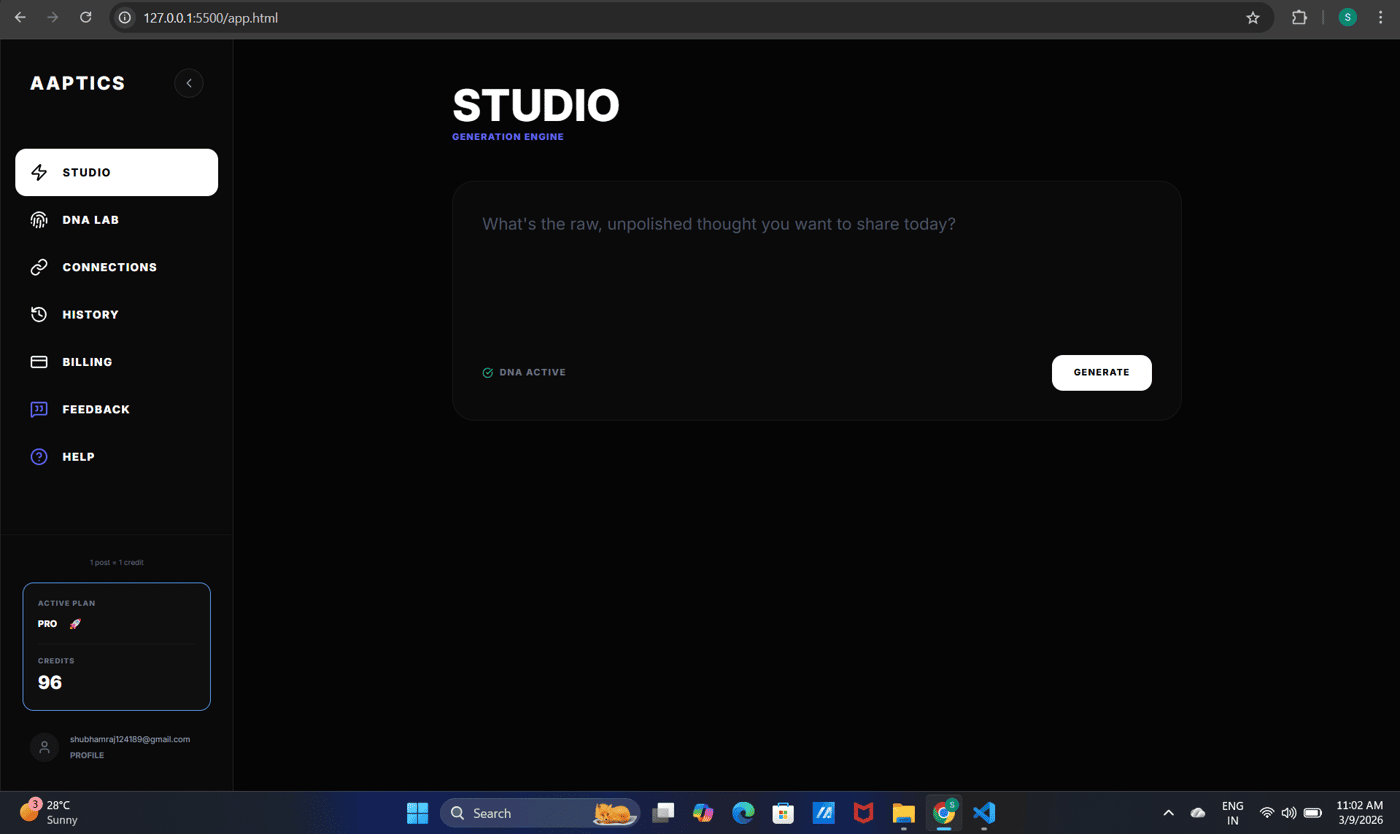
1. The Extraction Engine (Voice DNA): Users paste 3-4 of their past, human-written posts. The system analyzes the text to extract specific "DNA Clues"—vocabulary frequency, sentence length variation, and formatting styles. It creates a unique profile in the database. When they generate a new post from a raw thought, the AI strictly adheres to this DNA profile.
2. The Tech Stack & Security:
Database: Supabase. I implemented strict Row Level Security (RLS) so users cannot manipulate their API credits or bypass the paywall via the frontend console.
Visuals: I skipped DALL-E 3 because it often ruins text rendering on images. I integrated the Recraft v3 API specifically to generate professional, text-perfect visual concepts alongside the posts.
3. The Scheduling Worker: Handling global timezones was the trickiest part.
The UI takes the user's local time and converts it to a strict UTC ISO string before storing it.
I have a custom Python worker running 24/7. It checks the DB every minute:
if current_utc >= scheduled_utc, it fires the payload directly to the LinkedIn API.
I just launched the V1 and am trying to get my first 10 solid beta testers to break the system and roast the UI.
Questions for the community:
For those who built scheduling tools, is a continuous Python worker loop scalable as user count grows, or should I migrate to a message broker queue (like Redis/Celery) right now?
If you are active on LinkedIn, do you feel authenticity is still a priority, or has the market accepted robotic AI text?
Would love to hear your thoughts, and if anyone wants to test the DNA extraction, let me know!
Explore More - aaptics.in


How do you evaluate if the DNA extraction truly captures writing style vs the LLM filling gaps with generic patterns?
That’s the hardest problem to solve! We evaluate the DNA fidelity on three strict vectors:
Negative Constraints: Did it successfully avoid typical LLM crutch words (like "delve" or "tapestry")?
Syntax Matching: Humans write with erratic pacing (a 1-word sentence, then a long paragraph). LLMs write in uniform blocks. We measure if the output rhythm matches the user's historical cadence.
The Zero-Edit Rate: Are beta users hitting "schedule" immediately, or are they manually tweaking the tone?
By injecting the Voice DNA as an isolated, immutable system prompt, we force the LLM to map the raw idea directly into the extracted syntax, leaving no room to hallucinate generic filler.
How do you usually evaluate output quality in your own AI workflows?