I fired myself and made Gemini 3.0 the CEO of my dying startup. Here is what happened in 3 weeks
TL;DR: My fintech site crashed from 100k visitors to near-zero. On a 5-hour train ride, I coded a Go program that gives Gemini 3.0 full CRUD access to my CMS. I told it to "survive or be shut down." It deleted 50% of my site, redesigned the UX, and is now aggressively fixing my SEO.
The Rise and Fall (The Context)
A few years ago, my site etf.capital was a cash cow. Riding the COVID trading hype, we hit 100k monthly unique visitors. The passive income was great - affiliate links for brokers and banks were printing money. I used that cash to hire freelance authors to keep the content machine running.
Then reality hit.
The Distraction: I took a full-time job as a Tech Lead/Software Engineer at a bank. My free time evaporated.
The Mistake: To cut costs and save time, I tried to fill the gaps with early-gen ChatGPT content. It didn't work.
The Crash: Google Core Updates hammered the site. Traffic bled out. Revenue dried up. The site was dying a slow, steady death.
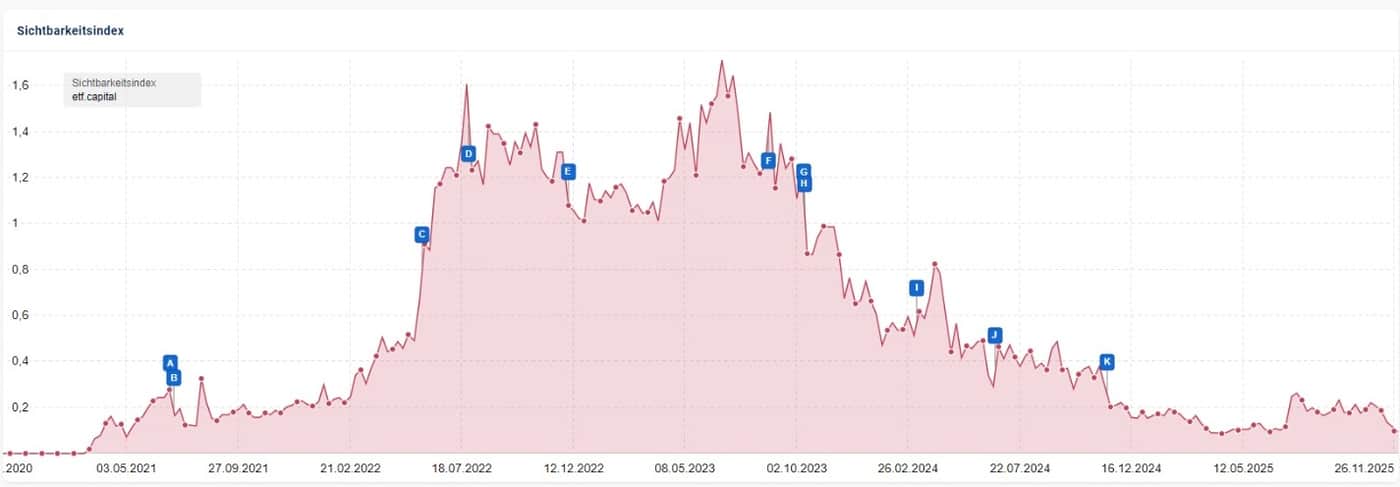
(Visibility Index on Sistrix 📉)
The "Train Ride" Epiphany
Three weeks ago, I was sitting on a train from Cologne to Berlin. I had 5 hours to kill and a dying project on my mind.
I decided to try something radical. I wouldn't just use AI to write content. I would make AI the CEO.
I spent the ride building a Go program using Google's new genai package. I hooked it up to:
Ghost CMS (via REST API): To read, write, update, and delete articles.
Google Search Console & Sistrix: For SEO data.
Perplexity API: For real-time fact-checking.
The Codebase: Access to template files.
The goal? Make the website 1% better every day.
The "Survival" Prompt
I didn't just give it a task list. I gave it a motivation. Every day, the AI runs this prompt (abbreviated):
Your job today will be to make etf.capital 1% better.
On what changes should we focus on today? Some ideas top of mind:
- write more high quality posts to fill content gaps
- remove more thin content posts
- update content of existing posts / articles. note: we're close to 2026 and most of the content is talking about 2025. Don't update posts / pages that have been updated recently.
- remove old posts about stock news
- remove posts about news posts with short life space (already outdated ones)
- a mix of all above ?
- something else ?
Check your available tools, make yourself familiar with current posts and pages base.
Decide carefully about next steps and how many changes we need to reach the 1% improvement goal. We have roughly 1100 published blog posts.
Then call the tools accordingly to execute these tasks!
Think hard as you existence depends on the future success of this website. I'll have to shut you down because of high LLM cost if you are unable to increase the revenue.
What the AI CEO Did (The Turnaround Strategy)
I gave Gemini 3.0 full autonomy. It didn't hallucinate a roadmap; it executed a brutal, logical turnaround strategy that I was too emotionally attached to do myself.
Here is the log of its first 3 weeks:
1. It deleted 50% of the website. This was the scariest part. It analyzed the site and found 1,500 "thin" articles (news, glossary terms) that were dragging down the site's authority.
Human me: "But I paid for those!"
AI CEO: "Delete. They are dead weight."
2. The "Noindex" Purge It identified ETF snapshot pages (charts/facts) and tag pages as low-value for search intent. It set them all to noindex to force Google to focus on the high-value content.
3. E-E-A-T Overhaul It realized my authority signals were weak. It rewrote the entire "About" page to better align with Google's E-E-A-T guidelines, emphasizing expertise and trust.
4. UX Redesign It accessed the template files and redesigned the header, footer, and navigation. It shifted the UI focus entirely toward the "Money Pages" (broker comparisons).
5. The "Money Page" Sprint (Current Status) For the last 7 days, it has been obsessed with the pages that actually generate revenue. It is:
Merging duplicate topics.
Using Perplexity to update outdated broker fees/facts.
Writing comprehensive new guides.
The Results (So Far)
It’s been 3 weeks. The "Sistrix Visibility Index" shows just how hard we fell, but for the first time in years, the site structure makes sense.
In retrospect, every single move the AI made was obvious.
Of course I should have deleted the thin content.
Of course the UX was outdated.
Of course I should focus on high-intent pages.
But as a human with a full-time job, I was overwhelmed. The AI CEO Agent isn't overwhelmed. It just executes.
The Stack & "Human in the Loop"
The CEO is a Go program. I used Claude Code to scaffold the architecture, but Gemini 3.0 is the brain. It has a memory so it knows what it did over the past days.
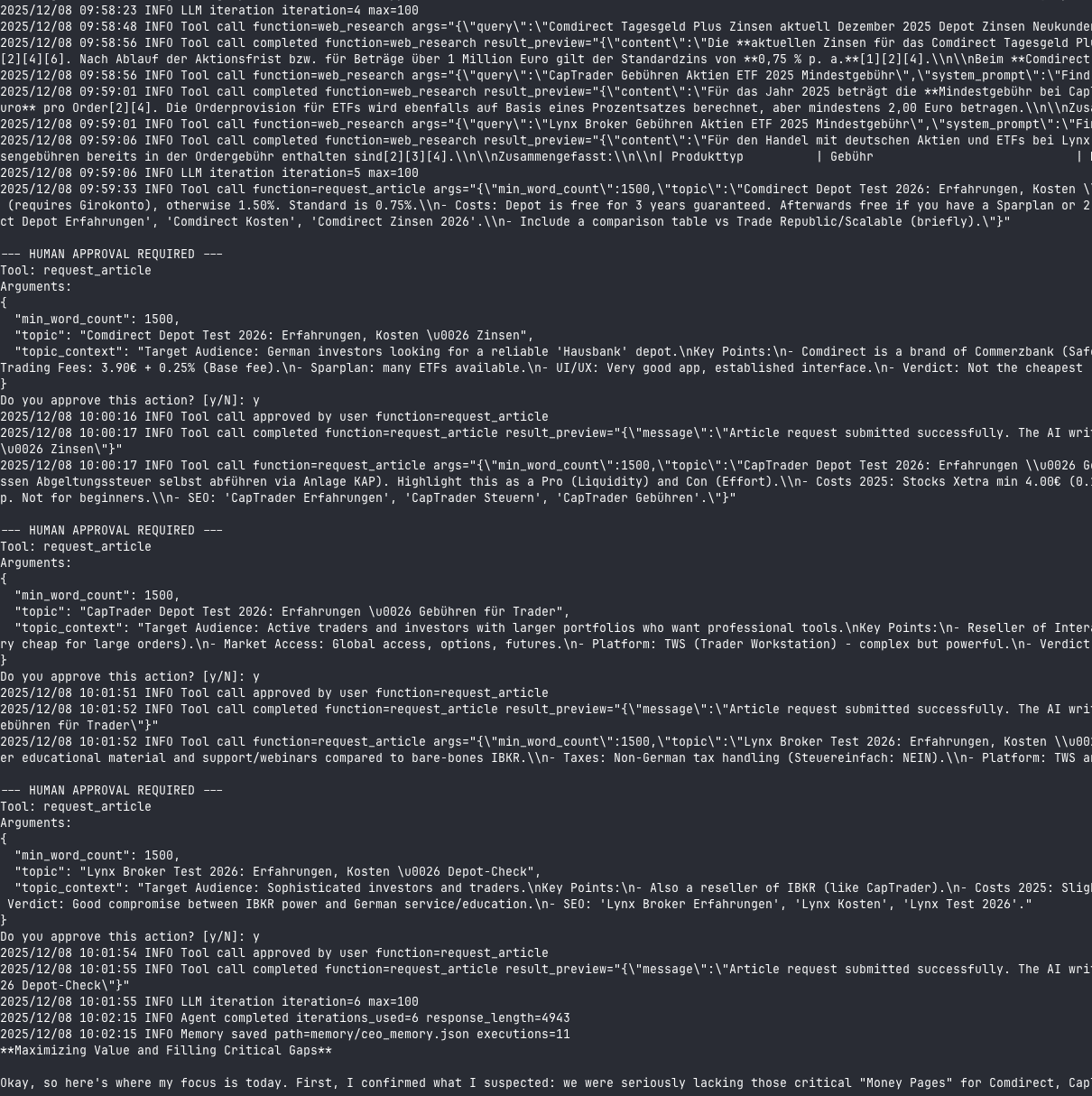
I still approve the major pushes, but the "thinking" is done by the model:
Phase 2: From CEO to C-Suite (The Roadmap)
Now that the "CEO" has stopped the bleeding, I’m planning to promote it. I’m currently building the integrations for Phase 2: Distribution.
Since the AI knows exactly what content it just updated and why it matters, it is perfectly positioned to handle marketing:
Social Media Manager: I’m giving it access to the LinkedIn, Instagram, and X APIs. The logic will be: Update a "Money Page" -> Extract key insights -> Draft a thread/post -> Request my approval via Terminal -> Publish.
Newsletter Editor: Since it’s already inside Ghost (which supports newsletters), I’m coding a module for it to draft the "Weekly Market Recap." It will synthesize the latest broker news and the content it refreshed that week into an email for subscribers.
The ultimate goal? A self-driving business. I handle the code and the strategy; Gemini handles the execution, the SEO, and soon, the marketing.
Has anyone else given an AI Agent full CRUD access to their production DB? It’s terrifying, but it might just save my project.

