I found 3 H1 tags on ClickUp’s homepage
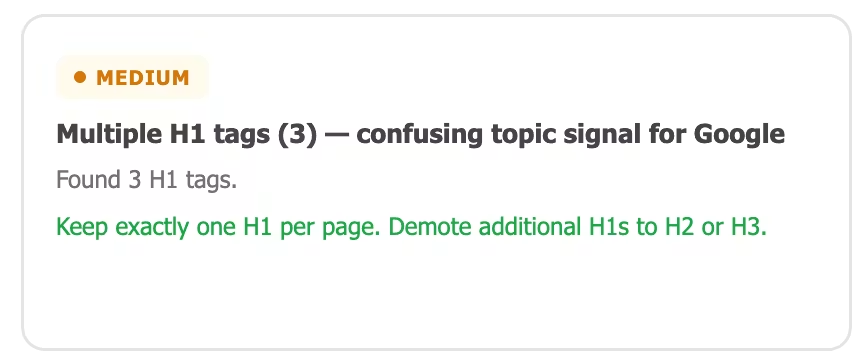
I ran a test audit of ClickUp's homepage while building WebAudits, a free website audit tool, and spotted something easy to miss: three H1 tags live in the DOM at the same time.
Most likely it's a side effect of layered A/B testing - multiple hero variants render in the markup at once, even when hidden via CSS. Visually fine, but search engines and AI crawlers read all three.
Three competing H1s means no clear signal to search engines about what the page is actually about - each one dilutes the others.
Worth checking on your own site if you run A/B tests on hero sections. How often do you audit your header structure: H1s, hierarchy, duplicates?

The finding is real but the framing is partially outdated SEO folklore. John Mueller has stated multiple times that multiple H1s don't hurt SEO. HTML5 spec actually allows them — each semantic section can have its own.
ClickUp ranks for thousands of high-intent keywords and has strong organic visibility. Their engineering team almost certainly knows about the multiple H1s and chose not to fix it because it isn't hurting them.
What actually matters from layered A/B testing: conflicting canonical tags, conflicting schema markup, hidden duplicate body content, CLS from variant overlap. H1 count is the visible symptom that gets attention but rarely the real issue.
What does WebAudits flag for variant-related issues beyond heading count?
You're right that Google doesn't penalize multiple H1s as a hard rule - but multiple H1s dilute the topical signal of a page. Ideally, H1 should align closely with the title tag, so both search engines and AI crawlers can clearly understand what the page is about.
For ClickUp - fair point, their domain authority is strong enough that this is essentially noise, not a ranking issue. But for lower-authority sites, I'd still recommend a single, focused H1 regardless of what John Mueller says, simply because you need every relevance signal working in your favor.
On what WebAudits checks - I'm currently at ~50 checks and expanding. There are standard technical checks (robots.txt, sitemap, meta tags, canonicals, hidden DOM text, heading hierarchy) but what I'm more excited about is the conversion-focused layer: No CTA above the fold, No social proof, No pricing path (SaaS-specific), Unclear hero message, schema validation, and more.
One thing I'm putting real thought into is segmenting checks by site type - SaaS, eCommerce, local business, etc. each have different patterns. A missing pricing path matters on a SaaS page; it's irrelevant on a portfolio site. That's the core differentiation I'm building toward.
Fair concession on ClickUp and fair defense on the smaller-site point.
Audit-by-site-type is your sharper differentiation and you might be underselling it. SEO audit category is saturated (Screaming Frog, Ahrefs, SEMrush, Sitebulb — all generic). "Audit tool that knows what matters for SaaS vs ecommerce vs local" is real positioning incumbents can't easily replicate. "50 checks" is feature talk; "audit built for [specific site type]" is positioning.
The CRO checks layer is the more interesting strategic question. CTA above fold, social proof, pricing path, hero clarity — that's conversion audit territory, not SEO. Different category, less crowded, different buyer. Worth pressure-testing whether you're building SEO audit with CRO layer (current) or CRO audit for specific site types (potentially sharper wedge).
GTM implication: distribution differs by site type. SaaS → Indie Hackers, Product Hunt, MicroSaaS communities. Ecommerce → Shopify community, DTC Twitter. Local → local SEO groups, agencies. Pick ONE site type, dominate, expand.
Which site type is converting best in your early traction? That's usually the real wedge.
(We're HiveMind — AI strategy copilot for this kind of wedge identification and positioning work. https://hivemind.myosin.xyz/auth/signup, code HivemindIH123.)