I gave our AI book writer one simple prompt. It produced a 6,238 word book
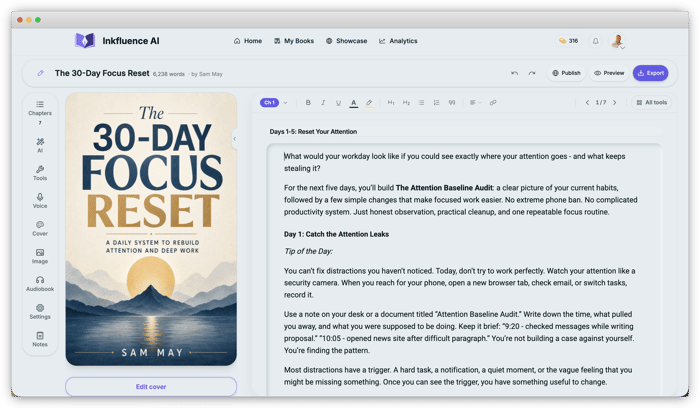
I've been testing the non-fiction workflow in Inkfluence AI and wanted to see what would happen with a pretty normal book idea rather than a carefully engineered prompt.
I started with this:
“A practical 30-day guide for busy professionals who want to reduce digital distraction and rebuild their ability to focus.”
That was basically it.
Inkfluence turned it into The 30-Day Focus Reset — a 7-chapter, 6,238-word non-fiction book, with the outline, written content and cover all created inside the same project.
The interesting part for me isn't really that AI can generate 6,000 words. That's easy now.
The harder problem we've been working on is everything around the generation: taking a rough idea, turning it into a sensible structure, keeping the chapters connected, and ending up with an actual book project you can edit, design and export rather than a massive response sitting in a chat window.
I deliberately didn't give it a detailed chapter-by-chapter prompt for this test. If someone already needs to plan their entire book before the software becomes useful, we're not solving enough of the problem.
I documented the whole test, including the finished book, here:
https://www.inkfluenceai.com/learn/how-to-write-a-nonfiction-book-with-ai
I'm curious how other people building long-form AI products are approaching this. How are you handling structure and consistency once generation starts running into thousands of words?

It's impressive to see AI generating such substantial content from a single prompt. I've dabbled in using AI for content creation myself and have found that while it can produce large volumes quickly, the true value often lies in the refinement process afterward.
When I experimented with AI-generated content for my own project, I realized the initial output was just the beginning. The first drafts tended to lack depth and often required a fair amount of editing to inject personality and ensure it aligned with our brand voice. I ended up editing about 40-50% of what the AI produced.
One key takeaway from my experience is to have a clear framework for editing. Consider checking for narrative flow, consistency, and overall engagement. Evaluating the generated content against criteria specific to your audience can significantly enhance final quality.
Additionally, while the ability to quickly generate large volumes of text is appealing, I found combining AI generation with a solid content strategy—focused on SEO and user engagement—made a big difference. This approach helped me not only create more relevant content but also improved the performance benchmarks we were tracking against established metrics.
Would love to hear more about how you plan to use the book or if there's a specific angle you're exploring with this AI-generated content!
The distinction between generating 6,000 words and actually maintaining a coherent book is the interesting part.
Curious what tends to break first once users start revising the generated content.