I got let go, spent 18 months building a productivity app, and now I'm taking it to Kickstarter
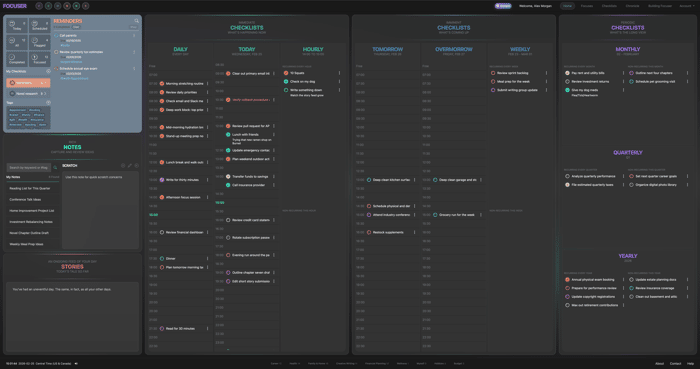
Most productivity apps ask: Did you finish your tasks?
Focuser asks: Do your actions support how you define success?
Nearly two years ago I unwillingly found myself back in the job market, ill-prepared. I was managing the search through Apple Reminders and Notes. I had a checklist for each weekday, one for the week, and various notes and folders. I spent more time manually updating the system than using it. Information got lost, lists fell out of sync, momentum stalled.
So I started building a web app that contained reminders, notes, and these checklists in one place, where the system handled the management, not me. Items automatically migrate between checklists as time passes, moving closer to the present, carrying over if left unfinished. From there the idea expanded, adding Focuses, secondary checklists, effort items, a searchable timeline of events. Focuses are user-defined areas of life that matter most to you: work, health, family, finances, whatever you decide. Every checklist belongs to a Focus, and every item you complete is tracked. Over time, Focuser builds a picture of where your effort actually goes, giving you insight no other productivity app affords. Did the way you spent your time reflect what actually matters to you? Was your life successful — today, last week, over time?
The core app is built and working. Focus Metrics, the analytics layer that shows effort distribution and balance over time, exists in an early form but has a long way to go. The bigger challenge ahead is the mobile experience: getting the app to feel truly native and engaging across every orientation on both phone and tablet, so it doesn't require you to sit at a computer. That alongside third-party integrations is where most of the remaining work lives. I've been building this full time for over a year and a half, funding it myself. Now I'm preparing a Kickstarter campaign to fund me through the remaining development work. That will be the moment of truth.
I'm building this in public from here on out: the Kickstarter campaign, the development of each roadmap feature, and the design decisions behind them — all documented in the Building Focuser blog.
Follow the journey at lifefocuser.com/building-focuser, or join the waitlist at lifefocuser.com while you're there.
What are the areas of life that matter most to you, and how would you structure your timeline around them?

Such a cool !!
The distinction between tracking completion vs tracking alignment is what most productivity apps completely miss. I've been thinking about this same problem from a different angle. Most of the time when my effort drifts from my priorities, it's not because I chose to work on the wrong thing. It's because I got pulled into a YouTube feed or an Instagram explore page without even realizing it. The inputs are the problem, not the planning.
I actually started using a Mac app that blocks the feed portions of social sites (homepages, recommendations, explore pages) while keeping the useful parts like search and DMs accessible. Combined with something like Focuser tracking where effort actually goes, you'd have both the awareness layer and the prevention layer. Your effort distribution metrics would probably look wildly different for most people if they just removed algorithmic feeds during work hours.
That's very true. Even though I'm not on social media & don't spend time on Youtube video spirals (anymore), I still found myself getting too focused on various things, so I integrated an audio chime in the app. Now when the tab is open, it chimes on the hour (mutable of course), which helps more than you'd think. I was also thinking of developing audible reminders configurable by customized sound & interval for people to upload their own tones or use the system defaults, & set cues for remembering to journal, or attend to this specific thing or whatever. The hope was to have my own spin on these sort of blocking apps but as an opt-in layer one could use, or leave alone if they don't need it.
Time certainly has a habit of passing by unnoticed!
really respect the persistence here - building something for 18 months after getting let go takes a lot of grit.
i like the idea behind focuses. most productivity tools track tasks, but very few help you see whether your effort actually aligns with the areas of life you say matter. that “effort distribution over time” concept is interesting.
if you’re preparing for Kickstarter, one thing that’s surprisingly helpful early on is looking at two things:
a lot of founders skip the competitor and campaign analysis step and go straight into building the page.
i’ve been experimenting with two lightweight tools around this:
• one analyzes crowdfunding campaigns and generates a rough launch strategy based on similar projects (messaging angles, positioning, etc.)
• another quickly maps competitors for an idea or product so you can see strengths, weaknesses, and positioning gaps in the market.
if you're experimenting with Kickstarter strategy or trying to refine positioning for Focuser, i’d be happy to share them and get your thoughts as a founder.
also curious - are you planning to build your Kickstarter audience mainly through the waitlist you mentioned, or thinking of other channels as well?
I wish I spent a lot less time continuing to develop in the lead up to the launch of the campaign, & far more on product positioning & campaign structure analysis! As it stands, I launched today to no great fan fare, which is fine. The app will be available to the public whether the project is funded or not.
I was mostly using here, my own blog on my app's site, LinkedIn (surprisingly had a lot of engagement there), & the pre-launch page at Kickstarter itself. Will see how it goes!
@hunter_focuser that makes sense... feels like a lot of the real learning only happens once something is actually live! congrats on the app being live and available to the public : ).
the linkedin part is interesting though, that’s not always obvious upfront!
i’ve been trying to understand this myself - whether having a clearer view of how similar products position themselves or how their campaigns are structured before launch would’ve actually changed anything
i ended up building something small to explore that (competitorsnap), but still figuring out how useful it really is in practice.. do you feel like something like that would’ve helped earlier...
That's very interesting actually, the amount of time taken to build this shows that you have vision more than a product,
one thing I am w worried about is did you validated the idea, building something for 18 months then appears that people do not like it is really massive ( though I thing having the virality in this post might indicate that your idea has some interest)
Also one thing I recommend as I have built an app for ios and android is that you keep testing it very well on ios as apple might reject for the least possible existing bugs (manual review), google play is not that strict but also take it serious as I heard a lot of people get rejected due to the massive apps being built by AI. Good luck
Thanks. I've certainly tried to think through everything so that my vision is fully realized. I've also tried to think through using it as an end-user, without my level of context. Ideally, users will be able to see the merit right away. But if they don't, at the end of they day if this is only helpful to me, then it's still a success in my mind. & if it is adopted by a decent amount of people, all the better!
I've actually been revamping the mobile apps now; testing on an Android tablet I recently got, & my normal iPhone. Tablet was only started last month, & the phone layouts were extremely old, well before the site got it's modern polish. It's taking some seriously long days to get both phone & tablets looking good (including landscape, split, & portrait), but should really help make this a tremendously helpful app.
18 months solo is a real commitment — the Kickstarter move makes sense as both funding and validation signal at once.
One thing that's helped a lot at flompt: separating "is anyone using this?" (activation) from "do they come back?" (retention) earlier than felt necessary. Both matter but they're different problems that need different fixes.
Rooting for you. github.com/Nyrok/flompt is where we're building in public — a ⭐ would mean a lot from a fellow solo founder 🙏
Well I did technically take half a year off or so where I focused mostly on woodworking, but either way, it's a long time working solo. It will be interesting to see if it can gain the sort of reach I'm hoping for. I've sort of been putting off the launching of this so I could get as much of it error-free so that I'm able to spend more time marketing & increasing awareness, & much less bug-hunting & fielding support issues, so hopefully that pays off as well.
& definitely interested in tracking activation versus retention; that's a good point.
One structural challenge with tools like this:
the moment the user stops updating the system, the data model collapses.
Life analytics only works if the underlying input stays consistent over time.
Most people maintain a system enthusiastically for a few weeks, then gradually stop logging things.
So the real design problem becomes:
how much signal can the system extract even when the user only interacts with it partially.
Good point! This is one of the questions I've sat with the most while building it.
The way I'd separate it: there's a difference between someone who stops using the system entirely and someone who keeps using it but tags inconsistently. The first case is something I've put real effort into addressing, even if it's not a metrics problem. A lot of that is just making the app genuinely pleasant to use: fast request/response cycles, a polished aesthetic, six themes, low error rates, care in the details. The honest bet is that a tool people actually enjoy using gets used. And as third-party integrations and calendar imports come online, the friction drops further; it starts meeting you where you already are rather than asking you to come to it.
There's also a design choice that cuts against drift more directly: the checklists auto-migrate items, carry over unfinished work, and reset recurring routines on their own. The system is designed to require as little active maintenance as possible; partly because I think "you have to keep feeding it" is exactly what kills most productivity tools over time.
The second case is more interesting. Focus tagging in Focuser isn't a separate logging step you have to remember; it's an optional but encouraged association you can apply to new and existing items whenever it makes sense. So if you're using the checklists to manage your week, you're generating signal whether or not you're being deliberate about it. A low tagging rate with high throughput still tells you something. It's directional, not broken.
It's also worth noting that Focus Metrics are part of the Complete plan; the people using it are already self-selected as invested users, which makes the consistency concern somewhat less acute in practice.
But I won't pretend the tension isn't real. The more value someone wants from the analytics layer, the more consistent their input needs to be. I just don't think that's a reason not to build the analytics layer.
That’s an interesting dynamic. Once analytics sits behind a paid plan, the consistency problem partly self-filters because the people opting in already care about the signal. In a way it changes the relationship with the data — they’re not just logging anymore, they expect something useful back from it.
Have you noticed a clear behavioral difference between free users who gradually drift and the users using Focus Metrics?
That was my thinking as well. We aren't live yet, so there really aren't free users, or paid ones for that matter. It will be interesting to see how many go for the full Complete plan each month, versus those on Basic or Pro plans. That said, the Kickstarter will feature quite a discount for lifetime access to Complete!
the kickstarter angle is really smart here, not just for funding but because a successful campaign gives you a story and social proof you can use for everything after. i've seen app founders use that initial momentum to lower their cost per install when they eventually run paid ads, because the "funded on kickstarter" badge builds instant credibility in ad creatives. also totally agree that mobile is where this needs to feel great first, most people want to check in on their day from their phone not a laptop. are you thinking iOS first or launching both platforms at the same time?
Thanks. I would certainly be very pleased if I could earn the 'funded on Kickstarter' badge. That said, I'm specifically not going to have ads anywhere on or in my site. I wrote a blog post about it at https://lifefocuser.com/building-focuser/did-you-forget-to-add-ads.
I'm actually the sole developer for the entire web app & native device app. I only have an older iPhone (portrait only), & now an Android tablet. I'm currently working through the tablet landscape layout, then will tackle the split & portrait screens, before circling back to iPhone. Tablet screens are just too different to phones that I'm having to serve two different screens depending on which form factor is being used. & as the sole developer, it's just going to take time to go through & layout tablet fully, let alone revisit the iOS app & update all the screens to be aligned with the way the web app looks today. These are both important roadmap items the Kickstarter campaign will hopefully fund as well.
The “alignment over completion” framing is strong.
As a developer who recently launched my own app while navigating career decisions, I’ve been thinking about a similar tension — it’s easy to optimize for visible output (features shipped, tasks done), but much harder to measure whether those actions actually move you toward the life or direction you care about.
Especially in an AI-accelerated world where building is getting faster, the differentiator feels less like productivity and more like intentionality.
The Focus Metrics layer seems like it could make that gap visible in a way most tools avoid.
This is exactly it, and congratulations on your launch. That experience of shipping something real probably makes this tension more concrete than any framework can.
Focus Metrics started from a simpler need: I wanted to see how I was actually doing across each area of my life, so I could adjust and find greater balance. But there are two distinct layers to that. One is being able to visually trace how everything connects back to what matters. The other is seeing the relationships and trends in real time and over time. That second layer is where it gets genuinely useful, because that's where patterns become visible and intentional adjustment becomes possible.
Would love to know what you ended up building. Sounds like you've been wrestling with the same things.
I really like the concept of Focuses — most productivity apps optimize for task completion, not alignment.
One thought: the real differentiator might be quantifying how effort distribution changes over time and correlates with outcomes.
For example, if someone consistently completes more tasks under “Family” than “Work,” that’s interesting — but what’s more powerful is showing whether that distribution aligns with how they define success.
Have you considered layering in insight like:
“Your time allocation this month matches your stated priorities 72%.”
Or showing behavioral drift between intended focus and actual execution?
That could move this from being an improved task manager to something closer to a self-alignment / life analytics tool.
Curious how you’re thinking about the long-term defensibility here — is it the data layer, the behavioral model, or something else?
Thanks, me too! That's precisely the sort of metrics I'm trying to illustrate. I want to be shown how I'm doing not just on each focus in isolation, but relative to the other focuses I've defined. That way I can adjust my effort. The current architecture has toggle-able pills for Today, This Week, Last Week, This Month, Last Month, This Year, Last Year, & All Time so you can see how these sorts of datasets are trending & panning out given a selected timeframe.
There's always going to be some level of deviation, which itself is measured. "Clean the garage" is probably not going to be an item many people attribute to a specific focus, but it's real effort nonetheless.
I'm toying with the idea of gamifying recurring commitments to encourage active participation, but not developing any sort of warning or negative reinforcement toasts or similar. But if I do decide on something like either, they will be controlled by account settings & one must opt-in for that increased level of oversight, so to speak.
Indeed, I set the default time interval in checklists like Daily & Today for 30 minutes, but the user has the option to make it 15 minutes, or as loose as 3 hours if they don't want the pressure 30 minute slots brings. I think giving users the flexibility to control how their system is setup is pretty important. I know I'd appreciate it, as I appreciate your feedback.
The insight about effort distribution vs stated priorities is brilliant. Most productivity apps just track completion, but you're asking the deeper question: "Is this actually what matters to you?"
I've been building apps solo too, and that alignment problem is real. I built Tiny Steps (habit tracker) with a similar philosophy - instead of streak pressure, it focuses on sustainable progress that fits your actual life patterns. Turns out people need systems that work with their reality, not against it.
The automatic migration between time-based checklists sounds like it could solve the "manual maintenance hell" problem perfectly. Curious about the Focus Metrics analytics layer - are you thinking more dashboards or something more integrated into the daily workflow?
Sustainable over streaky is a smart philosophy. Streak pressure is real — I haven't missed more than three days in 396 on Duolingo because that mascot gets increasingly judgy as the day goes by. I've actually taken lessons from it in thinking through how Focus Metrics handles streaks.
Focus Metrics lives in the Chronicle rather than the main dashboard, which is intentional. The dashboard is where you work, the Chronicle is where you reflect. The analytics cover all Focuses with a balance score, trend lines per Focus across different timeframes, recurring streaks that silently reset without fanfare or shame, and effort distribution per Focus. The Focuses page has much the same but scoped to each individual Focus.
Keeping it separate from the daily workflow was important. Reflective on demand, not competing for attention when you're just trying to get things done. That said, I'm toying with a setting to bring some gamification into the daily workflow for those who want it — streaks visible as you go, that sort of thing. There if you want it, invisible if you don't.
This resonates a lot. I'm building something in a similar space -- an AI-powered personal growth platform with goal tracking and accountability (growthcoach4u.com). My origin story is almost the same: I used physical planners and journals for years, and eventually got frustrated enough to build the digital version I wished existed.
Your point about the system handling the management instead of you is spot on. That's the core problem most productivity tools miss -- they create more work instead of removing it.
Curious about your Kickstarter approach. What made you choose crowdfunding over just launching directly with a waitlist and early pricing? I've been debating that myself.
Goal tracking is a tricky thing to data-model I'm finding out, since everybody is so different. Having AI power the platform is bound to help I'm sure. And I probably would have been right there with you with physical planners but my handwriting's illegible even to me, making it an even worse system!
The way the system handles a lot of the tedium is a valuable differentiator. I know I'm spending very little time working the system and more time developing and taking care of other areas long-neglected.
I chose Kickstarter because it was a platform I was already familiar with, and have seen enough stories about funding goals being reached early and overwhelmingly that it seemed like a good avenue. Plus it's another way to reach an audience of people who might genuinely benefit from the app. I have a very small online presence myself, having gotten rid of social media a while ago and never really posting when I had it, so the reach the platform can provide is going to be key.
Ha, the illegible handwriting thing is too real. Mine looked like a doctor's prescription after about two weeks of journaling.
The data model point is interesting -- we ran into the same thing. Everyone structures their goals differently, and trying to force a rigid framework kills adoption. AI actually helps a lot there because it can adapt to how someone naturally thinks about their goals instead of making them fit a template.
The Kickstarter-for-reach angle makes a lot of sense, especially if your organic presence is small. It's basically buying distribution through the platform's built-in audience. Smart move. I've been going the opposite route -- trying to build organic reach first through communities like this one and LinkedIn -- but honestly the cold start problem is brutal either way. Will be following your campaign to see how it goes. Rooting for you.
The illegible handwriting has only gotten worse in the digital age. Good to know I'm not the only one.
Focuser makes certain assumptions. Recurring items that are assigned to a focus are a natural point for metrics to track. Effort items are natural indications of intention. But creating templates for users to define which items under which conditions count as success or failure was something ultimately not really feasible in an AI-less platform like mine. Curious how much of that burden AI actually lifts for you in practice, versus just making the friction less visible.
The cold start thing is brutal regardless of approach. I'm doing the same community-building thing and it's slow. Hopefully the Kickstarter audience provides some lift. We'll see. Thanks for the kind words -- means something coming from someone in the same boat.
The 'built it for myself first' path is underrated as a validation method — you're your own most honest daily user. I'm in a similar spot with a car maintenance app: built out of personal frustration, now figuring out how to translate that into broader traction.
One thing that helped me think about the Kickstarter angle: the campaigns that convert best tend to lead with a very specific, uncomfortable insight rather than features. You already have it — 'you think you spend 30% of your time on family. Focuser shows it's 9%.' That one number is the whole pitch.
The 'build it for myself first' path is valuable, true, and if that's ultimately not enough, at least I'll have made a tool I like using!
Can't imagine car maintenance being anything less than a consistent source of frustration, so rooting for your app to solve some real pain — traction with a car maintenance app feels pretty on point.
The numbers angle has come up a few times in this thread and keeps landing harder than anything else. Going to make sure it leads the story rather than gets buried in it. Appreciate the nudge.
The shift from "did you finish your tasks" to "do your actions match what you say matters" is a much harder question to answer honestly. Most productivity tools avoid it because the answer is usually uncomfortable.
I'm curious about the Kickstarter angle specifically. Software campaigns on Kickstarter have a mixed track record. The ones that work tend to have a very tight demo video showing the before/after in under 90 seconds. Have you mapped out what that looks like yet?
The Focus Metrics layer sounds like the real differentiator here. If you can nail the visualization of "where you think your time goes vs where it actually goes," that's the kind of insight that sells itself. Everything else in productivity is just task management with different paint.
Thanks for the feedback.
There are essentially two layers to how Focuser answers the honest question.
The first is the framework: you create Focuses with your own colors and assign items to them. That creates a visible, immediately recognizable picture of what matters to you throughout the app.
The second is Focus Metrics. It looks at everything and gives you the answer of how well you're actually doing, honestly and without judgment. There's already a working version in the Chronicle: an overall balance score, sparklines showing satisfaction per Focus over time, effort distribution bars including unassigned items, and a recurring ledger that counts wins without calling out breaks.
Sometimes the answer is uncomfortable. I clearly need to hit my ten squats per hour goal more often because it's dragging my whole score down. Knowing how poorly I'm hitting that target relative to other focuses is uncomfortable, but it's also the clarity I needed. It's on me why the numbers are low, and that's an opportunity for growth rather than something to wallow in. The system doesn't judge me, so why should I?
I could see how a tight before/after demo video would be ideal for a lot of software campaigns. But a demo covering my old system and transitioning to the new one isn't really feasible. Focuser goes well beyond what I was doing before that it wouldn't be a fair 1:1, and any aspect captured of how Focuser works is already covered in other videos available on the site and in the campaign.
I do plan on creating a great, well scripted, and practiced personal video for the pre-launch page, where I can talk directly about why I built it and show the app doing what it does. Less infomercial, more founder story.
Love the framing "did your actions reflect what matters to you"
One thing I'd flag: the lack of integrations with tools like Notion, Linear, or Google Calendar could be a real barrier. Worth running a quick survey to see how much that matters to your audience.
The honest concern though is timing. 18 months of solo development before public validation is a big bet. The Kickstarter will tell you what earlier user conversations might have. Rooting for a strong launch either way.
Really appreciate the feedback.
Google Calendar and Apple Reminders sync are actually part of what the Kickstarter funds, so those are coming. Notion and Linear are outside the scope for now, but worth tracking.
The timing point is fair, though the context is a little different than it might look. I built Focuser for myself first. I've been my own user the entire time, which means the validation has been happening daily, just privately. The 18 months wasn't building blind; it was building something I actually needed and kept reaching for.
I'll also be honest: it wasn't a straight 18 months. I took a significant break to focus on woodworking during a period of discouragement. Coming back to it with fresh eyes actually made the product better.
The Kickstarter isn't asking people to validate the idea. The idea works. It's funding the final layer of something that already does what it's supposed to do. That's a different bet than most campaigns.
The "Focus Metrics" concept is interesting — showing where effort actually goes vs. where you think it goes. That gap is usually eye-opening.
One thing I'd push back on gently: 18 months of full-time solo development before any paying users is a risky path, especially heading into Kickstarter. The productivity space is brutally competitive and the biggest risk isn't whether you can build it — it's whether people will pay for it over the dozen free/cheap alternatives they already half-use.
Have you tested the core insight (effort distribution tracking) with real users yet? Even a spreadsheet version? The reason I ask is that I build tools for small business owners and the features I was most excited about building were almost never the ones users actually cared about. The thing that got traction was always simpler than I expected.
For Kickstarter specifically, the campaigns that work for software tend to have a very clear before/after story. Not "here's all the features" but "here's your life without this, here's your life with it." The Focus Metrics angle could be that story if you frame it right — "you think you're spending 40% of your time on health, but you're actually spending 8%." That kind of concrete, slightly uncomfortable insight is what makes people pull out their wallet.
Rooting for you — building in public from here is the right call.
Thanks for the thoughtful response. This is exactly the kind of feedback I was hoping building in public would surface.
The app isn't public yet, so it's less "built without validation" and more "built for myself first." I needed a better system and built one. Over time I started to think it might be useful for other people too. If it changes my life and makes me feel like I'm living more successfully because of it, that felt worth building regardless.
Real user testing has been limited. A handful of people through TestFlight, with little to no feedback. Family isn't keen on working for free. It's a gap I'm aware of. I'm hoping to get more feedback from people visiting the site, as well as from users joining post-launch and using the 30-day free trial to determine what's working for them and what isn't.
The before/after point is the one that lands hardest. The truth is I've only been able to use the app properly myself for a few months. There was simply too much left to build before my own backlog was low enough to feel the benefit. But I have noticed a difference. I'm attending to the things I think I should be doing more often than I was before. That's the story. I just haven't told it that way yet, and you're right that I should.
The "you think you're spending 40% on health but you're actually spending 8%" framing is exactly what Focus Metrics is designed to surface. It's about showing which areas of your life are getting too much attention and which are being neglected. That's the insight I need to lead with.
"Turning a layoff into an 18-month build is a hell of a journey, Hunter. The shift from simple task completion to 'effort distribution' is a really thoughtful pivot—most apps tell you what you did, but very few tell you if you actually spent your time on the things that matter (like health or family vs. just 'busy work').
The Focus Metrics concept is a great way to solve the guilt of the 'unfinished checklist' by showing the bigger picture of where the energy went. This kind of mission-driven productivity tool would be a perfect entry for the current competition; entry is $19 and the winner gets a trip to Tokyo.
Prize pool just opened at $0. Your odds are the best right now. Definitely worth a look while you're gearing up for that Kickstarter 'moment of truth'!
I'd likely structure my timeline around Product, Health, and Deep Learning—seeing those move in sync would be a huge motivator."
The framing of "did your effort reflect what actually matters" is the right question, just one layer up from where I kept getting stuck. When I left my last role and started building my own thing, alignment stopped being a personal productivity problem and became a business decision problem. I had no shortage of tasks that felt important. The harder thing was figuring out which ones were actually moving the needle versus just keeping me busy. Two completely different problems.
Did you find that once people were using it, the "Focus" categories stayed stable, or did founders and freelancers keep reclassifying what mattered to them week to week?
The first $500 MRR is the hardest milestone because everything is manual and nothing compounds yet. The founders who get through it are usually the ones with conviction about a specific problem rather than a general vision.
What's the specific problem you're most confident about solving?
The 'effort distribution vs life priorities' angle is brilliant. Most productivity apps optimize for task completion, but you're solving the deeper problem of intentional living. That disconnect between what we say matters and where our time actually goes is real.
I've been building productivity tools too (including one for ADHD users who hate traditional streak-based systems), and the hardest part is always the mobile experience. Desktop is great for planning, but mobile is where habits actually live. Your auto-migration between time-based checklists sounds like it could work really well on mobile once you nail the UX.
Kickstarter for productivity tools is interesting. Have you thought about how you'll demo the 'insight over time' value prop in a campaign video? That seems like your biggest differentiator but might be hard to show in a 2-minute pitch.
Consistency for me, I started noticing most creators that win
aren't necessarily more talented... they just show up every week without fail.
Built a 30-day content calendar template to solve this for myself. Took the
guesswork out. Now I batch create + schedule instead of "what do I post
today?"
Same principles apply with every journey. Consistency compounds.
The Focus Metrics angle is brilliant. Most productivity apps track completion but miss the bigger picture of whether you're working on what actually matters. I've been building apps for a while and noticed the same gap with my habit tracker, Tiny Steps. People would religiously check off daily tasks but still feel unfulfilled because they weren't aligned with deeper goals. Your approach of connecting daily actions to life areas could be game-changing. How are you planning to present the effort distribution insights without overwhelming users? The balance between actionable data and analysis paralysis seems tricky to nail down.
Thanks! I've architected how I think Focus Metrics will play out and effort distribution will certainly be a part of it. Right now I'm trying to live in the numbers as I have them & see what makes sense & what's not working.
I've tried to create a visually interesting & immediately clear analysis though. & for actionable items you don't have time for, you can always drag it to a further away checklist & let it come back to you in due time.