I got tired of context-switching anxiety, so I built an execution companion for founders.
Hey everyone,
I’ve been freelancing for a while and building my own products on the side. Over the years, I’ve noticed a recurring theme in my own work, and I see the exact same thing happen with the businesses I consult for.
The biggest bottleneck isn't a lack of ideas or skills—it's the chaos of context-switching.
When you’re a founder (especially solo or in a tiny team), you are doing everything. One minute you’re fixing a database bug, the next you’re drafting an email campaign, and then you’re trying to figure out a customer support issue.
Every time I looked at my main project trackers (like Notion, Linear, or Asana), I'd just freeze. Those tools are fantastic for storing everything a business needs to do, but looking at a master list of 80 completely unrelated tasks is a terrible way to actually focus.
I realized I didn't want to replace my main task managers—I just needed a companion app strictly for execution.
So, I built LexisOps.
It sits alongside your main databases as a stripped-down command center built specifically around the psychology of a founder. Here is the workflow that finally worked for me:
-
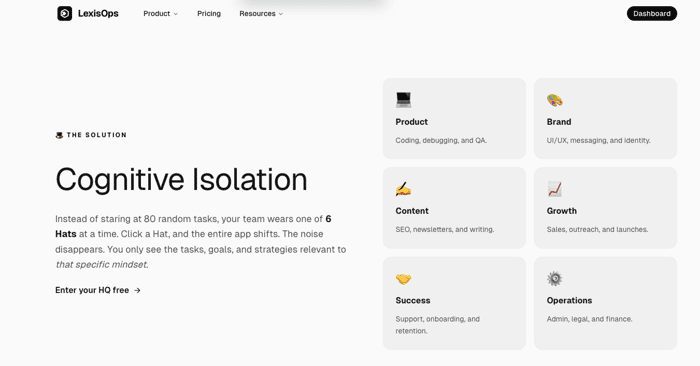
The "Hat" System (Cognitive Isolation)
Instead of looking at one giant list, the app separates your day into 6 "Hats" (Product, Marketing, Support, Ops, etc.). When I click into the "Product" Hat, marketing tasks literally do not exist on my screen. It forces me to stay in one mental mode at a time. -
Brain Dumps over Data Entry
When my brain is a mess, I just use a capture tool to dump a messy paragraph of half-formed thoughts (e.g., "Need to fix the hero text, also email Sam about the demo, and update the privacy policy"). The app runs in the background to extract the actual actionable items and auto-sorts them into the correct Hats so I don't have to manually categorize anything. -
Goals over Folders
I removed nested folders and sub-projects completely. Everything is just tied to a specific Goal. If a task doesn't serve an active goal, it shouldn't be on the list.
Basically: dump your messy ideas and plans, let the app instantly structure them into organized tasks, and then export them right back into your favorite project management tool.
I’m sharing it here because I know this community acutely feels the pain of wearing every hat in a business. I'd love to know if this workflow resonates with how you build, or how you personally manage the day-to-day chaos without getting overwhelmed.
Any honest feedback is hugely appreciated!

The “Hat” framing is stronger than the task manager framing.
Most founder tools try to organize work.
You’re trying to reduce cognitive bleed.
That’s a much more painful problem.
The interesting part is not “AI organizes tasks.”
It’s that you’re removing the psychological cost of seeing unrelated responsibilities at the same time.
That’s why the Product Hat example works immediately.
The moment marketing disappears, the brain stops negotiating priorities.
I’d lean harder into that angle because “execution companion” still sounds slightly soft for what the product is actually doing.
You’re not helping founders track work.
You’re helping them preserve mental continuity.
That’s a much sharper category.
Also: LexisOps explains the ops side, but it slightly undersells the psychological side.
If the product evolves further into founder cognition / execution infrastructure, something like Xevoa.com would probably carry the long-term positioning better.
Thank you so much for your feedback.
Ozan, one thought since this thread stuck in my mind.
The strongest issue with LexisOps was not only the name. It was the category tension: task operations versus founder mental continuity.
If you are still shaping the product, that is worth pressure-testing before more landing copy, onboarding, and user feedback lock it into the wrong frame.
I’m doing focused naming/positioning audits for early products now. For LexisOps, I’d specifically look at:
whether the current name makes people expect an ops/task tool
how to frame the “Hat” concept more sharply
whether the product should be positioned around mental continuity, execution infrastructure, or founder focus
where the name may limit the product if it grows beyond task management
what stronger naming/domain direction would fit the serious version
It is not a long consulting thing. Just a sharp written breakdown with practical recommendations.
I’m doing a few at $99 while refining the format. If useful, connect here and I can give you a clear outside read:
https://www.linkedin.com/in/aryan-y-0163b0278/
Of course.
The main thing I’d pressure-test is whether LexisOps still fits once the product is more about founder mental continuity than task operations.
If it stays ops-focused, the name works.
If it becomes execution infrastructure for how founders think and move through work, the name may start feeling too narrow.