I got tired of guessing which traffic actually pays, so I built cookieless analytics with revenue attribution
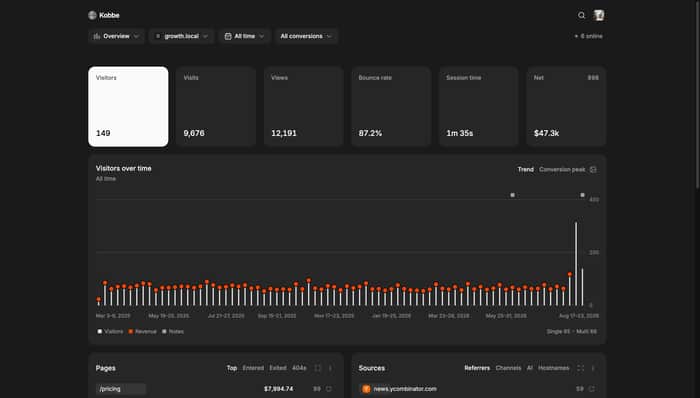
TL;DR: I built cookieless web analytics that shows which pages and traffic sources actually generate revenue, not just visits. Live demo, no signup: https://app.kobbe.io/demo/kobbe-studio
Hey everyone,
For years I ran privacy-friendly analytics on my own projects, and every month I hit the same wall: I could see a spike from some referrer, but no idea if those visitors ever paid me. When a sale came in, I'd manually cross-reference Polar timestamps with my traffic dashboard to guess where the buyer came from. It never really worked.
The tools that do answer that (GA4, Mixpanel-style setups) come with cookies, consent banners, and a data model I didn't want to force on my visitors. So I built Kobbe: https://kobbe.io
How it works: you add a 1.8KB script tag and connect your payment provider via webhooks (Stripe, Polar, Paddle, Mollie, Shopify, and a few others). Paid orders show up next to your traffic: attributed revenue per landing page and source, first/last-touch or linear credit, touches before purchase, median time to purchase.
The privacy part I cared most about: no persistent browser-side identifiers at all for normal analytics. Checkout attribution is opt-in and tab-scoped only, so no long-lived visitor profiles. Raw IPs are never written to the analytics database — same-day uniques come from a daily-rotating anonymous hash that can't be reversed or linked across days. GPC and Do Not Track stop the tracker before any request is sent. To be upfront: it runs on Cloudflare Workers, so requests are processed on Cloudflare's global edge. The company itself is EU-based (Åland Islands, to be exact).
Beyond that it covers the usual: realtime, funnels, custom events, UTM campaigns, Search Console integration, and AI-referrer grouping (ChatGPT, Perplexity, etc.).
Pricing is event-based from $8/month, all features on every tier.
Happy to answer questions, especially on the attribution model and where cookieless tracking has limits.
Mike

The revenue attribution angle is the strongest part here. It turns analytics from “who visited?” into “which traffic actually produced revenue?”
The problem you solved isn't "which tool has the most data." It's measurement latency.
You were doing manual timestamp cross-referencing between Polar and your analytics — that's probably 1-2 days of lag (or weeks if you checked sporadically) before knowing "traffic from X actually paid." The mental model was fuzzy, so distribution channel decisions defaulted to hunches.
Now it's: visitor lands, buys, you see it attributed same-day. That collapses latency from days to hours. Same amount of data exists in both systems, but the compression of latency to real-time changes what you can actually do with it.
That's the entire difference between "I ran some marketing experiment" and "I know which marketing channel matters." One has feedback loops tight enough to learn. The other one doesn't.
The cookieless part is good design, but the real product is the latency collapse. You're not building an analytics vendor. You're selling iteration speed by making the cost of measuring attribution cheap enough to look at the next day instead of the next quarter.