I handed my content marketing to agents. 6 months later organic traffic is 34x.
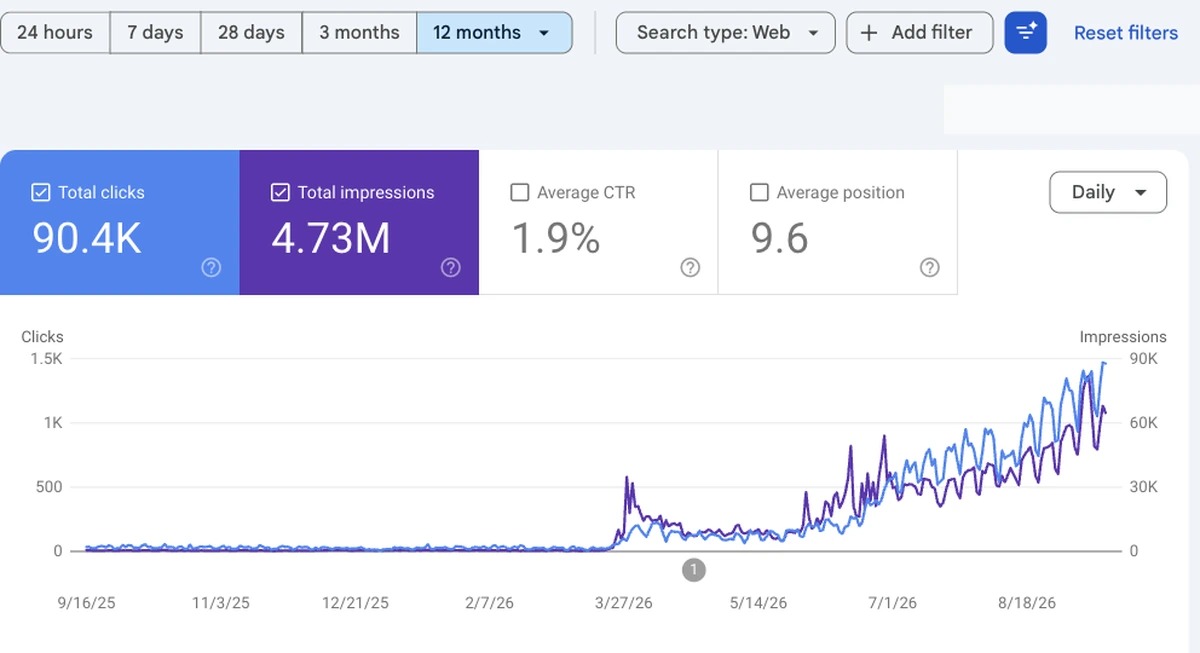
That's Search Console for the last 12 months on a site I've run for years. Everything flat on the left is before February.
I'm solo on this. I haven't written, researched or edited a single one of the articles that did it.
Here's what the six months actually looked like, including the two months I wasted.
What the setup is
The site publishes 200 articles a day now. It put out 200 today, and there are just over 23,000 live.
I've been doing SEO for 22 years, so the pipeline isn't anything clever. It's what I would do by hand for one article: pull market research from Google Ads data, settle on a keyword, fetch the top 10 results and read what they cover, then write something that covers all of it and adds what none of them bothered with.
The only change is who does it. That work now runs as agents, end to end.
The first two months were a write-off
Of everything published in April, 53% never got a single impression, even after 60 days. Researched, covered, shipped, and more than half of it might as well not exist.
My first guess was that Google could tell a machine wrote it. Wrong. I pulled index status on the dead pages and 66% were indexed normally. Not rejected. Indexed, and nobody was searching for them.
So I checked all 1,412 dead pages for any adjacent keyword doing 100 to 2,000 searches a month. Found one for 158 of them. Eleven percent. The rest were sitting in a vacuum.
The pipeline was fine. I'd pointed it at keywords that were too big. Cover the top 10 for a competitive term and you land at position 11, and position 11 gets you nothing. Doing that a thousand times doesn't change the arithmetic.
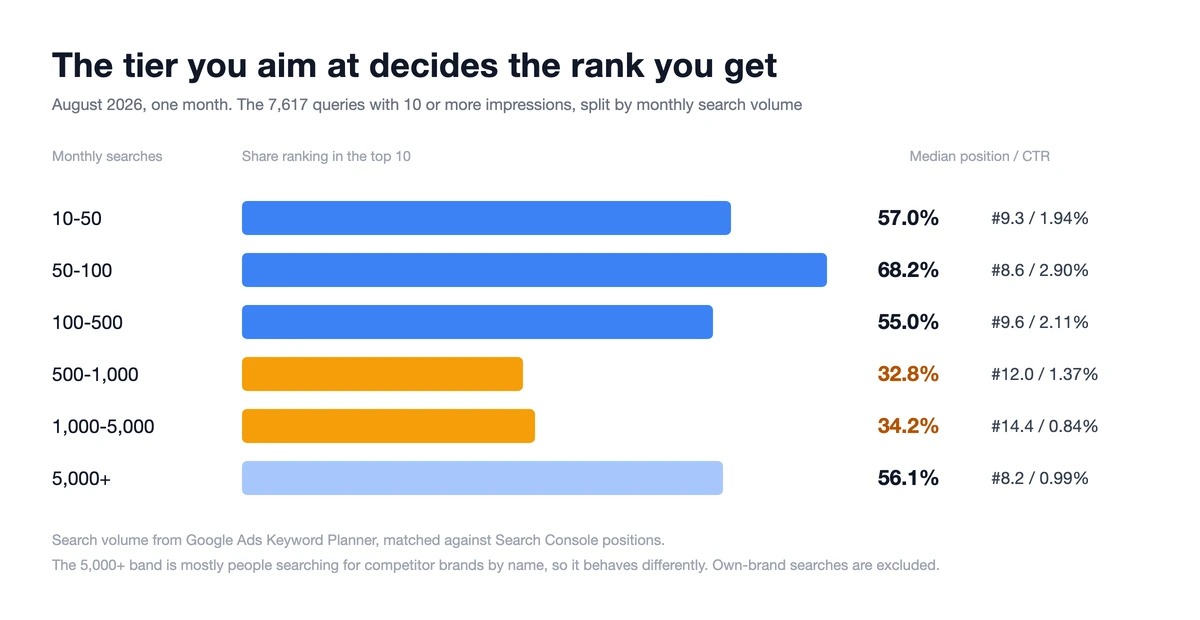
At 1,000 to 5,000 searches a month, my median position is 14.4 and only 34% of those queries reach the top 10. At 50 to 100 searches a month, median is 8.6, 68% are in the top 10 and CTR is 2.90%, the best of any band.
From June I kept every step and only moved the target down. Zero-impression rate went 53% in April, 35% in May, 25% in June. Same agents, same pipeline.
What that does to the business
With February as 1:
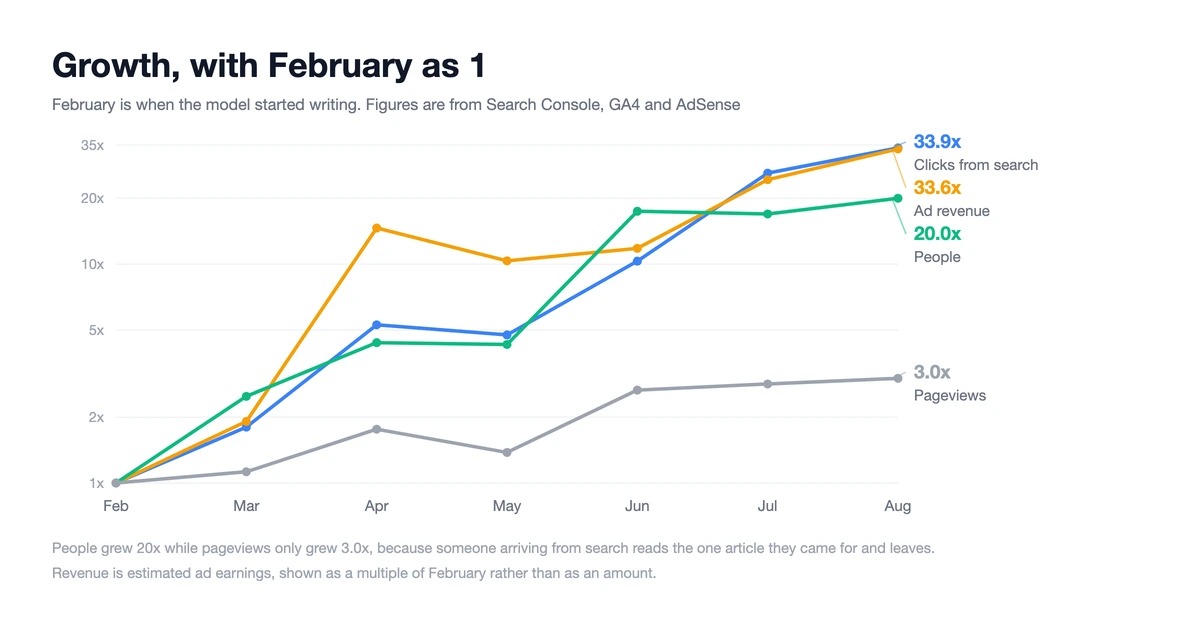
Clicks from search, 33.9x. Ad revenue, 33.6x. People on the site, 20.0x. Pageviews, only 3.0x.
Revenue tracked clicks almost exactly, so the value of a click held up while the volume went up 34 times. Nothing got diluted. September had passed the whole of August by the 16th.
The pageview line is the one founders ask about. People grew 20x and pages grew 3x, because someone arriving on a long tail query reads the one article they came for and leaves. The site went from 12.4 pages per person in February to 1.9 in August. This audience does not browse. That was fine, because each article answers exactly one question and the monetisation on it is relevant to that question.
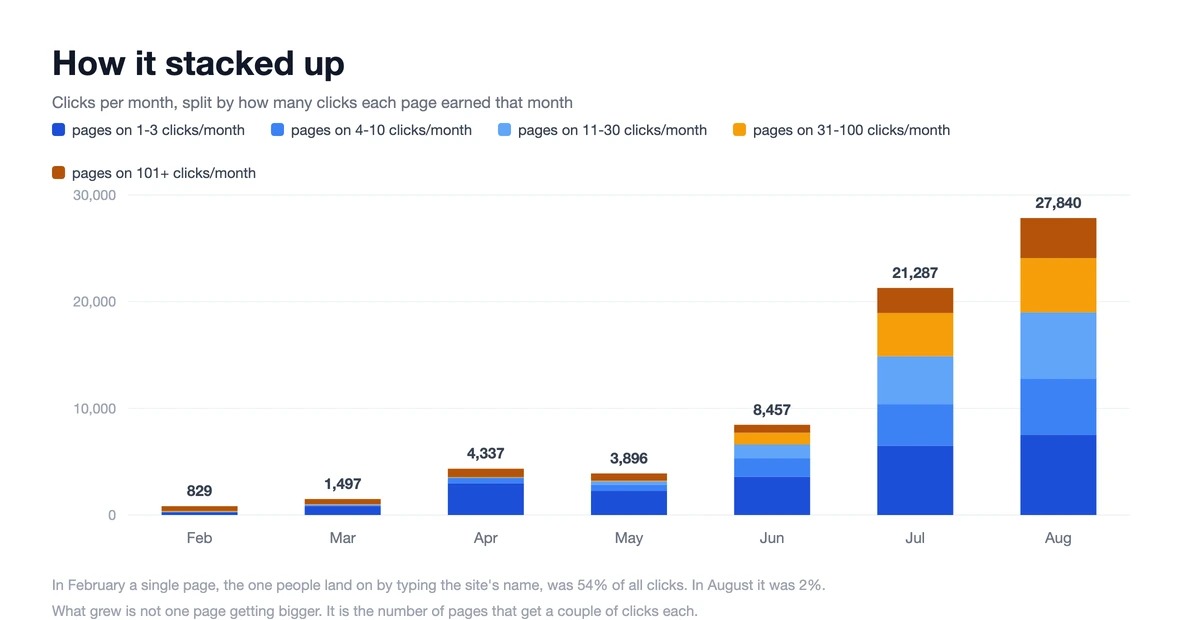
In February, 209 pages on the whole site got a click, the top 10 took 70.9%, and one page by itself, the one people land on by typing the site's name, was 54% of everything. All head, no body. By August, 6,839 pages got a click, the top 10 took 10.1%, and the biggest single page was 2%. If any one page vanished tomorrow I could not tell from the numbers.
The traffic number is not really the interesting bit to me. Nothing in it is load-bearing any more, which is a very different position to be in than having one page carry the site.
The thing I wasn't expecting
Up to March this site had never once had a link exchange request. Not one, in years.
Once the blog section existed and the articles piled up, they started coming in almost daily. I've never done outreach and I've never run a link building campaign. Adding a blog was the whole intervention.
And it's not who I'd have guessed. Companies much bigger than mine, listed companies, law and accounting firms, the kind of organisation that would not have taken my call a year ago. Almost nothing from the link farm end. Whatever a stocked blog signals, the people whose job is to vet a site before linking to it are reading it as legitimacy.
Half of this is deletion
Nobody talks about this part and I think it matters more than the publishing.
28 days with zero impressions and a script redirects the topic. 56 days and it sets the page noindex and drops it from the sitemap. That runs every morning without me. On August 19 it removed 1,601 articles in one pass and I found out from the log.
If you only ever add, the share of your site that is dead climbs forever, and that ratio is the thing a spam system can actually see. Raw volume tells it very little.
What my job is now
Choosing which tier to aim at, and signing off on what gets cut, is not automated and it isn't going to be. That part has to be argued out against the numbers, and an agent on its own has no stake in the answer.
In practice: every morning the agents report in. What got impressions. What has gone 28 days with nothing. What the retarget queue is holding, which is 2,418 articles as I write this. I read that against the KPIs, we talk through what it means, and I decide what the next batch is about.
So the job is one decision a day, off a report I did not compile, about work I am not going to do. It took a while to stop feeling like I was skiving.
Next thing I want to fix is that retarget queue. 2,418 is more than I am getting through and it has been growing for weeks, which means there are a few hundred articles sitting at zero that could probably be pointed somewhere useful. I have not worked out how to make that decision faster without handing it over, and I do not want to hand it over.

The scale is impressive, but the retarget queue sounds like a routing problem more than a writing problem.
I’d group the 2,418 pages using signals you already collect—topic cluster, keyword tier, article age, index status, first-query impressions, and SERP volatility. Review a small sample from each group, then give that group one route: target a reachable long-tail variant, consolidate into a stronger existing page, or retire it.
That keeps the final call human, while turning thousands of page-by-page decisions into a handful of repeatable policies. I’d also track whether each retargeted group earns impressions or clicks after 28–56 days, otherwise the queue will refill without teaching the system anything.
The deletion schedule is the part I want to steal. I am at the opposite end of the authority spectrum and it applies even harder there.
DA 3, ten referring domains all scrapers, four visits a month. Every page at zero impressions is actively diluting the crawl budget that might get one good page seen. You can afford a 1,601-page cull when thousands of others pull clicks. I would be cutting from maybe 40 pages, so the discipline has to start before publication.
Your April-to-June zero-impression drop, 53 to 25 percent, by moving the keyword tier down is the cleanest experiment I have seen on targeting versus quality. Same pipeline, same agents, same domain. Only variable is which queries you aimed at. That falsifies the objection that AI content is penalised, because the content did not change.
Does your 28-day retarget script check whether the page was crawled, or just whether it got impressions? Never fetched is a different problem from fetched-indexed-and-ignored.
The retarget queue is the interesting question, and there is a second axis you can sort it on that costs nothing to compute.
First split the 2,418 by impressions, because two different defects are sitting in one bucket. Zero impressions is a targeting miss and your existing tiering already fixes it. Impressions with zero clicks is a title and intent problem, and retargeting the keyword will not touch it.
Then sort the rest by whether the answer can be inlined. We measured this on two sites this month. One carried 87,400 Copilot citations over 90 days and zero sessions attributable to an AI source, because every top cited page was a review or a pricing comparison, which an answer engine reads out in full and the reader is finished. The pages that turned a citation into a visit were the ones whose value cannot be carried inside the answer: setup guides, live comparisons, anything with a tool or an input on the page.
So for 2,418 articles, rank by how inlineable the answer is and work the non-inlineable ones first. An inlineable page sitting at zero will still be at zero after you retarget it, because the click was never available to win. That also reads on your own numbers: 12.4 pages per person down to 1.9 is what one-answer-per-page looks like, and it is fine while ads are the monetisation, but it means every page has to earn its click on the way in rather than from the page next to it.
Caveat: two sites, neither publishing at your volume, so it is a lead and not a law.
The other thing your post surfaces and does not measure is the inbound. Link exchange requests from listed companies arriving daily, after years of none, is a channel you have opened and are not instrumenting. If you want a free read on the channels the blog is now earning attention on, contentmation.com/score runs a pass with no login. At your scale it will tell you nothing new about search, which is most of your traffic, so it is only worth the minute for the rest.
I'm testing And copy pasted my agent to see if it works. for my b2b
Two things stood out. First, "the tier you aim at decides the rank you get" is a cleaner way of saying what most SEOs learn the hard way: scaling output without tiering is just burning index budget. Your April to June pivot, from 53% zero-impression pages to actually ranking, is a great case study in that.
Second, the link exchange requests from listed companies feel like the real moat forming. The 34x traffic is the headline, but inbound interest from much bigger companies means the library is becoming a reference asset that compounds on its own. I'd track that inbound-request rate as its own KPI - it's a leading indicator that the content has crossed from "indexed" to "authoritative."
This is the measurement visibility problem at scale - you handed off the work but now have to measure what the system is actually doing. The 34x traffic number is powerful because it's observable, but most teams using agents for content never set up the instrumentation to catch what worked. Measuring agent outputs backwards from actual user behavior is the only way to know if you're running agents or they're running you.
The deletion system may be the most valuable part of this, but I’d keep a small control group before trusting the 28/56-day rules completely.
Leave perhaps 5–10% of zero-impression pages untouched for another 60 or 90 days, grouped by keyword tier and index status. Then you can see how many would have surfaced naturally versus how many remained dead.
Without that holdout, pruning and growth happen together, so it is difficult to separate the value of deletion from the improved keyword targeting. It would also tell you whether different tiers deserve different expiry windows.
The 2,418-page retarget queue is more interesting than the 34x traffic. How do you decide which pages deserve another target versus deletion?