I just open-sourced my new project: Kumbukum
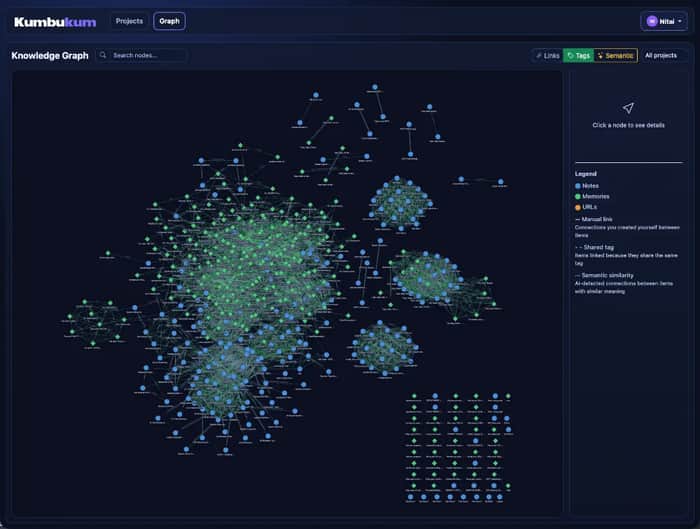
After building with AI tools every day, I kept running into the same problem:
They're great at reasoning, but terrible at remembering.
Important context kept getting lost across sessions:
• decisions
• notes
• links
• small learnings
• project-specific knowledge
So I built Kumbukum — an open source memory infrastructure for teams and AI tools.
It lets you store, retrieve, and connect:
• notes
• memories
• URLs
• relationships between them
• Git sync
• and I'm currently adding email, too
It works with MCP-compatible tools, so assistants can pull the right context instead of starting from scratch every time.
For me, the important part is that this infrastructure stays readable, manageable, and editable by you and your team. You can add, update, or remove anything yourself with a beautiful design.
What I wanted was something practical:
• shared memory for teams
• inspectable and editable
• usable across tools
• self-hostable
• not another black box
So I open-sourced it.
If you're working with AI agents, MCP, or just trying to stop the "same context every session" loop, I'd love your feedback.
Website: https://kumbukum.com
GitHub: https://github.com/kumbukum/kumbukum
Happy to answer questions or hear how you're handling memory and context in your setup.

Nitai, solving the "AI amnesia" problem by building an open-source, MCP-compatible memory infrastructure is a massive unlock for team productivity. By ensuring context is inspectable, editable, and self-hostable, you're moving past the "black box" limitation and allowing collective knowledge to actually compound across sessions.
I’m currently running Tokyo Lore, a project that highlights high-utility logic and validation-focused tools like yours. Since you’re building the definitive infrastructure for persistent AI and team memory, entering Kumbukum could be the perfect way to turn your own validation journey into a winning case study while your odds are at their absolute peak.
Yes, I'm not trying to win the best coding trophy or build the most sophisticated system according to "standards", but a fully capable system that works. For me, this is creating a scalable system with semantic search, a database, and a nice UI. If I can help you in any way, let me know.
That’s a solid approach — “works + scalable” beats over-engineered any day.
The semantic search + inspectable memory angle is especially strong.
Would actually be great to explore this a bit deeper — especially how you’re structuring memory (granularity, updates, pruning, etc.).
Also happy to share thoughts on positioning/use cases if that helps 👍
See my reply to you in teh pther treath :)