I Keep Running Into Other People Solving the Exact Same Problem We Are. Here's What That Actually Tells Me.
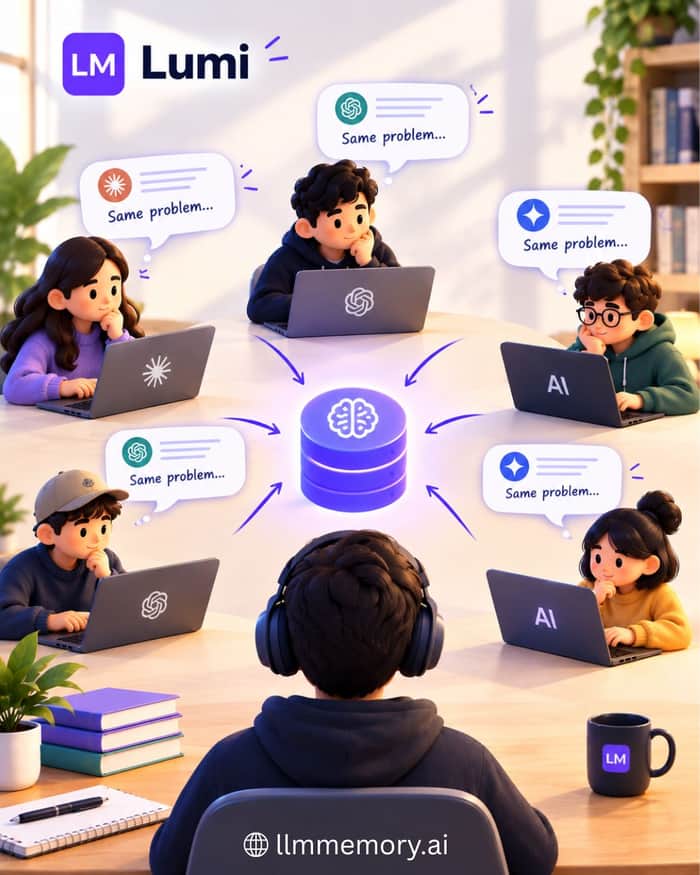
Spend enough time in Reddit threads about AI memory and you start noticing something: it's not just us. Someone posts about switching between ChatGPT and Claude, and in the replies there's always at least one other person who built their own memory layer to solve it. Different names, different implementations, same exact problem statement almost word for word.
First instinct was mild panic, more competition than I realized. Second, more useful thought: when multiple independent builders keep arriving at the same problem without knowing about each other, that's usually a signal the problem is real and underserved, not a signal to back off.
What's actually interesting is how similar the framing always is. Nobody describes it as "I want a memory product." It's always "I got tired of re-explaining myself" or "the built-in memory only works in one app." The problem gets discovered the same way every time, through friction, not through market research.
Practical takeaway, if you're building something and you keep finding other people building the same thing independently: that's not proof you're too late. It's closer to proof the timing is right and the category is still being defined, whoever nails the execution and distribution wins, not whoever thought of it first.
Anyone else been in a space that suddenly feels crowded and had to decide whether that's a red flag or a green one?

The reframe you're describing — from "there's competition" to "multiple independent builders arriving at the same problem is proof the problem is real" — is one of the most useful mental shifts for early-stage founders. Independently converging on the same pain point without coordination is actually one of the strongest signals you can get. What usually separates the winner from everyone else is distribution and positioning, not the idea itself. Keep going.
Spot on! In the beginning, finding others solving the same problem feels like a panic moment—like you're already behind. But you're so right, it’s actually the ultimate green flag that the pain point is real and people are actively looking for a better way. Execution and distribution are what truly separate winners. Great perspective!
I used to think finding competitors was automatically bad news. Now I almost see it as validation that the problem is real.
The part that matters is whether you can find a sharper angle: a different customer segment, better onboarding, a simpler product, or a stronger distribution channel. Competition doesn’t necessarily kill an idea. Sometimes it just forces you to be clearer about why your version should exist.
Seeing competitors solving the same problem can actually be reassuring rather than discouraging. It means there is probably a real pain point and enough demand for multiple people to notice it independently.
The important question becomes less “Does someone else already do this?” and more “Why would a certain type of customer choose us instead?” Sometimes the difference can be positioning, distribution, simplicity, integrations, customer service, or focusing on a very specific audience. I think founders sometimes abandon good ideas too early because they discover competitors, when in reality the absence of competitors can sometimes be a bigger warning sign.
yeah
The repeated problem statements are useful, but do the users actually want the same memory workflow, or are you seeing several different jobs hiding behind the same complaint?