I kept misjudging how people would react to my ideas. So I built a tool to test it first.
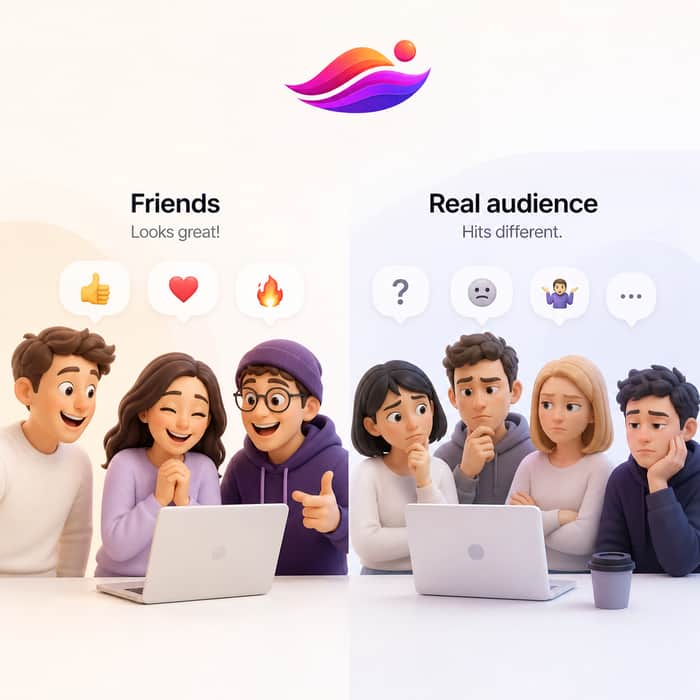
I kept running into the same problem.
I’d spend time on a design, a post, a creative, or even just a simple idea. I’d show it to a few people, get positive feedback, and feel confident about it.
Then I’d put it out there and the reaction would be completely different. People would misunderstand it, focus on the wrong thing, or just not care at all.
After a while it became obvious what was happening. I wasn’t really testing anything. I was just validating ideas with people who think like me.
So I built something to try a different approach.
It takes a single idea, message, or creative and shows how different types of people might react to it. Not one answer, but a range of perspectives based on different backgrounds and mindsets.
I’ve been using it to test:
product ideas
ad creatives
thumbnails and posts
even decisions I wasn’t sure about
Sometimes the differences are small. Sometimes they completely change how you see the same thing.
If anyone wants to try it, you can drop something here and I’ll run it through and share the results.
Or you can try it directly:
https://viberoom.io

Sorry I forgot to post the link https://viberoom.io/share/lZk1sJNL3ijETFsNqHS7DjLtHRbaZilp
This is one of those ideas that sounds simple at first, but the more you think about it, the more use cases you start noticing. Curious to see where this goes.
Totally agree!
The interesting part here is not whether people “like” the idea.
It’s whether different audiences misunderstand it in completely different ways.
That’s usually where products quietly fail.
Most founders validate with people who already share their assumptions, vocabulary, risk tolerance, and taste. So they think they’re testing reaction, but they’re really testing familiarity.
The moment the same message gets interpreted differently by different psychologies, you start seeing where positioning breaks.
That’s why this feels more useful for messaging than “idea validation.”
You’re not testing if the idea is good.
You’re testing whether perception stays stable across audiences.
That’s a much more expensive problem than most founders realize.
Also: Viberoom is interesting, but it still sounds slightly entertainment/social-first.
If this evolves deeper into decision simulation / perception infrastructure for founders, something like Xevoa.com or Beryxa.com would probably scale harder long-term.
Really thoughtful comment. I think you articulated something most founders underestimate.
People think they are validating an idea, but in reality they are often validating a shared set of assumptions inside a familiar bubble.
The dangerous moment starts when the same idea gets interpreted completely differently by different types of people with different experiences, psychologies, and attitudes toward risk. That is usually where positioning quietly breaks without the founder even noticing it.
That is why I have been thinking less about “idea validation” and more about perception stability across audiences. A product can make total sense and still fail if every audience reconstructs a different version of what it is.
And yes, I agree about the current perception of VibeRoom. From the outside it can still feel a bit entertainment or social first, even though the deeper direction is much closer to decision simulation and perception infrastructure.
Have you personally run into situations where a product felt completely clear inside the team, but the audience interpreted it in a totally different way?
Yes, and it usually happens when the internal team names the product around how they understand it, not how the market first receives it.
Inside the team, “VibeRoom” may mean simulated audience reaction or perception testing.
Outside, people hear “vibe” and “room” and naturally place it closer to social, entertainment, community, or content.
That gap matters.
Because if the first frame is wrong, every explanation after that is doing correction work.
For your direction, the stronger frame is not “room.”
It is perception stability, decision simulation, and audience interpretation.
That feels much closer to infrastructure for founder judgment than a social product.
That is why I’d pressure-test Xevoa or Beryxa seriously if you’re building beyond the current entertainment read.
That is actually part of the reason I intentionally did not position it as something overly serious or enterprise-first.
I think the social and everyday-use potential is much bigger than just “startup validation.”
People can test almost anything:
ideas, messages, ads, awkward conversations, positioning, creative concepts, landing pages, even small daily decisions where they just want a better sense of how something might be perceived.
I also see the strongest fit not with giant corporations, but with small groups and independent professionals: designers, marketers, freelancers, creators, small business owners, people running ads, building small brands, pitching clients, posting content, etc.
For example, a freelancer running Google Ads or Instagram campaigns could quickly test which messaging angle feels more convincing before spending money on traffic.
Huge companies already have budgets for large-scale research, surveys, focus groups, analytics teams, and internal tooling. Simulating reactions from 20 or 30 personas is probably not that valuable for them.
What interested me more was making this kind of “perception testing” accessible to individuals and small teams that normally have zero access to audience research at all.
There are millions of people making small but important communication and positioning decisions every day without any feedback loop.
That makes sense.
If the market is individuals and small teams, then I would not force it into an enterprise frame either.
But I still think the same naming issue exists.
The product is not really “social.”
It is helping people reduce uncertainty before they publish, pitch, spend, or decide.
That is a much stronger category than “vibe.”
Creators, freelancers, marketers, and small business owners are not buying a room.
They are buying confidence before exposure.
That is the frame I’d protect.
So the name does not need to sound corporate.
But it does need to signal:
test perception
reduce uncertainty
avoid costly misreads
If VibeRoom keeps making people think social/entertainment first, it may attract attention but still blur the real use case.
I think the entry point is much more emotional and intuitive than “research platform.”
Most people are not thinking:
“I need synthetic audience analysis.”
They are thinking:
“How will people react to this?”
“Will this sound stupid?”
“Why does this ad feel off?”
“Would this message annoy people?”
“Does this idea make sense outside my own head?”
That emotional uncertainty is probably the real starting point. The research aspect comes later.
Mike, one thought after sitting with the VibeRoom thread.
The strongest unresolved point is not whether the product should feel casual or serious. I think you were right that the entry point is emotional and everyday-use driven.
The real question is whether VibeRoom makes people understand the buying trigger fast enough:
“Will this be misunderstood before I publish, pitch, post, or spend?”
That is stronger than social, research, validation, or vibe-testing.
If useful, I can do a focused naming/positioning audit around this exact issue: current name perception, category framing, first-line positioning, buyer trigger, and whether VibeRoom can carry the product without people mentally filing it as entertainment/social first.
Not a long consulting thing. Just a sharp written breakdown you can use before more landing copy, examples, and user memory build around the current frame.
I’m doing a few of these at $99 while refining the format.
If useful, connect here and I can give you a clear outside read:
https://www.linkedin.com/in/aryan-y-0163b0278/
Exactly.
That emotional uncertainty is the real wedge.
People are not buying “research.”
They are buying relief from the risk of being misread.
That is why the name matters even more.
If the product is helping someone ask:
will this land badly
will people misunderstand this
am I about to publish the wrong thing
then the brand has to carry that tension clearly.
VibeRoom captures the casual side, but it may still understate the real value.
The deeper promise is not “come test a vibe.”
It is “know how this will be received before it costs you.”
That is a much stronger buying trigger.