I kept starting projects and dropping them. So I built a system that wouldn’t let me
Hey IH 👋
I probably started around 5 or 6 projects over the last few years. Most of them just stopped.
Not because I ran out of energy or ideas. Because at some point I'd pause and realize I couldn't answer one simple question.
Why this idea?
Not in a vague sense. Why this problem? why this audience? why now? ??
Victor, my co-founder and the engineer behind NicheIQ, was hitting the same wall from a different direction. He'd build something that worked, spend evenings improving it, polish parts nobody was ever going to see. Then stop. Same question, same silence.
We came from opposite sides. I spent years on the finance and business side of early-stage companies, watching founders choose ideas loosely and validate too late. Victor spent years building products and systems, instinct always pulling him toward shipping first and figuring things out as he goes.
Different backgrounds. Identical mistake.
And when we started talking about it, we realized the problem wasn't the ideas. It was that neither of us had a process we actually trusted.
One more thing before you read on.
This post is on me, Lucy. And for me its the hardest part. Really. I used that founders come to me for advise, and its not the same how to promote own product. I handle sales and growth. Victor builds the product. I have never in my life run a social media account or posted anything publicly and honestly my co-founder will not let me hear the end of it if nobody shows up.
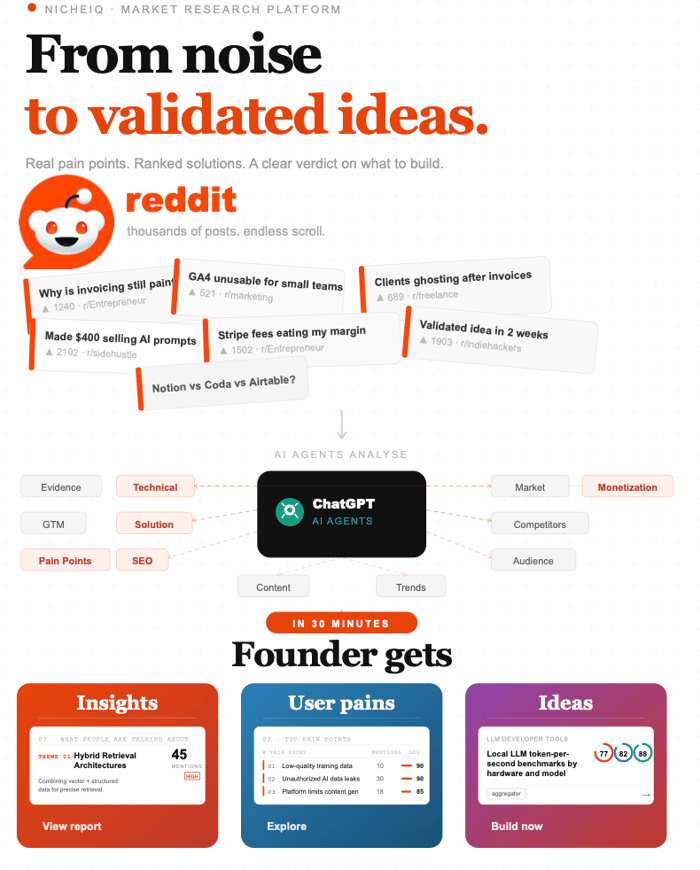
So if nothing else, please just click through. For the partnership. Explore tha Niche Catalog with more than 500+ niche market researched and 1600+ ideas
👉 Welcome https://nicheiq.dev/
How do you validate ideas or monitor a niche you're interested in?

the "why this idea" silence is painfully real. I dropped a bunch of projects the exact same way, you get two months in and realize you never had an answer, just momentum.
what fixed it for me wasnt better ideas, it was forcing a checkpoint BEFORE writing code. put the idea in front of strangers and watch what they DO, not what they say. a landing page with a waitlist and 2-3 survey questions attached does this brutally well, if people wont even leave an email and answer "whats your biggest pain with X" then your why-now question is already answered. I build Lighthouse which keeps that waitlist + survey + follow-up email in one place instead of duct taping Typeform and Mailchimp together (disclosure, its my product), but the tool is not a shortcut, you still have to DM the signups and have real conversations, theres no way around that part.
on niche catalogs, my slightly contrarian take: 1600 ideas is 1599 too many. a catalog cant tell you which problem YOU can stay obsessed with for two years, and thats what actually kills projects, not picking the wrong niche on paper. id rather pick one pain I personally feel and run the waitlist + survey test in a week than browse researched niches for a month
The pattern I've noticed with AI coding tools is similar — easy to start fast, hard to stay consistent.
Cursor and Claude Code are great at generating code. The failure mode isn't the first session; it's session 10, when the AI has quietly started making assumptions that contradict session 1.
The fix: a CLAUDEmd or mdc rules file that defines the project invariants before writing a single line. Not a checklist — actual constraints. What pattern to always use, what to never generate, what to ask before touching. Written once, read on every session.
It's the same idea as your system: the friction isn't starting, it's maintaining direction. The rules file is the direction, written down so you don't have to re-decide it each time.
What's the main thing that caused you to drop projects before — was it losing the thread of what you were building, or something else?
For me it’s less “validate the idea” and more “stress test the assumption behind it.”
If I can clearly point to a specific group already trying to hack a workaround, I keep going. If I’m the one having to convince them the problem exists, I drop it.
For niches, I just watch for repeat friction—same complaint, different people, over time. That’s usually enough signal without overthinking it.
To be honest this a saturated niche, but I hope your saas works
The "why this idea, why this audience, why now" question is brutal honestly. I've been there with projects that felt right until I couldn't answer that and then suddenly the motivation just evaporates. Building something to force yourself to answer that question before you're too deep in is actually smart. The fact that you're both coming from completely different backgrounds and hit the same wall is what makes this feel like a real problem worth solving. Good luck with the launch, going to check out the niche catalog.
The accountability structure is underrated. We've noticed the founders who ship fastest are the ones with an external deadline forcing their hand — whether that's a paying client, a public commitment, or a milestone payment structure. Curious what the system looks like — is it habit-based or tied to external accountability?
First of all, sharing your journey openly is a huge milestone! Your breakdown of the founder’s wall is incredibly relatable. It’s so easy to mistake a lack of a clear, structured validation process for a lack of motivation or technical capability. Seeing a business strategist and a skilled engineer realize they were hitting the exact same wall from opposite sides is a great reminder that great execution means nothing without the right why and who.
Its so good to see you persevere and do a lot of hard work wishing you all the luck for this journey of yours
That question — why this, why now — is the one that killed most of my projects too. Not a lack of ideas. Not even a lack of energy. Just couldn't answer it honestly when it counted.
What I eventually figured out is that the question itself isn't the problem. It's that most of us don't have a system that forces us to answer it before we're already three months in and too attached to walk away.
Your framing around process v instinct is spot on. I've been on both sides of that. Neither works alone.
Good luck with NicheIQ. The niche catalog idea is genuinely useful — there's a real difference between having an idea and knowing whether the ground is solid under it.
The pattern you're describing of starting strong and then losing steam when validation gets fuzzy is something I've struggled with too. Having a structured process forces you to confront the uncomfortable questions before you've invested months of work. I'm curious what your validation process actually looks like step by step. Do you start with the problem interviews or go straight to checking if there's existing demand first?
The dynamic you described between you and Victor really resonated — the business person validates too late while the engineer over-polishes things nobody will see, but they're actually the same mistake from opposite ends. Both are building conviction on assumptions that haven't been tested yet. For monitoring niches, I've found the most reliable early signal comes from where people are already self-organizing: specific subreddits, niche Slack communities, niche newsletters. Does your catalog surface those community signals, or is it more focused on top-down market sizing data?
Hi Lucy! I totally resonate with that 'silence' when asking yourself 'Why this problem?'. I’ve been working on a POS system for a local pizzeria recently, and I found myself in a similar loop: polishing backend details that nobody would see while struggling to balance shipping features with real-world validation.
It’s really interesting how you and Victor are tackling the 'process' gap. I'm currently leaning heavily into building a robust, portable local architecture (SQLite-first) to ensure that even if the business needs change, the product remains solid for the end user.
Great initiative with the Niche Catalog! How do you personally suggest balancing 'building the perfect system' vs 'validating the market' when the technical side starts to get complex?
The question "Why this idea?" has killed more projects for me than technical challenges ever did.
I've found that the strongest validation signal is when people are already actively looking for a solution rather than needing to be convinced they have a problem.
Interested to know whether you've noticed certain niches validating much faster than others.
For validation, I like forcing each idea into one observable behavior before looking at market size: who is already hacking around this problem today, where are they complaining, and what workaround do they pay with time or money? A niche catalog gets more useful if every idea has that evidence trail attached, not just the market description.
Lucy, the moment you described, pausing mid-build and realizing you couldn't answer "why this idea," is one of the most honest things I've read on this forum in a while.
I've been there. With VeloxSync and Meraki Lingua. The energy is real, the code is real, the momentum is real. But if the answer to "why this problem, why this audience" is fuzzy, you feel it eventually. Usually at the worst possible time.
What you and Victor built sounds like the tool you both needed before you needed it. That's usually the best signal that something is worth making.
And for what it's worth, this post landed. First public post, real story, no fluff. That's a harder skill than most founders give it credit for.
Respect for putting yourself out there, Lucy. On the validation question: tools like NicheIQ are useful for sparking ideas, but they cannot tell you which one will pay. The only real validation is collecting money before you build. My rule for the founders I coach: write the offer, send it to 30 people in the target niche by name, and ask for a $50 or $100 deposit. Not 'would you use this'. Not a survey. Actual dollars committed. If 5 people pay, the idea is real. If nobody pays, no amount of niche research saves it. The 'why this idea, why now' question almost always answers itself once someone hands you money. Until then, you are just journaling. Good luck with the launch.
What's the system? Genuinely curious — I've been shipping more consistently since I started treating each project as a 6-week sprint with a hard stop date.
The 'why this problem, why this audience, why now' framing is deceptively hard to answer honestly — and I think that's exactly why so many of us skip it. It's much easier to keep building than to sit with the discomfort of not really knowing if the problem is urgent enough for the right people. What you described about Victor polishing parts nobody would see really resonated; that's a classic signal that the conviction in the idea isn't fully there yet. For your question on validation: the fastest signal I've found isn't a landing page or survey — it's finding 5-10 people actively trying to solve the problem right now and talking to them before writing a line of code. Does NicheIQ surface demand signals from communities and forums, or is it more trend/keyword based?
This is a strong founder pain because the real problem is not lack of ideas. It is not trusting the reason behind the idea enough to keep going when the work gets boring.
That is a sharper angle than “niche catalog.” The product feels more like an early decision system for founders: why this market, why this audience, why now, and what signals are strong enough to justify building.
I’d lean harder into that trust/process layer. A catalog of 500 niches and 1600 ideas is useful, but the bigger promise is helping founders avoid months of building around a weak assumption.
One thing I’d pressure-test early is the name. NicheIQ explains what it does, but it may keep the product feeling like a database of niches rather than a serious market-intelligence layer for deciding what to build next.
Exirra .com would fit that broader direction better if the product becomes about founder signal, niche intelligence, and validation before execution. The product can stay exactly what it is, but a stronger brand shell could make it feel less like an idea list and more like a system founders trust before committing months of work.
Thank you, make a sense!
Glad it landed.
I’d only revisit the naming seriously if you plan to position this beyond “niche ideas” and more as a founder decision/intelligence layer.
If that broader direction is real, then it’s worth pressure-testing before the product gets too tied to NicheIQ publicly.
Thanks