I killed my Chrome extension and rebuilt it as an Arabic-first web app
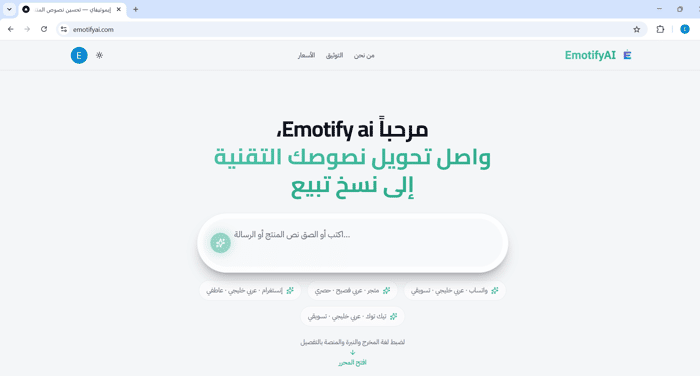
I killed my Chrome extension and rebuilt it as a web app. Here's why.
EmotifyAI started as a Chrome extension. A few months in, I made a hard call and scrapped that form factor to rebuild it as a full web app.
The reason: I kept hitting the same wall. Most general-purpose AI tools are great at English and weak at Arabic, the tone, the nuance, the way people in the Gulf actually make buying decisions. A browser extension was too cramped to solve that well. It forced the product to live inside someone else's UI when the real value needed room to breathe.
So now it's a web app, Arabic-first (English fully supported too). It turns dry, technical product descriptions into copy that actually converts, tuned for Gulf consumer psychology rather than translated-from-English filler.
Where I'm at right now: deep in market research and go-to-market. I have a clear niche (e-commerce store owners on Salla and Zid) but I'm still figuring out the cheapest, highest-signal way to reach them. Currently testing Instagram Reels with a hook built around "95% of your buying decision is emotional."
Open questions I'm wrestling with, and would love input on:
For a non-English SaaS targeting a specific regional market, does build-in-public even translate? Or is the audience here just not on these platforms?
Anyone gone from extension to standalone app? What did you underestimate?
Solo founder, no formal dev background, doing the product, prompts, and marketing myself. Happy to share specifics on the stack or the prompt system if useful.
Would mean a lot to get the feature set torn apart: emotifyai.com

Thanks for writing this, we're early on our own first project and felt that same ceiling living inside someone else's UI.
Genuine question: are Salla and Zid owners even on IH or X? From the little I've seen they live on Snapchat and WhatsApp, so I wondered if build-in-public here validates the story more than the market.
What reply rate are the Reels DMs getting? Rooting for it.
Thanks for the insightful comment! You hit the nail on the head—Salla and Zid merchants are indeed heavily active on Snapchat and WhatsApp.
To tackle this, I decided to run Google Search Ads targeting them directly at the moment of intent. Honestly, it’s been much tougher than expected. Dealing with Google's algorithms, keyword matching, budget management, and continuous optimization requires a ton of focus and rapid decision-making. But I decided to take the hard route, throw myself into the market, and learn by doing.
As for the Reels DMs reply rate: it's actually been great, provided the targeting is laser-focused. When you hit the right segment, the engagement is definitely there. Wishing you the best with your first project!
This feels like the right pivot, Mostafa.
The main risk now probably is not the feature set. It is testing the product in places where the buyer is not actually present, then reading weak response as weak demand.
For an Arabic-first SaaS aimed at Salla and Zid store owners, the GTM test has to prove buyer access, not just content engagement.
I would not solve that loosely in the thread because the answer changes the hook, channel, and first offer.
If you’re open to it, share your email and I’ll put the tighter first-customer path together properly.
Spot on analysis, Aryan! Validating actual buyer access rather than just content engagement is definitely the real test here.
I’d love to hear your thoughts on a tighter path to the first customers. You can reach me at emotifyai@gmail.com. Looking forward to connecting and hearing your insights! Thanks for reaching out.
Thanks! I’ve just sent it over.
Looking forward to hearing your thoughts whenever you have a chance.