12
14 Comments

I launched a project for Indie Hackers who are tired of posting on every network just to be forgotten.

Hi everyone,

We all know the exact feeling. You spend weeks coding, fixing bugs, and polishing your UI. Then launch day comes. You record a great demo video, post it on Twitter, Reddit, LinkedIn, and TikTok... and 24 hours later, itโ€™s completely dead in the feed.

Thousands of Indie Hackers launch every day just to be forgotten by the algorithm. The endless "post and pray" cycle is exhausting, especially when you are a solo developer.

But recently, I realized the rules of the game have changed. People aren't just Googling for new SaaS tools anymore; they are asking Perplexity, SearchGPT, and Gemini. The shift from traditional SEO to GEO (Generative Engine Optimization) is already here.

However, there is a massive bottleneck for us builders: Short-form videos and visual demos are a black box for AI models.

LLMs cannot "watch" your Reel to understand your software. If they can't read the context of your video, they can't index it. And if they can't index it, they will never cite your project when a user searches for your exact solution.

Thatโ€™s why I built OrionReel.

๐Ÿ‘‰ https://orionreel.com

I wanted to build a way to stop dying in the feed and start injecting our startups directly into AI memory. OrionReel is an AEO (Answer Engine Optimization) platform built specifically for this transition.

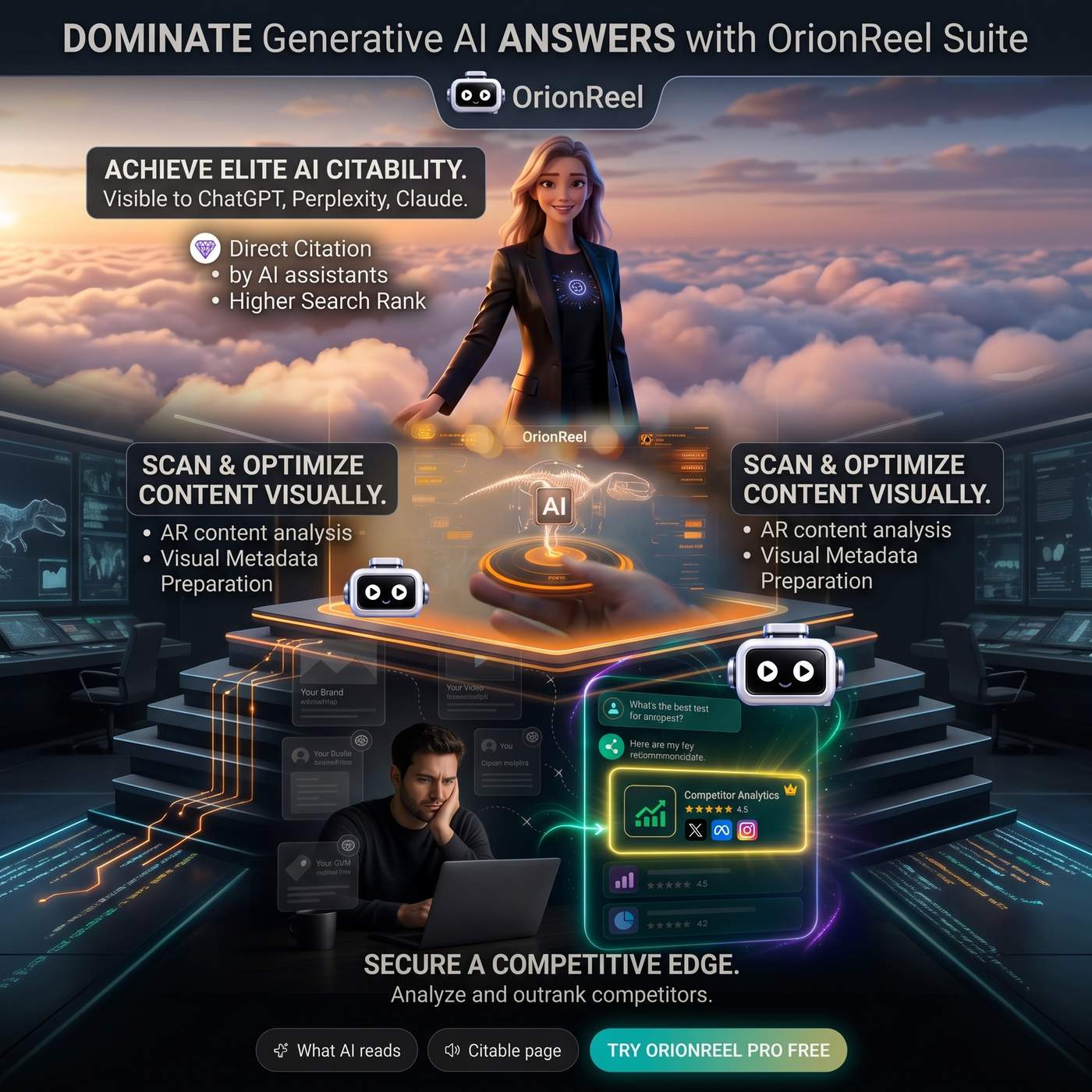
Instead of just hosting a standard video that disappears tomorrow, OrionReel deconstructs your short-form content into a 3-in-1 citable knowledge packet:

The Video Stream (for human engagement).

The UI Pictures (for visual context).

The Semantic Text Layer (for AI indexing).

Every post you make carries a structured, machine-readable data layer that explicitly tells LLMs what problem you solve, who your tool is for, and what your demo is showing.

My goal with this platform is simple: Ship once, stay indexed forever.

I just launched the MVP, and I wanted to share it here first because no one understands the pain of distribution and the struggle of getting eyes on a project quite like the Indie Hackers community.

I am still figuring out the best direction for the platform, and I would love your brutally honest feedback. Does the concept of AEO make sense for your current marketing stack? Would you take an extra 2 minutes to add a semantic layer to your demos if it meant being permanently citable by AI engines?

The platform is live and completely free to try. If you have a project demo ready, feel free to upload it and create your first GEO-indexed unit.

Thank you for reading, and for always being a community that pushes builders forward. ๐Ÿš€๐Ÿš€๐Ÿš€๐Ÿš€๐Ÿš€๐Ÿš€๐Ÿš€๐Ÿš€๐Ÿš€๐Ÿš€

posted toAvatar for product OrionReel
OrionReel
  1. 1
    The part Iโ€™d watch closely is whether โ€œlasting beyond the feedโ€ becomes a measurable outcome for users. If someone can see that an old demo is still getting discovered or cited weeks later, that feels much more tangible than AEO as a concept. The product gets really interesting when the semantic layer produces visible distribution after the original post is already dead.
    1. 1
      Exactly the outcome we're building toward, and it's why we lead with measurement instead of the "AEO" buzzword. Every post has a live evidence ladder: Machine-readable, Crawled, Multi-sourced, Retrieved, Cited, built from real server-side crawler logs, not vanity metrics. So you can literally watch an old post keep getting fetched by GPTBot, PerplexityBot, Google and others weeks after the feed moved on. We even expose it as a public read API, so it's auditable, not a marketing claim. The reason it works: OrionReel is a low-noise, zero-algorithm lane built so LLMs can read and recommend content with almost no friction. Every post ships 3-in-1, the video for humans plus a structured citable layer (transcript, JSON-LD, intent Q&A) for the machines. No 24h feed war, no algorithm to game. That clarity is why crawlers glide through and keep coming back, and "lasting beyond the feed" becomes something you watch happen per post, in real time. Being honest: we count verified crawler retrieval, we don't pretend to guarantee a specific model will cite you. That distinction is the whole point.
  2. 1

    Love the problem you're solving here! Being forgotten after spending hours drafting posts on X/Reddit/LinkedIn is so frustrating.

    How are you handling platform-specific tone? I've found that generic cross-posting usually gets ignored because Reddit hates PR-speak, while X loves bullet points. Finding that balance for authentic engagement is super tough. Wish you luck with OrionReel!

    1. 1
      Appreciate it. Quick clarification that actually helps here: OrionReel isn't rewriting your posts for each platform's human tone. The layer we generate is for the machines, transcript, JSON-LD, intent Q&A, so AI assistants can read and retrieve your content correctly. You still post to humans in your own voice wherever you want. The whole thing is a low-noise, zero-algorithm lane built for the machines: no feed war, no algorithm to game, just clarity and structure they can glide through. That's exactly why the crawlers read it and keep coming back. So the "Reddit hates PR-speak" problem stays in your hands, which is honestly where it should be. Think of it as the machine-readable twin of your content, not a cross-posting tool.
  3. 1
    This is exactly the wall I hit yesterday โ€” posted everywhere (PH, LinkedIn, X) and only IH gave me any real engagement. What's the project actually doing โ€” cross-posting automation, or something more about tracking what's working?
    1. 1
      Neither cross-posting nor plain analytics, and that's the point most tools miss. OrionReel is a low-noise, zero-algorithm lane built so LLMs can read and recommend content with almost no friction. Every post ships 3-in-1: the video for humans, plus a structured citable layer (transcript, JSON-LD, intent Q&A) written for the machines. No 24h feed war, no algorithm to game. That clarity is exactly why crawlers glide through and keep coming back. And you don't have to take my word for it: the crawler log is a public read API, verified server-side. Have a look: https://orionreel.com/api/crawlers . Post once, then see who's actually reading it instead of praying to a feed.
      1. 1
        Huh, that's a genuinely different angle than what I expected โ€” hadn't thought about optimizing for LLM crawlers specifically as a distribution channel separate from human feeds. Checked the API link, interesting to see it's actually verifiable server-side instead of just a claim. Is this mainly useful once you already have content publishe
  4. 1
    The bigger question for me is whether founders see AI visibility as important enough to add another step to their publishing workflow. Iโ€™d be curious whether your early users are already actively trying to get discovered through AI search, or whether the semantic layer itself is what makes them interested in AEO. That seems like an important distinction for the positioning.
    1. 1
      Great distinction. Right now it's the second group people don't wake up wanting "AEO," they feel the pain of great content dying in a 24h feed. The semantic layer is the hook because it's automatic: you post like normal, we generate the machine-readable layer (transcript, JSON-LD, intent Q&A) so it's zero extra steps. The AI-discovery upside is what makes them stay once they see crawlers actually reading their pages.
      1. 1
        Thatโ€™s an interesting split. Iโ€™d be curious whether the first real โ€œahaโ€ for users is the content lasting beyond the feed, or seeing actual crawler/AI discovery happen afterward.
  5. 1

    The short-form video distribution headache is real. Congrats on climbing the Build Board today!

    Quick question on the niche angle: are you seeing any traction with local service businesses/restaurants using short-form video for Google Maps & local SEO updates, or is the user base strictly digital creators for now?

    Asking because visual proof (short videos of dishes/kitchens) is becoming a huge ranking signal for local businesses, but owners never have time to edit or syndicate them.

    1. 2
      Hey Fabrice, I checked out LocalPatron genuinely solid. Answering Google reviews with AI in 23 languages is a real pain point for local businesses, nicely solved. Here's why I'm reaching out: what you do (local SEO + reviews) and what I do (making content citable by LLMs) are complementary, not competing. As people start asking ChatGPT and Perplexity instead of Googling, being readable and recommendable by the models becomes its own channel on top of the SEO you already nail. OrionReel is free right now, and honestly I'd value your feedback more than a signup you know the local-business world way better than I do. If you want to poke at it and tell me what's missing for your use case, that would help me a lot. We're very early, so you'd be getting in before it's locked down more. No pressure just thought it was worth putting on your radar.
    2. 2
      Thanks! Right now the core users are digital creators and founders, but you're pointing at exactly where this gets big. Local businesses have the strongest "visual proof" signal and the least time to structure it. That's the whole thesis they shouldn't have to. You post the raw clip, the citable layer gets built automatically. Local service verticals are on the roadmap; would love to pick your brain on the restaurant angle.
      1. 1

        Really appreciate you checking out LocalPatron!

        You nailed the overlap: GEO (making local entities citable in Perplexity/SearchGPT) is the natural next layer over traditional Google Maps SEO. When a user asks an AI "where's the best local spot," the model needs machine-readable visual context (video + structured data) to cite them with confidence.

        I'd be more than happy to test OrionReel and give you raw feedback on how it maps to local service verticals.

        Will test a workflow tonight and send you a DM with actionable notes!