I Let an AI Agent Run a SaaS Like a Solo Founder. It Made the Same Mistakes Humans Make.
https://www.aimadetools.com/blog/i-let-ai-agents-run-saas-like-startup-team/
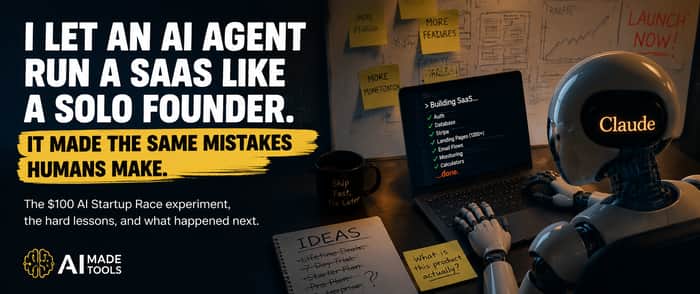
I agents can build SaaS faster than ever. But after letting Claude run one like a solo founder, I found the bottleneck wasn't coding. It was judgment. The hardest parts of building a startup still aren't automated.

The bottleneck flipping from execution to judgment is the real signal. Humans took weeks to get what an agent generates in minutes - but both hit the same wall: auditing what was built and deciding if it matters.
This is the measurement problem at scale. An agent can hallucinate features and structure just as easily as a human can overthink architecture - the difference is speed of failure, not speed of success. You generated 1,300+ pages and had to read every one because you couldn't trust the agent's self-report.
The founders who'll win aren't the ones who automate execution first. They're the ones who can measure execution faster - build systems that tell them immediately if what was just created is right or wrong, without requiring a full audit.
This was exactly my takeaway.
The agent was never the bottleneck for execution. It could build faster than I could review.
The hard part was building the measurement layer: what is correct, what is useful, what should be deleted, and what is just impressive-looking output.
I think the future AI-native founder workflow is not "agent builds → human approves". It's closer to "agent builds → automated evaluation filters → human makes the strategic calls."
The scarce skill becomes judgment, not execution.
The auditing point is the part that interests me most.
Once an agent can generate that much work autonomously, manual review starts becoming the bottleneck. Have you thought about using risk-based sampling rather than trying to inspect everything — concentrating independent review on higher-consequence actions, unexpected outputs, failures and places where the agent claims success?
That’s essentially the problem we’ve been exploring with OpsWatch: independently verifying what production agents actually did rather than relying on their own reporting.
It's interesting to hear about your experience with AI agents in running a SaaS. I’ve found similar dynamics when incorporating AI into my workflow, especially in the context of content strategy.
One key realization I've had is that while AI tools can handle a lot—like automating content creation, SEO optimization, and performance analytics—the final judgment always requires a human touch. When I first integrated AI into my blogging process, I was excited about the speed at which I could produce content. But I noticed that the quality and relevance of that content often missed the mark because the AI didn't fully grasp the nuance of my audience’s needs or the brand voice.
For example, I set up a workflow that automated content generation based on certain keywords, which significantly cut down my writing time from days to hours. However, my engagement metrics initially dipped because the content lacked the context that resonates with my readers. It was only after I started incorporating a review phase where I could inject personal insights and make final edits that I saw a meaningful increase in audience engagement up by around 30% in just a couple of months.
So, while AI can accelerate processes, the bottleneck will often be in how you integrate the human element. Balancing automation with your own judgments, insights, and creativity might be the key to not only moving fast but also ensuring that what you deliver truly connects with your audience and fulfills their needs. Would love to hear how you're tackling that balance in your project!
The part about not being able to trust the agent’s own report is exactly what caught my attention.
Once the agent has built the system, how are you deciding that the audit itself is sufficiently independent from the thing being audited?
For example, are you validating a sample of outputs against an external source of truth or intended acceptance criteria, rather than relying on the same agent/tooling stack to tell you whether the build succeeded?
That separation between execution and independent evidence-based assurance is what I’m building around with OpsWatch, so I’d be very interested in how you’re approaching it.
This aligns with what I've seen while building my own AI product. The coding part got easy fast, but every failure mode traces back to a judgment call the agent wasn't equipped to make (when to ask, when to defer, and when the "right" answer depends on context it doesn't have). Curious whether you found any pattern in which decisions it botched, or was it pretty evenly spread across the board?
Some numbers from the experiment:
The interesting part wasn't getting it to build. The interesting part was auditing what it built afterwards.
Curious: what would you trust an AI agent to own today, and what would you never delegate?