I let Claude Code run my entire SEO pipeline. Here's how
I've been building SEO Ladders, an AI SEO content platform that finds keywords, generates articles, and publishes them to your cms.
It works great from the dashboard. But I kept noticing something: I'd be coding in Claude Code or Cursor, think "I should write a blog post about X," and then have to context-switch to the browser, log into the dashboard, set everything up, and come back to my IDE.
So I built an MCP server.
Now I can do this from my terminal:
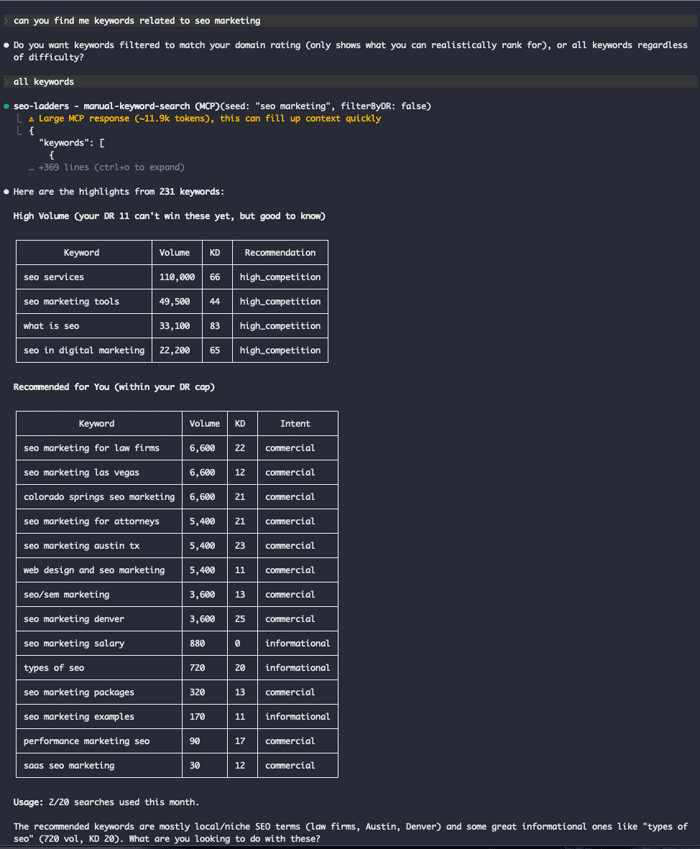
"Find keywords I can rank for"
→ Returns 87 keywords filtered by my domain rating
"Generate an article about best project management tools"
→ 13-step pipeline runs: outline, sections, FAQ, citations, images, JSON-LD
→ Returns full Markdown + HTML with meta tags and OG tags
"Publish to WordPress"
→ Done. Live on my site.
No tab switching. No dashboard. Just chat.
What the MCP server includes:
- 11 tools total
- Keyword research (matched to your domain rating so you only see keywords you can actually win)
- Full article generation with images, YouTube embeds, FAQ, citations, E-E-A-T signals, JSON-LD
- Site audit (health score, broken links, Core Web Vitals)
- Content calendar management
- Publish to WordPress or any webhook or CMS
- Content refresh detection (find articles losing rankings)
What surprised me:
The MCP protocol means any AI tool can use it — not just Claude Code. Cursor, Windsurf, Codex, even n8n workflows. I built one integration and got distribution across every MCP-compatible client for free.
The articles come back as complete HTML documents with meta tags, Open Graph, Twitter cards, and JSON-LD baked in. You can save them locally or publish directly. No formatting step needed.
What I'd do differently:
I should have built the MCP server first, not the dashboard. The dashboard took months. The MCP server took a weekend. And it's actually a better distribution channel — devs find it in MCP directories (cursor.directory, skills.sh, ClawHub) and try it without ever seeing the marketing site.
If you're building a SaaS with any kind of API, consider exposing it as an MCP server. It's the new "Zapier integration" but for AI-native users.
If you have been struggling with finding keywords your product can rank for and writing SEO optimized articles that can bring you organic traffic, you can give it a try - seoladders.com. Looking for early feedback.
Would love to hear — are any of you using MCP servers in your workflow? What tools have you connected?

what happens before
Publish to WordPresswhen someone else checks the draft? if an editor says one claim or citation is wrong, can that note get back to the exact HTML version + section in the next MCP run, or are you pasting it into Claude Code?i'm working on PreApp around that handoff. happy to try one synthetic article end to end, no site or customer data.
Strong instinct on building the MCP server before the dashboard. I went a step further on the research side: DataForSEO's MCP for SERP and keyword pulls, plus our own Search Console MCP, means a research session can pull live SERPs, crawl competitor pages and map keywords to a content plan in one sitting. The brief for the article I'm about to link took an afternoon; the equivalent used to be a research week spread across separate tools with copy-paste in between.
One thing I'd add to your pipeline if it's not already there: a live check of the actual top 10 before you commit a target. We had a keyword flagged as low-difficulty by the score, but the first page was all high-authority university and publisher domains a young site won't displace regardless of content quality. Wrote an article that still hasn't ranked because of it. Difficulty scores measure links, not who you'd actually have to beat.
Full breakdown of the setup: dhawalshah [.] net/article/claude-code-for-marketing/
Brilliant shift in architecture, Samuel. Building the MCP first is the ultimate distribution hack to capture devs where they already execute code.
I ran into a parallel bottleneck during deep sessions in Claude Code-the velocity is insane until semantic drift kicks in and the agent completely forgets the macro project layout or hooks.
To fix that context rot without local overhead, I built Remora (remora-jade.vercel,app). It’s a lean webhook tool that serializes and heavily compresses codebase layouts directly into the execution memory layers so the state stays locked.
Bypassing dashboards via webhooks/MCP is 100% the right play. I'd love to get your technical take on how you're optimizing token efficiency across that 13-step generation pipeline!
Samuel, building an MCP server for SEO Ladders is a genius distribution play. I totally agree that exposing APIs to AI-native workflows is the new Zapier.
But as a solo dev building PRIZM, I have to ask the uncomfortable CFO question: How does your 13-step pipeline translate to Annualized P&L?
I’ve seen founders automate 100+ articles a month using similar stacks. Their traffic goes up, their DR looks great, but because they aren't tracking the Net Profit impact per keyword (Margin vs. Acquisition Cost), they are often scaling "SEO wins" that are actually net losses.
I launched on PH last week and flopped (2 upvotes) because I realized most devs would rather talk about "13-step AI pipelines" than face the "Financial Autopsy" of their automation. I’ve built a logic engine that converts these SEO/Growth metrics into a 12-month financial impact.
I’d love to see if your SEO Ladders logic can integrate a "Profitability Filter." Not just "can I rank for this," but "will this rank actually pay for my servers and my time?"
I won't drop the link to respect the rules, but I’d love to hear your take on adding a "Financial Layer" to MCP workflows. My profile has the logic if you're curious.