I looked at Shopify upsell apps for 2026 — the interesting shift is happening after checkout
Most Shopify upsell advice still sounds the same:
Show a popup.
Recommend a bundle.
Add a discount.
Use a countdown timer.
Increase AOV.
That still works in some cases.
But I think the bigger shift in 2026 is not just where the upsell appears.
It is what happens after the customer has already bought.
The post-purchase moment is one of the most underrated stages in ecommerce.
The customer has already trusted the store.
They have completed the payment.
They are still thinking about the product.
They may need help, setup, warranty, accessories, refills, replacement parts, or a better way to use what they just bought.
That is a very different moment from a random product popup.
A weak post-purchase flow says:
“Here are more products.”
A strong post-purchase flow says:
“Here is what makes your recent purchase more useful, complete, or protected.”
That difference matters.
For example:
A customer buys a beauty device. The next useful action may be refill heads, serum packs, or extended protection.
A customer buys a coffee machine. The next useful action may be filters, cleaning tablets, beans, or warranty registration.
A customer buys electronics. The next useful action may be a case, charger, screen protector, protection plan, or setup support.
A customer buys a home appliance. The next useful action may be a care plan, replacement part, installation help, or support registration.
That is why I do not think the future of Shopify upsells is only about checkout popups.
It is moving toward post-purchase journeys.
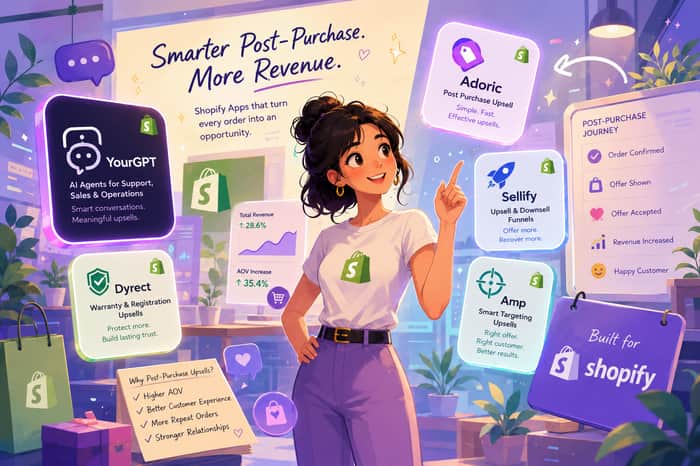
I looked at a few Shopify upsell and post-purchase tools from this angle: not just “which app shows an offer,” but “which app helps the customer take the next useful action after purchase.”
Here are the ones I would look at in 2026.
- YourGPT — for AI-led customer conversations after purchase
YourGPT is interesting because it does not fit the old definition of a Shopify upsell app.
It is not just a tool for showing one extra product after checkout. It is an AI-first platform for customer support, sales, and operations, which makes it more like an AI layer for customer conversations, product guidance, support automation, and post-purchase workflows.
That matters because many upsell opportunities do not happen only on a checkout page.
They happen when a customer asks:
“Which accessory works with this?”
“Do I need a refill?”
“Can I add a warranty?”
“How do I use this product?”
“Where is my order?”
“Can I get support?”
“What should I buy next?”
“Is this compatible with the product I bought?”
A normal upsell widget can show an offer.
An AI agent can understand the customer’s question, use context, and guide them toward the next useful action.
That could be a product recommendation.
It could be a warranty flow.
It could be a support answer.
It could be an order update.
It could be a setup guide.
It could be a follow-up workflow.
It could be a sales conversation that does not feel like a sales pitch.
For Shopify brands, this becomes useful because support and upsells are starting to overlap.
A customer asking “which refill do I need?” is not just asking for support.
That is also a revenue opportunity.
A customer asking “can I add protection?” is not just asking a question.
That is also a post-purchase upsell opportunity.
A customer asking “how do I use this product?” may need an accessory, plan, bundle, or related product.
The key is that the recommendation has to feel useful.
That is where AI-led conversations can work better than static offers.
Best fit: Shopify brands that want to connect customer support, sales, operations, product recommendations, and post-purchase engagement in one flow.
Where it works well: customer support, sales automation, product guidance, post-purchase conversations, AI-powered workflows, and customer operations.
My take: YourGPT is not the typical “show an offer after checkout” tool. It makes more sense for brands that want upsells to feel like useful conversations instead of random product pushes.
- Dyrect — for warranty, registration, and ownership-based upsells
Dyrect is useful for Shopify brands selling physical products where the customer relationship continues after purchase.
This is especially relevant for categories like:
Consumer electronics
Appliances
Beauty devices
Tools
Fitness equipment
Luggage
Baby products
Outdoor gear
Kitchen products
Mobile accessories
For these categories, the post-purchase journey is not only about “buy another product.”
It is also about ownership.
Who bought the product?
Where did they buy it?
Is the warranty active?
Has the customer registered the product?
Do they need protection?
Do they need spare parts?
Will they need service later?
Can the brand reach them directly?
That is where Dyrect becomes useful.
The upsell is connected to product registration, warranty activation, extended protection, claims, and ownership data.
For example:
A customer buys a beauty device and registers it. During the registration flow, the brand can offer extended protection or refill packs.
A customer buys an appliance and activates warranty. The brand can later recommend filters, cleaning kits, or service plans.
A customer buys electronics from a retail store or marketplace. The brand can still capture first-party ownership data using registration.
This is not the same as a simple “frequently bought together” offer.
It is a deeper post-purchase system.
Best fit: Shopify brands selling durable or high-value physical products where warranty, ownership, support, and customer data matter.
Where it works well: warranty registration, product registration, protection plans, claims, serial number tracking, customer portals, and ownership-based upsells.
My take: Dyrect is strong when the upsell is tied to product ownership, not just another product recommendation.
- Adoric Post Purchase Upsell — for simple post-checkout offers
Adoric is closer to the classic Shopify post-purchase upsell app.
It is useful for stores that want to quickly test offers after checkout without building a complex workflow.
For example:
A skincare store can offer refills.
A fashion store can recommend a matching item.
A gadget store can offer a cable, case, or related accessory.
A supplement store can offer a bundle or subscription.
A pet store can offer treats, grooming tools, or repeat-purchase packs.
The appeal is simplicity.
You can create post-purchase offers, show product recommendations, add discounts, use timers, and test whether customers accept extra offers after payment.
This is useful for early-stage Shopify stores because you do not always need a complex system at the beginning.
Sometimes you just need to answer one question:
“Will customers accept a relevant offer after checkout?”
If the answer is yes, then you can build more advanced flows later.
Best fit: Shopify stores that want a simple way to test post-purchase upsells.
Where it works well: one-click offers, product recommendations, discounts, timers, and beginner-friendly upsell campaigns.
My take: Adoric is a good starting point if you want to validate post-purchase upsells before investing in a deeper customer journey.
- Sellify Post Purchase Upsell — for upsell and downsell funnels
Sellify is useful when you want more than one post-purchase offer path.
Instead of showing one offer and stopping there, you can create upsell and downsell funnels.
For example:
A customer buys a camera.
You offer a premium accessory bundle.
If they skip it, you offer a cheaper memory card.
Then you show a thank-you page offer.
That structure can work because not every customer will accept the first offer.
Some buyers may reject a larger bundle but accept a smaller add-on.
That is where downsells become useful.
Sellify can fit stores with several natural add-on paths:
A camera store can offer batteries, bags, memory cards, or protection.
A pet store can offer treats, grooming tools, or subscriptions.
A skincare store can offer bundles, refills, or trial sizes.
A fashion store can offer matching products or accessories.
A home goods store can offer care kits, replacement parts, or add-ons.
This is more funnel-based than a basic product recommendation.
Best fit: Shopify brands that want flexible post-purchase funnels.
Where it works well: upsells, downsells, thank-you page offers, add-ons, warranty offers, free shipping offers, priority processing, and AI product recommendations.
My take: Sellify is practical if you already know your product combinations and want to test different offer paths after checkout.
- Amp Post Purchase Upsell — for targeting rules and campaign control
Amp is useful if you care about showing different offers to different customers.
This is important because not every buyer should see the same upsell.
A high-value order may deserve a premium add-on.
A low-value order may need a cheaper accessory.
A customer buying from one collection may need a matching product.
A customer from a specific country may need a different offer.
A buyer who purchases multiple units may be a better fit for a bundle or service upgrade.
Amp focuses on targeting rules and campaign control.
That makes it useful for stores with multiple product categories, different margins, international customers, or specific offer logic.
For example:
If a customer buys from the “coffee machines” collection, show filters or cleaning tablets.
If a customer’s cart value is above a certain amount, show a premium protection plan.
If a customer buys from a specific country, show a region-specific add-on.
If the customer buys multiple units, offer a bulk accessory bundle.
This type of targeting helps the offer feel more relevant.
And relevance is probably the biggest factor in whether a post-purchase upsell works.
Best fit: Shopify stores that want more control over who sees which post-purchase offer.
Where it works well: product-based triggers, collection-based triggers, cart value rules, quantity rules, shipping country rules, offer previews, and campaign reporting.
My take: Amp is useful when relevance matters more than simply showing the same offer to every customer.
What I learned from comparing these tools
The best Shopify upsell strategy in 2026 is not just:
“Show more products.”
It is:
“Help the customer take the next useful action after purchase.”
That action could be buying an accessory.
It could be activating a warranty.
It could be registering a product.
It could be getting support.
It could be starting a refill flow.
It could be choosing a care plan.
It could be asking an AI agent what they need next.
That is why the post-purchase category is becoming more interesting.
The old model looked like this:
Checkout → popup → maybe extra revenue
The newer model looks more like this:
Purchase → context → conversation → useful action → repeat revenue
For simple AOV experiments, classic post-purchase apps still make sense.
Adoric, Sellify, and Amp are useful if your main goal is to test add-ons, discounts, funnels, and targeting rules.
For physical products where ownership matters, Dyrect makes sense because the upsell is connected to warranty, registration, protection, support, and first-party customer data.
For brands that want a more flexible AI layer across support, sales, and operations, YourGPT is interesting because it treats upsell opportunities as part of the customer conversation, not just a checkout offer.
I think this is where Shopify upsells are heading.
Less random popup.
More context.
Less “buy this too.”
More “here is what helps you next.”
And that probably creates a better experience for both sides.
The customer gets something useful.
The brand gets higher AOV, better retention, cleaner customer data, and more chances to build a long-term relationship after the first order.
Curious what other Shopify founders are seeing:
Are post-purchase upsells still working for your store, or do customers only respond when the offer feels highly relevant?
