I lost a $2k enterprise lead because I was "Tab-Switching." Here’s the system that fixed it.
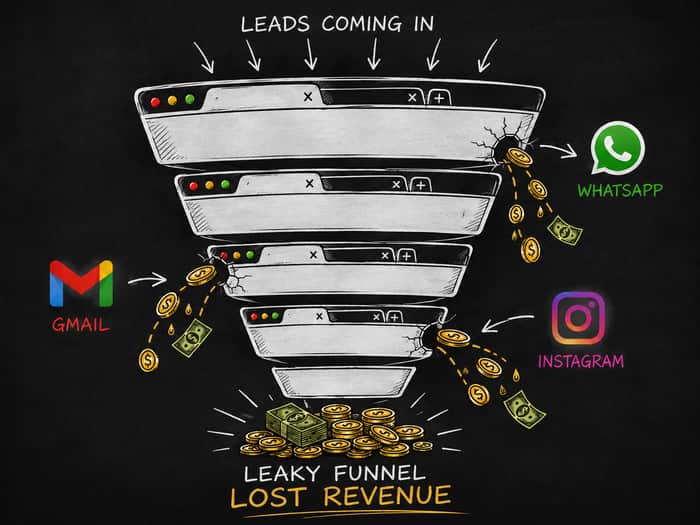
If you’re a solo founder or running a small team, you know the "Tab-Switching Tax."
It’s that mental drain you pay every time you jump from a Chrome tab with your Gmail, to the WhatsApp Desktop app, to your Instagram DMs, and back to your code.
Last month, I hit a breaking point. I had an enterprise lead ping me on WhatsApp. I saw it while I was debugging a deployment issue, thought "I'll get to that in ten minutes," and then… I got an email support ticket. Then a teammate asked a question on Slack about that same lead.
By the time I circled back to the WhatsApp message, the lead had moved on. That was a potential $200/mo in MRR (or a $2.4k ACV) down the drain because my stack was a mess of disconnected notifications.
I eventually stopped the bleeding by moving my entire communication stack over to Airchannel.
You can see what they’re building here: https://airchannel.ai/
The Problem: Communication doesn't scale in silos
When you're at $0 MRR, juggling apps is fine. But as soon as you start growing, "manual" communication becomes your biggest bottleneck. You run into three specific walls:
The Context Gap: You remember a customer said something important, but was it in a thread on X, a WhatsApp voice note, or an email?
The Collaboration Mess: You want to ask a teammate for help on a ticket, so you take a screenshot, post it in Slack, talk about it there, then go back to the original app to reply. It’s exhausting.
The Vibe Metric: You think you’re responding fast, but you have no actual data. You're operating on vibes instead of performance.
Moving from Juggling to Operating
I realized I needed to stop treating my inbox like a chore and start treating it like a high-performance engine. I needed a system that did three things:
1. Internal Collaboration (Without the Screenshots)
I stopped using Slack to talk about customers. Now, I use Internal Note Threads directly inside the conversation. If a lead asks a technical question on WhatsApp that I can't answer, I tag my dev right there in a private note. He sees the whole history, gives me the answer, and I reply all without the customer ever seeing the "behind the scenes" mess.
2. Real-Time Analytics (Killing the Vibe Metric)
You can't optimize what you don't measure. Once I moved to a unified setup, I got access to Real-Time Analytics. I finally saw my average response time (it was way worse than I thought) and which channels were actually driving high-intent leads. Seeing a dashboard of "Time to Close" per channel changed where I spent my marketing budget overnight.
3. The Unified Source of Truth
The biggest win? Putting WhatsApp and Email in the same stream. No more "where did he send that?" Moments. One contact, one timeline, regardless of where they messaged from.
The ROI of Sanity
Since centralizing the chaos, my response time has dropped by 60%, and more importantly, I’m not scared of my notifications anymore. I know exactly who is handling what and where the bottlenecks are.
I’ve been using Airchannel.ai to run this setup. It’s a unified inbox that actually feels like it was built for founders who hate clunky CRMs. It handles the WhatsApp/Email merge perfectly, but the real "secret sauce" is the internal collaboration and analytics, it turns your support from a cost center into a data-driven sales machine.
If you're still drowning in browser tabs and missed DMs, Airchannel is worth a look just for the mental clarity alone.
Check them here: https://airchannel.ai/
How are you guys handling the hand-off between sales and support? Are you still "Slack-and-Screenshotting," or have you moved to a shared inbox model?

I think there is a research done by University of California, Irvine where they found that after an interruption, it takes an average of 23 minutes and 15 seconds to fully refocus on the original task. So, tab switching can do exactly that and I have experienced it myself.
The $2k wasn't lost to tabs, it was lost to the "I'll get to it in ten minutes" deferral. Same thing happened to us once. Now we track reply latency as a number, like every other metric — first-touch speed decides the whole deal, and most founders can't even name their average response time.
This comment was deleted 6 days ago