I’m Adding Pixal3D to My Image-to-3D Tool — Here’s Why I Think AI 3D Still Has Room for Indie Products
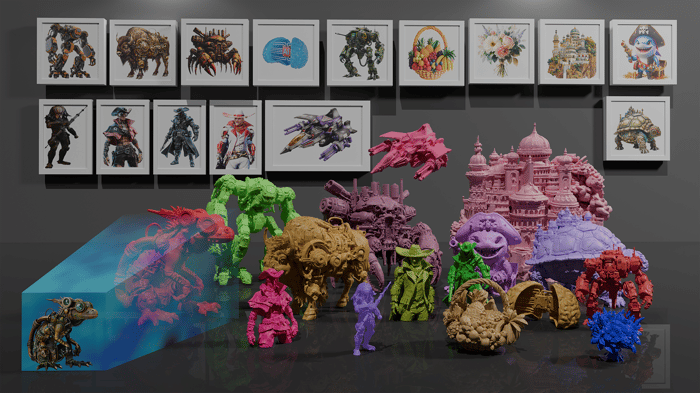
I’m building an image-to-3D product called AI Image to 3D.
The basic idea is simple: users upload an image, generate a 3D model, preview it in the browser, and download the result.
Recently, I started integrating Pixal3D, a new image-to-3D model focused on higher-fidelity 3D generation from a single image.
I wanted to share why I think this is interesting from an indie product perspective.
The model is not the whole product
A common mistake in AI products is thinking:
New model = new product.
But I don’t think that’s enough anymore.
Most users don’t want to learn model names. They don’t care which paper a model came from. They don’t want to compare APIs manually.
They want a result.
For image-to-3D, that result usually means:
upload an image
get a clean 3D model
rotate and preview it
download a usable file
maybe try another model if the first result is not good
That’s why I think there is still room for indie products in AI 3D.
The opportunity is not just wrapping one API. The opportunity is making the workflow easier.
Why Pixal3D is worth adding
Pixal3D is interesting because it focuses on fidelity.
In image-to-3D, fidelity is a big deal.
A model can generate a nice-looking asset, but if the output does not match the input image well, many users will not trust it.
For example:
A product seller wants the 3D model to look like the real product.
A game creator wants the asset to respect the concept image.
A designer wants the shape and proportions to stay close to the original.
An AR builder wants the object to feel recognizable.
So I see Pixal3D as a useful addition, especially for users who care about preserving the uploaded image.
Why I’m building this as a multi-model tool
I don’t believe one image-to-3D model will be best for every use case.
Some models are better for speed.
Some are better for texture.
Some are better for stylized objects.
Some are better for product-like objects.
Some are cheaper.
Some produce cleaner files.
So instead of building a product around only one model, I’m trying to build AI Image to 3D as a multi-model workflow.
The user should be able to upload one image and try different models without opening five different websites.
That is the product layer I think users actually need.
The user problem is still real
3D content is hard.
Most small businesses, indie game developers, and creators do not have a 3D artist available all the time.
Even if they do, creating 3D assets takes time.
AI-generated 3D does not need to replace professional 3D work completely to be useful.
It only needs to make the first draft faster.
That alone can be valuable.
Some possible users:
indie game developers creating rough props
e-commerce sellers testing 3D product previews
designers turning concepts into quick 3D references
AR/VR builders creating prototype assets
creators making 3D visuals for experiments
My current product direction
Right now, I’m thinking about the product in this way:
Start with image-to-3D generation
Support multiple models
Make preview and download very simple
Add model comparison
Add texture-related tools later
Build SEO pages around real user intents
The SEO angle is also interesting.
People search for things like:
image to 3D model
image to 3D
AI 3D model generator
convert image to 3D model
image to GLB
AI texture generator
image to STL
These are practical keywords. The search intent is clear. Users are usually trying to solve a real workflow problem.
What I’m still unsure about
I still don’t think AI 3D is fully mature.
There are limitations:
some objects generate badly
hidden parts are guessed
topology may not be production-ready
transparent or reflective objects are difficult
users may expect too much from one image
So the product has to educate users.
A good image-to-3D product should show examples, explain what inputs work best, and make it easy to retry.
My takeaway
Pixal3D is exciting, but not because it magically solves every 3D problem.
It’s exciting because it improves one of the most important parts of image-to-3D: fidelity to the input image.
For indie founders, I think the opportunity is to build a useful workflow around these models.
Not just “here is another AI model.”
But:
upload → generate → preview → compare → download → use
That is what I’m trying to build with AI Image to 3D.
Would love to hear from other founders: do you think AI 3D is still too early, or is this the right time to build small workflow tools around it?
