I’m an architect building an AI translation workflow for serious long documents
Hi Indie Hackers,
I’m Ming, an architectural designer by profession, and for the past half year I’ve been building GoodTrans, an AI document translation workflow for long and serious documents.
My goal is ambitious: to make long-document translation much faster than traditional manual translation, significantly cheaper, and good enough for serious review and real-world use.
I’m not a full-time software founder by background. My day job is architecture. But after work, my biggest hobby is playing with computers. And during the past few years, with the AI wave, I’ve been having a lot of fun experimenting with different tools.
The idea for GoodTrans came from a very practical moment.
A friend of mine works in foreign trade. He knew I was familiar with AI tools, so one day he asked me to help translate several technical documents into Chinese. I tried Claude, Gemini, and ChatGPT. I eventually got the work done, but the process was exhausting.
That experience made something very clear to me:
AI translation is already excellent for short text, but long-document translation still breaks in frustrating and very boring ways.
First, I had to find a good PDF OCR tool to extract the original document structure. I tried many different tools just to get the source text into a usable form.
Then came the translation problems:
Terms drifted.
Headings moved.
Names changed.
Numbers were missed.
The output looked fluent, but it was hard to fully trust.
And throughout the whole process, both during and after translation, I still had to manually copy, paste, format, compare, review, and package everything section by section.
So I started building GoodTrans around one belief:
For a translation product, translation quality is the “1”. Everything else is a “0”.
If the translation itself is not good, all the extra features are just decoration.
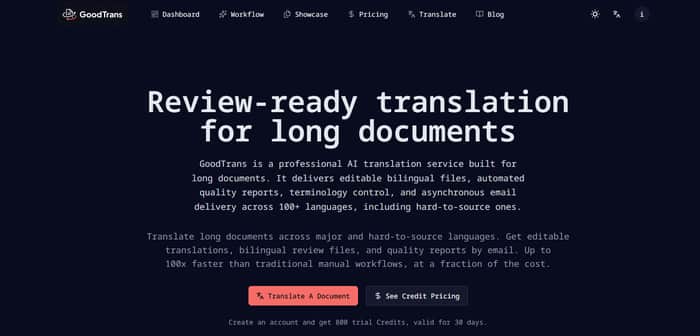
GoodTrans is not meant to be another chat-style translator. The goal is to produce high-quality, review-ready translation output for long documents.
The current workflow is:
- Upload TXT, Markdown, PDF, or paste text
- Choose source language, target language, target locale, document purpose, and style
- Add terminology notes or upload a glossary
- GoodTrans parses and cleans the document, organizes the body text, splits it into segments, translates section by section, reviews the translation, and improves it over multiple rounds
- The task runs asynchronously, so users don’t need to sit in front of the computer waiting
- When it is done, users receive editable Markdown/TXT files, a bilingual review file, and a quality report by email
I care a lot about the translation philosophy behind the workflow. In Chinese translation theory, there is an old standard: “faithfulness, expressiveness, and elegance.” That is the kind of direction I want GoodTrans to move toward, especially for serious long-form content.
The delivery package matters because translation quality must be inspectable.
For serious documents, a fluent paragraph is not enough. Users need to check terminology, structure, omissions, numbers, links, names, and whether the translation still fits the purpose of the document.
In our testing so far, GoodTrans has performed especially well on technical documents, cross-border business materials, academic and research texts, content writing, literary prose, long articles, and some low-resource or hard-to-source language needs.
GoodTrans currently supports translation across 100+ languages. I think this is important because in many smaller language markets, finding a qualified human translator can be slow, expensive, or simply difficult.
The project is still early, and the hardest parts are exactly the parts that matter most:
- Making long-document translation stable
- Improving translation quality across different document types
- Keeping terminology consistent
- Making the output easy for humans to review
- Explaining clearly how this is different from manually using ChatGPT or DeepL
The website is live here:
New users get 800 trial Credits, enough to test the full workflow on a short real document.
I’d love feedback from other founders:
- Is the positioning clear?
- Would you trust this kind of workflow for real business or technical documents?
- What would you need to see before paying for AI document translation?
Happy to answer questions and share more about the building process.

This is a strong problem because you are not selling “AI translation.” You are selling trust in long documents where small mistakes are expensive: terminology drift, missed numbers, structure changes, inconsistent names, and output that sounds fluent but cannot be fully relied on.
That distinction matters a lot. The strongest positioning is not “translate 100+ languages.” It is review-ready translation workflow for serious documents. The quality report, bilingual review file, glossary support, async workflow, and inspectable output are the parts that make this feel more serious than manually using ChatGPT or DeepL.
I’d also pressure-test the name before more users and content lock in. GoodTrans is clear, but it sounds a bit generic and utility-like for something handling business, technical, academic, and cross-border documents. If the product is meant to become a serious document intelligence workflow, the name should carry more trust and category weight.
Beryxa .com would fit that direction better. It feels more like an enterprise-grade AI/document workflow brand than a simple translator, while still giving you room to expand into review, terminology consistency, document QA, and multilingual business workflows.
For this product, naming is not cosmetic. If people are trusting it with serious documents, the brand has to feel serious before the workflow does.
I’m very pleased that my product has received your attention as soon as it was released.
Regarding the name, my personal opinion is that, as a new product, it’s important to make it memorable. Therefore, I chose a simple and easy-to-remember name. Of course, the cost of registering the domain name was also a factor I took into consideration.
My initial intention in developing this product was to ensure that the translation quality exceeds that of manual translation. The efficiency of this method is more than 100 times higher than that of manual translation, and the cost is likely only one-third of the cost of manual translation. Based on our intensive testing with test users over time, it’s proven to be highly reliable, and the quality is truly remarkable. Although we didn’t make any promises regarding “high quality,” this product definitely meets those expectations.
The long text you mentioned is precisely one of the core features of goodtrans. Imagine a novel with over 50,000 words—just by uploading it, high-quality translations can be received via email within about an hour. The delivery package includes TXT files, MD files, bilingual translations, and quality reports. It’s truly exciting!
Regarding the supported languages, I didn’t initially plan to support many languages. However, the Claude series of models actually support over 200 languages. Therefore, Goodtrans is indeed a great tool for translating texts in minor languages as well.
That makes sense. I understand why GoodTrans works early: it is simple, memorable, and instantly tells people the product is about translation.
The bigger opportunity is that the product you described is much more serious than the name/copy currently signals.
A 50,000-word novel translated in around an hour, with TXT, MD, bilingual files, and quality reports, is not just “AI translation.” That is closer to a review-ready document workflow.
The strongest positioning may be around trust in long-form translation: terminology consistency, inspectable output, bilingual review, document structure, and quality evidence. That is where the product can feel different from people manually using ChatGPT, Claude, or DeepL.
I would not force a rename immediately if GoodTrans is helping people understand the basic use case.
But I would pressure-test whether the brand and landing page are making the product feel too generic compared to what it actually does.
If useful, I do focused naming/positioning audits for early products: current name risk, category framing, domain perception, trust gap, and what stronger positioning direction I’d take before more users and content build around the current name.
I’m doing a few at $99 while refining the format. For GoodTrans, the audit would focus on making it feel like a serious document translation workflow, not just another translator.