I’m building tag pages before I even have traffic (my SEO structure for an AI directory)
The Reality
Today I wasn’t adding tools. I was working on structure.
Specifically, building tag pages early on seekaitool.com.
The Deep Dive
Most directories start the same way:
Add tools first.
Figure out SEO later.
I almost did that.
But I stopped and asked myself one question:
Where will people actually land?
Not the homepage.
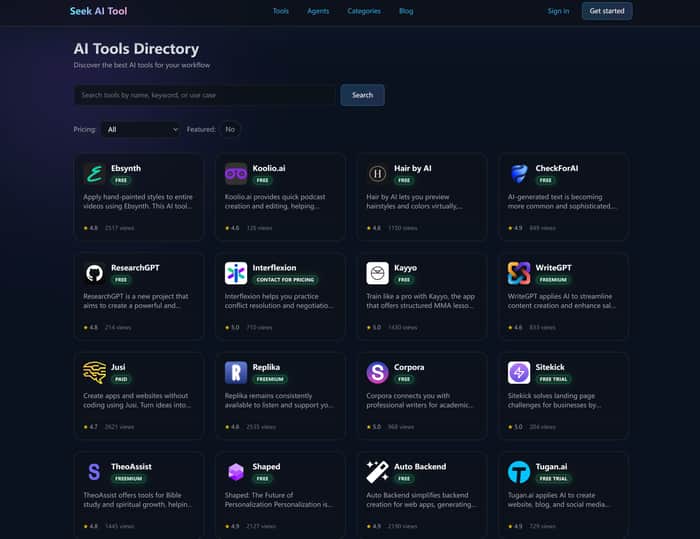
Something like this:
Why this matters
No one searches for “AI directory homepage”.
People search for:
AI tools
AI writing tools
AI image generators
That means discovery doesn’t happen on the homepage.
It happens on pages with intent.
What I’m doing differently
Instead of waiting, I’m building those entry points early.
Pages that are:
focused
understandable in one glance
not overloaded
Even something simple like the /ai page becomes important.
It’s not just a list. It’s an entry point.
The constraint I added
I don’t create a page unless:
I know what it’s for
I can explain it in one sentence
it’s something someone might actually search
Otherwise, it doesn’t exist.
What changed for me
I stopped thinking:
“How many tools do I have?”
and started thinking:
“What pages deserve to exist?”
That shift is subtle, but it changes everything.
The Ask
If you’ve built a directory or content-heavy site:
Did you design your structure early,
or fix it after you had content?
And which pages ended up mattering the most?

Building SEO structure early is the right call — retrofitting it after you have content is painful. The tag page approach for AI directories makes sense because long-tail searches are how most people discover niche tools. What's your internal linking strategy between tag pages?
Building the taxonomy before the content is the right instinct. The subtlety is that the tag system also shapes what you add next. If /ai exists as an entry point, it implicitly commits you to keeping it fed, and suddenly you are optimizing tool selection for the page rather than for the directory as a whole.
The bigger unlock I have seen with directory-style sites is that intent pages and listing pages are two different types of content, and search engines treat them differently. An /ai page that reads like a category intro with 6 or 8 carefully picked tools outranks a /ai page that is just a 400-item grid, at least in the sectors I have watched. Worth tracking which of your tag pages are behaving more like editorial and which are behaving like catalogue.
This is so true — I made the mistake of adding content first and fixing structure later, it cost me a lot of rework. Starting with intent-based pages early just makes everything cleaner and easier to scale.
That makes sense if the tag pages map to real search intent and each one can stand on its own. I’d keep the taxonomy tight at first and make sure every page has unique copy, filters, and internal links, otherwise you end up with index bloat before Google has any reason to care. The pages that work best early are usually the ones you’d want to send a cold visitor to, not every possible tag.
How about comparing tools but in very detail ? Many tools are "free" but they are not really free as if you really want to export something quality out of it, you'll need to pay and sometimes that's a real catch. For example, let's say some AI video generator is free. For a real video generation, of 30 seconds, none are free. Some will cost you $10 other $50.
This is a smart shift — most people treat structure as an afterthought.
One thing I’ve noticed though: early structure works only if it’s based on validated search demand, not assumptions.
Curious — are you building these pages based on actual keyword data, or shaping them first and validating later?
Great approach. Thinking in pages before content is a key shift.
But here’s an important nuance: it’s not just what pages exist, it’s which ones can realistically rank.
“AI tools” is extremely competitive. A generic /ai page can get lost.
I’d add:
Go deeper: long-tail (e.g., AI tools for Shopify, AI for real estate)
Build pages with clear angles (comparisons, use cases, “best for”)
Add real content, not just listings (intro + context)
The structure is solid. The edge will come from winning specific searches, not generic ones.