I Needed a Simple Kelvin to Celsius Conversion, So I Made It Easier
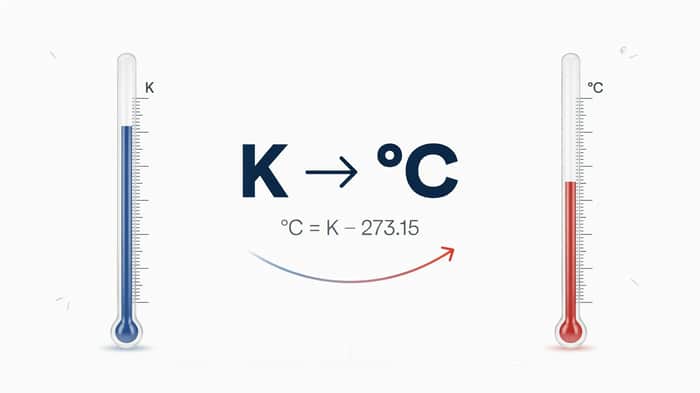
A surprisingly common problem when working with scientific data is dealing with temperature units.
You might get a value such as 300 K, while the context you're working in uses Celsius. The conversion itself is simple, but having to repeatedly calculate it can become annoying when you're dealing with multiple values.
The basic formula is:
°C = K − 273.15
So:
300 K − 273.15 = 26.85 °C
That's the whole calculation.
Why Kelvin and Celsius Can Be Confusing
Kelvin and Celsius have the same size temperature intervals. A change of 1 K is the same magnitude as a change of 1 °C.
The difference is their zero points.
0 K = −273.15 °C
and
273.15 K = 0 °C
This is why you subtract 273.15 when converting Kelvin to Celsius rather than multiplying by a conversion factor.
Kelvin is commonly encountered in physics, chemistry, thermodynamics, engineering, and scientific data. Celsius is generally more familiar for everyday temperature measurements.
A Few Useful Conversions
| Kelvin | Celsius |
| -------: | --------: |
| 250 K | −23.15 °C |
| 273.15 K | 0 °C |
| 280 K | 6.85 °C |
| 290 K | 16.85 °C |
| 300 K | 26.85 °C |
| 310 K | 36.85 °C |
| 373.15 K | 100 °C |
If you're only converting one value, doing the subtraction manually is probably faster.
If you're checking a lot of values, an online converter can save some repetitive work. I put together a simple Kelvin to Celsius converter for exactly this type of calculation.
One Detail Worth Remembering
Kelvin is written as K, without the degree symbol.
Correct:
300 K
Not:
300 °K
For the reverse conversion, the formula is:
K = °C + 273.15
So the two formulas are easy to remember:
Kelvin → Celsius: subtract 273.15
Celsius → Kelvin: add 273.15
I've also been building UnitMorph as a collection of straightforward unit conversion tools, with the goal of making small but repetitive calculations easier to handle.
If you're building something that works with scientific or engineering data, I'm curious: which unit conversion do you find yourself calculating manually most often?
