I Never Used Fertilizers—Here’s How Composting Became My Farm’s Foundation
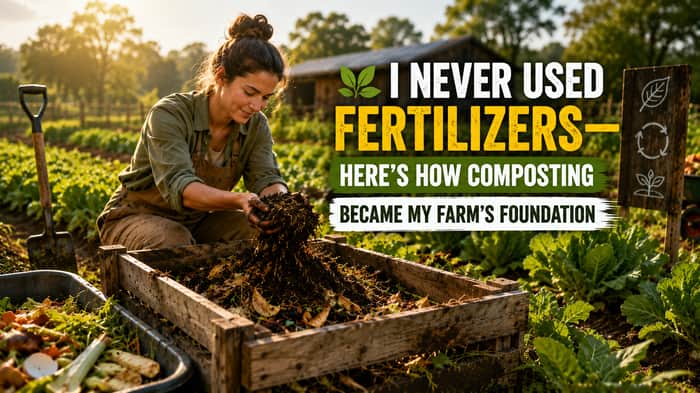
From the beginning, I made a decision that most people questioned:
I didn’t want to depend on fertilizers.
Not chemical ones. Not even regular external inputs.
At first, this made things harder.
There were doubts:
- Will the soil be fertile enough?
- Will yields suffer?
- Is this even practical long term?
But over time, I realized something important:
If the farm cannot sustain itself, it will always depend on something outside.
That’s what led me to organic composting—not as an alternative, but as the core system of how my farm functions.
1. The Real Challenge Was Not Yield—It Was Soil Health
When you don’t use fertilizers, you’re forced to confront the real issue:
Soil health cannot be outsourced.
You can’t rely on quick fixes.
You can’t compensate with external inputs.
Instead, you have to build fertility from within.
That’s where composting becomes essential.
Not as an add-on—but as the primary source of nutrients.
2. Composting Turns Waste Into a Resource
One of the first things I noticed was how much organic material was already available:
- crop residues
- plant waste
- natural biomass
Earlier, this would be ignored or discarded.
But composting changes that perspective.
Instead of asking:
“What do I need to buy?”
You start asking:
“What do I already have?”
And that shift is powerful.
Because once you start using farm waste effectively, the farm begins to support itself.
3. The Soil Starts Behaving Differently
This is something you only notice over time.
When compost becomes your main input:
- soil structure improves
- moisture retention increases
- microbial activity becomes stronger
The soil doesn’t just hold plants—it supports them.
Crops start growing with more stability, not because of heavy inputs, but because the foundation is stronger.
4. It Reduces Dependency Completely
One of the biggest advantages of composting without fertilizers is independence.
You are not:
- affected by price fluctuations
- dependent on supply chains
- forced to increase inputs every season
Your system becomes internally driven.
That doesn’t mean it’s easy—but it means it’s controlled.
And control is valuable in farming.
5. It Requires Patience—But Builds Long-Term Strength
Let’s be clear:
Composting is not a quick solution.
- It takes time to prepare
- It requires consistency
- Results are gradual
But that’s also its strength.
Because instead of temporary boosts, you’re building:
- long-term soil fertility
- sustainable productivity
- a system that improves over time
And once it stabilizes, it keeps working.
What Changed for Me
By relying completely on composting:
- I stopped depending on external inputs
- Soil health improved naturally
- Costs became more predictable
- Farming felt more stable and controlled
But more importantly, I built a system that doesn’t need constant correction.
Most farming systems today are built on addition:
add fertilizers, add chemicals, add inputs.
But there’s another way.
A way where the farm builds its own fertility.
Organic composting is not just a technique—it’s a mindset.
From:
“How do I improve output?”
To:
“How do I strengthen the system itself?”
And once you make that shift, everything else starts aligning.
If you want a deeper understanding of organic composting, how it works, and how to implement it effectively without relying on fertilizers, I’ve explained it in detail here:
Organic Composting: Turning Waste into Nutrient-Rich Soil
This will help you move from concept to real-world application.
