I put up $500 of my own money to test a new creator-distribution model for an indie product
Hey Indie Hackers,
One of the hardest parts of launching any SaaS or micro-tool is distribution. Upfront influencer sponsorships are risky (you pay $300–$1,000 with zero guarantee of clicks), and Google/Meta ads burn cash quickly if your conversion funnel isn't tuned.
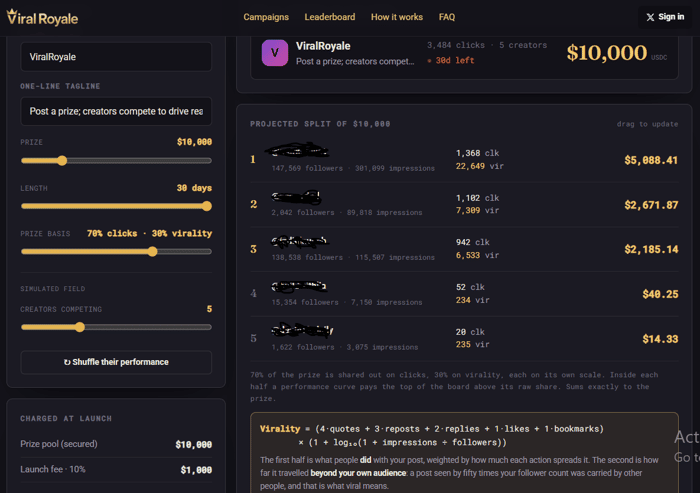
I built ViralRoyale (http://viralroyale.com/) to test an alternative: decentralized, performance-based bounty pools.
Instead of paying a creator upfront:
A founder funds a bounty pool (e.g., $500 in USDC).
Multiple creators grab unique tracking links and create content (tweets, tutorials, short videos, community posts).
The pool pays creators automatically based on verified clicks and reach they generate.
To test the loop with real traffic, I just personally funded a $500 bounty pool for Tibo’s product, Clipatra (clipatra.com). Creators are now incentivized to make content and drive traffic to Clipatra to claim portions of that pool.
I’m documenting how much traffic/reach this actually drives compared to traditional ad spend.
For the founders here:
Would you rather fund an open performance pool or negotiate individual creator sponsorships?
What tracking metrics matter most to you before you'd consider a campaign "successful"?
Would love your thoughts and feedback on the model.

I’d separate creator performance into two layers: distribution quality and business outcome.
Reach and verified clicks are useful for measuring whether a creator can generate attention, but I wouldn’t call a campaign successful based on those alone.
I’d track each creator through something like:
reach → qualified clicks → signup → activation → first meaningful outcome → paid conversion.
The interesting signal would be when a creator produces fewer clicks but significantly better activation or paid conversion than another creator. That tells you the creator’s audience actually matches the product, rather than just being good at generating traffic.
I’d also keep the creator-level data separate, because that could eventually become one of the strongest advantages of the performance-pool model: knowing which audiences actually produce customers, not just which creators produce clicks.
100% agreed. That two-layer funnel is the right way to think about it:
Distribution Quality: Can they grab qualified attention?
Business Outcome: Does their audience actually have high intent for this product?
The biggest signal in influencer marketing isn't volume—it's the discrepancy between clicks and activations. When a micro-creator with 100 clicks outperforms a massive creator with 5,000 clicks on paid conversions, you’ve discovered an authentic audience-product fit.
Keeping that creator-level attribution data clean is essentially the core data asset of the platform. Really sharp feedback.
One number for the comparison you are documenting. We ran a Reddit campaign at the end of August: £20.49 spent, 5,942 impressions, 38 clicks, £0.54 a click. That is the baseline a $500 pool is competing against, and it means the pool buys roughly 900 clicks at ad parity. So cheap traffic cannot be the pitch, because paid clicks are already cheap at small budgets. The pitch has to be that a creator's click converts better than a bought one.
The harder problem is whose numbers pay out. If ViralRoyale counts the clicks and the founder counts the signups, the two will disagree, and every disagreement reads as fraud to the founder. We spent last week finding out that the join between a click and a payment is exactly where tracking breaks. Pay on a postback from the founder's own checkout and the argument disappears, because the party holding the money is also the source of truth.
Spot on on both fronts:
The economic reality: Cheap traffic is a commodity. Competing with a £0.54 CPC on Reddit means the pitch can never be "we get you clicks for cheap." The pitch has to be: creator endorsements deliver 3-5x higher downstream conversion and LTV than cold ad units.
The payout mechanic: Tracking redirects always causes attribution drift and founder mistrust. Having bounty payouts trigger via a direct server-side postback/webhook from the founder’s checkout makes the founder's DB the unambiguous source of truth.
Thanks for sharing the exact campaign numbers—extremely helpful context.
Paying on verified clicks and reach is the part I would change, because reach is gameable and clicks are cheap, so you end up selecting for creators who are good at volume rather than creators whose audience actually buys. Pay on activation or first payment and the pool sorts itself. The only bar I use before calling a paid placement successful is whether it returned 3x cost in attributed revenue by month three, and clicks never once predicted that for us.
That is a fantastic idea. That would make much mor sense than many of the alternatives.
You nailed the exact flaw with pure CPC/impression models. Clicks are cheap, easily gamed by volume-chasers, and almost never correlate with a 3x revenue return on month three.
The only reason top-of-funnel clicks exist in early tests is lower creator friction, but the real unlock is custom event triggers—tying bounty payouts directly to activations, verified trials, or first payments.
Once founders can set the trigger at the revenue/activation milestone, the pool filters itself instantly: volume spammers leave, and creators with actual high-intent audiences stay.
The distribution model you tested is interesting because it forces a measurement: "which creators actually get conversions?" not "which creators have the biggest audience?"
The measurement difference matters. A creator with 50K followers who converts 1 buyer is a different signal than a creator with 2K followers who converts 10. Most distribution experiments measure vanity metrics (reach, impressions) instead of actual outcomes.
What I'd be curious: did you measure per-creator ROI after the fact? That tells you whether your distribution model has actually solved the problem or just moved the problem downstream to "now I have 100 failed partnerships to manage." The outcome measurement predicts whether this scales.
Spot on. The 2K-follower creator driving 10 buyers beats the 50K-follower creator driving 1 every time.
We track full-funnel conversion down to the individual creator ID. What makes the bounty model scale without turning into "managing 100 failed partnerships" is that the pool is completely self-serve—underperformers cost zero upfront negotiation time and take zero payout.
It acts as an automated filter: the data reveals who your high-ROI creators actually are, allowing you to either let the bounty pool keep rewarding them or pull them into direct partnerships.
Will share the creator distribution curve in the final write-up!
Congrats on Clipatra!
Not sure if helpful, but looking at if from an influencer/influencer agency perspective:
(It’s been a moment but I ran teams at a leading influencer-marketing agency for a while): You might want to verify the demand and willingness-to-post with enough influencers for this model first. If they have reach you pay for impressions to their audience, if they only get paid on conversion you’re getting into affiliate/commission/joint venture model territory and should look deeply into current industry practices, rates and solutions that reward influencers for selling (not just driving awareness/creating exposure/impressions/clicks).
My two cents as a founder with any of my companies (both B2B and B2C ventures actually) - I’d love to set a bounty pool but only if the influencers getting access are vetted for a minimum amount of brand safety.
If a highly polarizing or radical influencer ends up selling lots of my products thats a good outcome theoretically - but the fact that it might get my entire brand and startup cancelled (and might go against my own personal values) is not just an equal amount bad. It’s 100x worse and would make me stop short of trying this unless I can trust that who’s promoting my stuff isn’t fringe or involved in any dodgy or potentially scandalous stuff.
Super valuable perspective, especially on the brand safety front.
Influencer Economics: Pure performance definitely lands in affiliate territory. To get decent creators on board, bounty payouts per conversion have to offer significantly higher upside than standard flat-rate deals.
Brand Safety: 100% agreed—no founder will trade a few sales for reputational risk. That’s why we’re building in gated bounty pools (manual approval toggles) and basic vetting/whitelisting so founders retain control over who represents them.
Really appreciate the agency-side insight here!
I'd lean towards an individual sponsorship for a B2B product. I'd want to work with someone who already has a relationship with the people we're trying to reach, and give them time to understand what they're recommending.
Totally agree for B2B. When the product is nuanced and requires high trust, an established creator who deeply understands the workflow is worth the upfront investment.
The open bounty model is definitely best suited for self-serve tools, dev utilities, and lower-friction products where the landing page can do the selling.
Curious—for your B2B sponsorships, what formats usually work best for you (newsletters, podcasts, or dedicated videos)?
Awesome!
This is a great idea
Thank you
The $500 test makes this much more interesting than a distribution theory. Once the campaign ends, will you be able to trace the pool to activated or paying users, rather than just clicks/reach? That seems like the real comparison with sponsorships.
100% agreed—reach is step one, but down-funnel activation is where the real ROI lives.
Because each creator link carries unique UTM tracking parameters, founders can tie that incoming traffic directly to their analytics (signups, activations, subscriptions).
For the $500 Clipatra test, the goal is to break down the full funnel: total clicks -> free signups -> paid conversions, and compare the effective CAC against a traditional $500 fixed sponsorship.
I'll be publishing the full data and numbers once the pool runs out.
That’s a clean test, especially with the full funnel tied back to each creator. I’d be interested in seeing what the numbers reveal once the pool runs out. If you’re open to it, what’s the best email to reach you on?
Thanks! You can shoot me a DM on X @@nordinbuilds if you prefer.
Happy to chat and will definitely loop you in when the breakdown is ready.
I don’t use X or other platforms for this — email is the only one I use. If you’re open to it, what’s the best email to reach you on?
ahmad.firdaus@outlook.com
Thanks! I’ve just sent it over.
Looking forward to hearing your thoughts whenever you have a chance.
This is nice 👌
thank you