I read the 6 most-cited guides to localized pricing. They all stop in the same place.
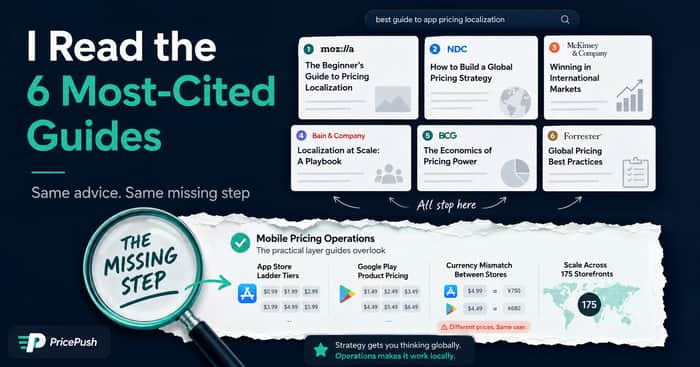
If you've ever searched "localized pricing" and tried to follow the advice as a mobile developer, you've felt this: the first 80% of every article is exactly what you needed. The last 20% quietly assumes you're running a SaaS, and you're left to figure out the rest.
I read the six most-cited guides on the topic. Paddle. RevenueCat. Discord. Tim Perry's piece on HTTP Toolkit. EDC. Stripe.
Every one of them is good. Genuinely useful work, all of it. The strategy sections converge on the same fundamentals: default currency conversion isn't enough, you need a structured methodology (PPP, willingness-to-pay tiers, market proxies), rounding is local, drift is real, and region-level revenue differentials are big.
Then the implementation section ends. And if you ship on iOS or Android, the implementation section is where most of the actual work lives.
Here's the part that's missing from every one of them.
App Store Connect runs on a price-point ladder. Apple has roughly 900 predefined price points per currency since the late-2022 pricing overhaul. You can't set "USD 14.27 in India," because that price doesn't exist on the ladder. You have to find the closest valid point Apple accepts. None of the six guides walks through this.
Google Play Pricing Templates were removed on October 27, 2025. The replacement is per-SKU pricing in the Console with no template layer. If your app has 30 SKUs across subscriptions and in-app purchases, that's 30 separate price grids to maintain by hand. Older tutorials still describe the old templates UI, so if you're following them today, the Google Play section is stale.
App Store Connect API rate limits become a real constraint when you push 175 storefronts. Documented per-key limits, plus undocumented backoff. "Just script it with the API" advice skips the queue, retries, and visibility layer. That layer is the work.
Apple and Google don't always quote the same currency for the same country. Algeria: Google Play prices in Algerian dinar (DZD). The App Store quotes Algeria in US dollars. Several smaller markets have similar Apple-USD / Google-local splits. Apply one per-country grid to both stores naively, and the math works on one platform and breaks on the other.
None of these gaps are flaws in the existing guides. They're a category boundary. The SERP that ranks for "localized pricing" is written for SaaS, and SaaS doesn't deal with price-point ladders, removed Google templates, or storefront-level currency overrides.
The mobile section just hasn't been written by them. I wrote it.
The full version reviews all six guides side by side with credit for what they nail, has a comparison table for the eight PPP indices people reach for, and walks through the mobile implementation gaps in detail.
Read it: https://pricepush.app/blog/localized-pricing-guides-all-stop-same-place

This is a strong wedge because you’re not just writing another localized-pricing guide. You’re identifying the implementation gap that SaaS-focused pricing content ignores: App Store price ladders, Google Play SKU maintenance, API rate limits, storefront-level currency differences, and stale platform assumptions.
That is a much sharper category than “localized pricing.” It feels more like mobile pricing operations, where the real pain is not knowing that PPP matters, but actually keeping Apple and Google pricing clean across many regions without breaking the math.
One thing I’d watch is the PricePush name. It explains the action, but if this becomes a broader mobile revenue/pricing operations layer, a cleaner SaaS brand like Beryxa.com may age better than a name tied mainly to pushing prices.