I realized AI agents don’t fail because they can’t think. They fail because their tools are chaos.
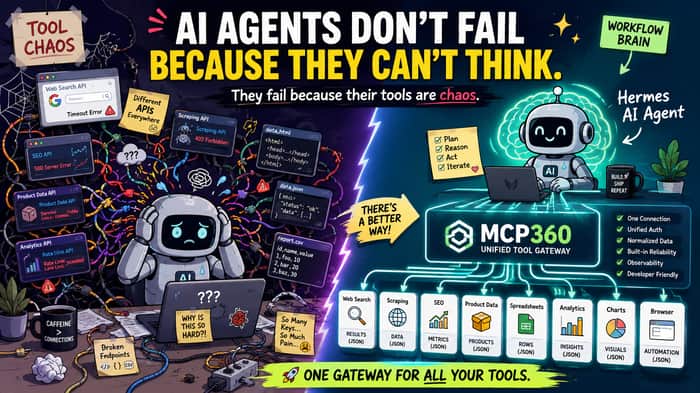
I’ve been looking at how autonomous agents break in real workflows.
The surprising part?
It’s usually not the agent’s planning that fails.
It’s the integration layer.
You ask an agent to do something useful like:
“Research this market, scrape competitors, check SERPs, compare product listings, and generate a report.”
Sounds simple.
But under the hood, the agent now has to deal with:
5 different APIs
5 auth methods
5 response formats
weird rate limits
broken endpoints
raw HTML here, JSON there, CSV somewhere else
random errors that kill the workflow
At that point, the agent isn’t really “working.”
It’s babysitting integrations.
That’s why I think the next big unlock for AI agents is not just better reasoning.
It’s unified tool access.
I wrote about connecting Hermes AI Agent with MCP360 for this exact reason.
Hermes handles the workflow:
Planning → execution → memory → reusable skills.
MCP360 handles the messy external tool layer:
Search, scraping, SEO tools, product data, custom APIs, routing, auth, formatting, and normalized responses.
So instead of connecting your agent to 20 separate tools…
You connect it to one MCP gateway.
That separation feels obvious once you see it:
Agent = workflow brain
MCP gateway = tool infrastructure
This makes agent workflows way easier to scale, debug, and maintain.
A few workflows this unlocks:
SEO research without switching platforms
competitor monitoring across search and content
Walmart/Amazon product tracking
sales research before outreach
market research reports from multiple sources
The bigger lesson:
Most people are still building agents like demos.
But production agents need infrastructure.
And in production, the boring layer wins:
Reliable tool access.
Consistent outputs.
Cleaner retries.
Less custom glue code.
I think indie hackers building AI products should pay close attention to this.
The winners probably won’t just have “smarter agents.”
They’ll have agents connected to better tool systems.

This matches what I've been seeing too, but from a different angle — unified tool access (which MCP360 sounds like it handles well) fixes the "babysitting integrations" problem, but there's a second failure mode underneath it: even with clean tool access, one agent's wrong output becomes another agent's trusted input, silently. The tools were never the only chaos — it's also that nothing states whether what an agent just told you is settled or still provisional. Ended up building explicit trust boundaries into every agent for exactly this reason. Complementary problem to what you're solving, not a replacement for it.
The interesting thing is that humans often have the same problem.
Most businesses don't struggle because they lack information.
They struggle because important information is scattered across emails, meetings, chats, notes, customer conversations, and a dozen other places.
The challenge stops being access to information and starts becoming visibility into what actually matters.
That's usually where things break down.
This is exactly why I'm building around tool orchestration first — Make connecting 21 tools in a structured flow. The chaos isn't the AI, it's the plumbing between tools. What's your current stack for keeping agents grounded?
This feels accurate — most agent failures in production are not reasoning failures, they’re integration failures.
Once you move past demos, the real complexity shifts into tool reliability: inconsistent schemas, brittle APIs, auth edge cases, and partial failures that don’t surface cleanly to the agent. At that point, even a strong model can’t compensate for messy inputs.
The idea of separating “workflow brain” from “tool layer” makes a lot of sense in that context. It mirrors what happened in software engineering more broadly — abstraction layers always win when systems scale.
Where it gets interesting is observability and recovery. Even with a unified gateway, agents still need predictable state, retry logic, and visibility into what actually happened step by step. Without that, debugging remains painful.
So yeah, reasoning is no longer the bottleneck. Infrastructure and tool standardization are becoming the real differentiator for production agents.
It's the system of record then that will last the test of time because AI is going to keep cannibalising any smart tools
The interesting part to me wasn't the infrastructure argument.
It was how differently the product looks depending on where you believe the bottleneck actually is.