I realized showing problems isn’t enough — so I built this
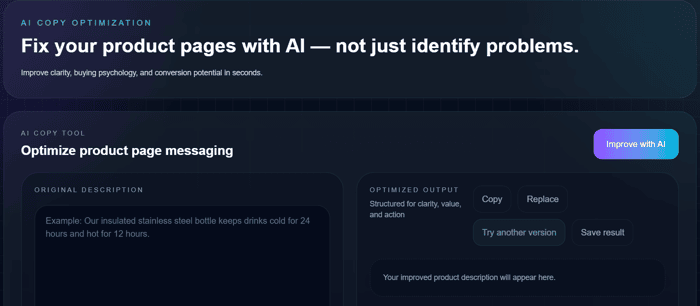
I built a Shopify audit tool that shows what’s hurting your conversions.
At first, it only told you what’s wrong.
But something felt off.
People don’t just want problems — they want fixes.
So I added AI that rewrites product descriptions based on clarity, structure, and conversion principles.
Now it’s not just:
“here’s what’s broken”
It’s:
“here’s how to fix it”
We also simplified the product:
• Free → 1 audit + top 3 issues
• Pro → full audit + AI + exact fixes
Already seeing people use it to improve their product pages and fix conversion issues.
Still early, still improving — but this feels like the first real version of the product.
Curious what you’d build next 👇

solid pivot. weve been through the exact same evolution with our web analysis tools. v1 just showed raw data — here are your SEO issues, here are your speed problems. nobody did anything with it. v2 added priority scoring and specific fix instructions for each issue, and suddenly people actually used it. the gap between "heres whats wrong" and "heres exactly how to fix it" is where all the value lives. most audit tools stop at diagnosis. the ones that win are the ones that prescribe.
That’s exactly the pattern I’ve been seeing as well.
The moment you move from “list of problems” to “prioritized fixes with actual implementation,” usage changes completely.
I’m building around that idea for ecom stores — if you’re curious, would love to hear how it feels from your perspective.
This is exactly the shift that separates tools people bookmark from tools people actually use daily. Diagnosis without a path to action creates more anxiety, not less.
We went through a similar evolution building AnveVoice (AI voice assistant for websites). Early versions could identify that users were struggling to navigate or find things on a site. But the game-changer was making the AI actually DO things — click buttons, fill forms, navigate pages — by voice command, not just tell you what's broken.
The "here's the fix, one click to apply" model you're describing maps perfectly to e-commerce. Store owners don't want to learn copywriting — they want better product pages. Same reason our users don't want to learn UI navigation — they want to get things done hands-free.
What's your conversion rate on free audits → paid users? That jump from "showing value" to "capturing it" is where most tools leak.
Really like how you put that — especially the “bookmark vs daily use” distinction.
We launched this version about a week ago, so still early, but already seeing initial traction and first paid users coming in.
Right now most of the focus is on improving that free → paid jump by making the value feel immediate and actionable.
That transition is definitely where everything happens.
Love this insight — diagnosing why something performs poorly is only half the battle. Too many tools stop at “here’s what’s wrong,” but real value comes when you help people fix it — and even better when you make that fix as frictionless as possible.
One pattern I’ve noticed (especially in e‑commerce tools) is that the jump from prescription → action is where adoption really takes off — not just pointing out problems, but giving users something they can implement with minimal cognitive load. It’s like showing someone a leaky tire vs. giving them the plug and instructions.
Curious though — what signals or metrics are you using to decide whether an AI‑generated recommendation is “good enough” to ship? Because quality here really makes or breaks trust with merchants.
Really good question.
Right now we’re focusing on a mix of clarity, specificity, and how actionable the output is — not just whether it sounds “good.”
If a recommendation is too generic or requires too much interpretation, it usually won’t get used.
So we’re iterating a lot based on real usage — what people actually implement vs. ignore — and refining from there.
Still early, but that feedback loop has been really valuable.
If you get a chance to try it, would be great to hear your take:
www.storeauditpro.com
This is the core insight behind every successful diagnostic tool: diagnosis alone creates anxiety, not action. You've essentially figured out that the product isn't the audit — it's the confidence to execute the fix.
The freemium cliff (3 issues visible, fixes locked) is smart. The user already believes the tool found real problems because they can see 3 of them. That belief is what makes upgrading feel safe rather than speculative.
The pattern generalizes — SEO tools, SaaS metrics dashboards, ad auditors. The ones that just show "your score is 42/100" leave users paralyzed. The ones that say "here's exactly what to change, in this order" convert and retain. You're building the right version of this.
This is such a good way to put it.
The “diagnosis creates anxiety, execution creates confidence” part really resonates — that’s exactly the shift we’re trying to make.
And yeah, the freemium cliff is meant to build that initial trust before asking people to go deeper.
Still iterating on how to make the path from insight → action as clear and immediate as possible.
If you’re curious, would love your take on how it feels in practice:
www.storeauditpro.com
Nice shift — pointing out problems is easy, giving fixes is what people actually pay for.
Next step I’d try: show a quick “before → after” result so users instantly see the impact.
Appreciate that — totally agree.
The “before → after” is exactly what we’re moving toward, because that’s what really makes it click for people.
Right now we’re already showing impact in terms of potential lift, but making it more visual and immediate is definitely the next step.
If you get a chance to try it, curious if that part feels clear enough:
www.storeauditpro.com
we went through the exact same evolution with our seo tools. started with a basic analyzer that just spit out a list of problems — missing meta tags, slow page speed, broken links etc. and yeah, people would run the audit, see 47 issues, feel overwhelmed, and close the tab.
the "here's what's wrong" to "here's how to fix it" shift is everything. we ended up bundling our tools with actual cheat sheets and templates (search vemtrac on gumroad) so people could go from "your meta descriptions suck" to "here, this is what a good one looks like for your industry."
the free/pro split is exactly right too. we give away the diagnostic tools for free and charge for the templates and guides that actually help you act on the findings. still figuring out how to get more people to that first aha moment though.
This is exactly the pattern I’ve been seeing too.
People run an audit, see a long list of issues, feel overwhelmed… and then nothing changes.
We’re trying to close that gap by going beyond just “what’s wrong” and making it easier to actually act on it — especially on the copy and conversion side.
That “first aha moment” you mentioned is spot on — still optimizing for that.
If you’re curious how we’re approaching it, would love your take:
www.storeauditpro.com
Moving from "here's a problem" to "here's the fix" is how you build a product people actually pay for. The Pro tier with exact fixes sounds like a solid value prop for busy Shopify owners. Nice work on the pivot!
Appreciate that — that’s exactly the direction we’re going.
Trying to move away from “advice” and closer to something store owners can actually act on immediately.
Love this! AI creates so many new possibilities and ways of problem solving. Great time to be building a product.
Appreciate it!
Feels like we’re just getting started — especially in ecom where most tools still stop at showing problems instead of helping fix them.
This resonates. Had a similar realization building tools for SaaS founders — most people know they should track MRR, churn, runway, etc. But knowing what to track and actually having a system to do it are two different things.
That's why I went from "here are the metrics you need" to building actual plug-and-play Excel templates that do the work for you — a SaaS metrics dashboard, a runway planner, and a fundraising CRM.
The shift from "awareness" to "actionable tool" is where the real value lives. Sounds like you nailed that with the AI copy fix. How's adoption been since adding the fix-it feature?
https://tobiasboscob.gumroad.com
This resonates a lot.
The “awareness → action” shift is exactly what we’re focusing on.
Early adoption has been promising — especially when users can go from insight to actual fix quickly. Still working on making that flow as frictionless as possible.
That’s a solid realization.
A lot of people point out problems but don’t actually build solutions.
Curious, how are you planning to get your first users?
Appreciate that.
Starting with founder-led distribution — posting, engaging in ecom communities, and talking directly to store owners.
Already getting early usage and feedback, which helps us refine what actually drives conversions.
The jump from "here's what's wrong" to "here's how to fix it" is exactly the right move, but I'd push you to think about what comes after that too. I've built a few audit-style tools and the pattern I keep seeing is: diagnosis alone gets you trials, prescriptions get you conversions, but one-click implementation gets you retention.
The free tier showing top 3 issues is smart because it creates a natural cliffhanger. People see 3 problems and immediately wonder what else is broken. That's a way better conversion hook than just limiting features.
One thing I'd watch — the AI rewrite quality is gonna make or break this. Store owners are surprisingly protective of their voice even when their copy is objectively bad. If the rewrites feel generic or "AI-y," people won't use them regardless of how good the audit is. Have you thought about letting users paste in example copy they like so the AI can match their tone? That'd be a meaningful differentiator from every other "let AI rewrite your stuff" tool out there.
What's the average audit completion rate looking like so far?
This is a really sharp breakdown — especially the “diagnosis → prescription → implementation” part.
That’s actually the direction we’re already building toward.
Right now, users don’t just get generic rewrites — the output is structured (headline, paragraph, bullets, CTA) so it’s immediately usable, not something they have to rethink from scratch.
On the brand voice side — we’re aware that this is critical. The system is already designed to adapt based on the input context, and we’re working toward giving users more control (including reference-style inputs) so it doesn’t feel generic or “AI-ish”.
And yeah — the 3-issue free tier is intentionally designed as a cliffhanger. We’ve seen that once users understand what’s actually broken, the upgrade decision becomes much more natural.
Still early, but usage has been strong and feedback so far has been very positive across different ecom setups — not just Shopify.
Appreciate you calling this out — you’re exactly pointing at where this category is heading. 🚀
This is a great evolution.
One thing I keep seeing:
Even “here’s how to fix it” is sometimes not enough — because it still requires effort.
The real jump seems to be:
→ from “advice”
→ to “default action”
Meaning:
If users still have to decide, rewrite, implement — many won’t.
Curious if you’ve thought about going one step further:
Actually applying the change automatically (with approval), not just suggesting it.
That’s usually where tools go from “useful” → “sticky”.
This is spot on — the real value is in reducing execution friction.
We’re already working toward that direction: not just showing what to fix, but helping users apply improvements with minimal effort.
Fully automated (with approval) is definitely where this goes next.
The shift from "here's what's broken" to "here's how to fix it" is the right call. Diagnosis is cheap, prescription is what people actually pay for. The free/pro split makes sense too — the free tier proves the tool works, the pro tier sells the outcome. What's been your main acquisition channel so far, the Shopify app store or somewhere else?
Exactly — that shift was the key realization for us.
We saw that just showing problems isn’t enough. Most store owners already suspect something is off — but they need clear direction on what to actually change.
So we built the product around actionable fixes:
→ what’s wrong
→ why it matters
→ exactly how to improve it
The free tier helps surface the issues, but the real value comes from helping users execute and improve their pages.
On acquisition — so far it’s been mostly organic (Indie Hackers, X, founder-led sharing).
We already have a solid base of customers using it, and the feedback has been very positive — especially around how practical and easy it is to apply the improvements.
Also, we built it to work across any ecommerce store, not just Shopify — so the use case is quite broad.
Still early, but definitely validating the direction.
This resonates a lot.
I think the missing layer is that people don’t just need to see the problem — they need to feel something about it.
I’ve been experimenting with this in a small project, and what surprised me is:
👉 even when the problem is clear, engagement doesn’t happen unless the interaction itself is interesting
It made me rethink whether solving a problem is enough…
or whether the experience of discovering the solution matters just as much.
Curious how you’re thinking about that —
do you see products as purely functional, or something closer to an experience loop?
That’s a really good point.
I’ve noticed the same — people don’t act just because they see the problem, they act when it actually clicks emotionally.
Feels like the way the insight is delivered matters almost as much as the insight itself.
That’s something I’ve been trying to build around too.
What kind of interaction made the biggest difference for you?
For me, the biggest shift came from moving away from “presenting value” to making the user do something small to unlock it.
Instead of just showing options, I started experimenting with interactions where the outcome isn’t fully known upfront — something closer to a moment of discovery.
One simple example I tried was introducing a dice/roll mechanic, where users trigger an action and get a result rather than passively choosing from a list.
What surprised me was that even though the underlying value didn’t change, engagement went up because it felt more like a rewarded action than a decision.
It made me think that sometimes it’s not about reducing friction completely, but about reshaping it into something playful and anticipatory.
Curious if you’ve explored anything along those lines — where the interaction itself carries part of the motivation?
Smart move — I went through the same realization building analytics dashboards. Showing store owners their CAC is too high means nothing if they don't know which channels to cut. The "diagnosis without prescription" gap kills engagement fast.
One thing I'd watch out for though: how do you handle cases where the AI rewrite clashes with a brand voice the merchant spent months building? That's where I've seen automated copy tools get pushback.
Yeah, that’s exactly the gap we ran into.
Showing problems without a clear way to fix them just doesn’t stick.
On the brand voice point — totally agree, that’s where a lot of tools fall short.
Right now the goal isn’t to replace a brand’s voice, but to give a clearer, more structured version that’s easier to adapt.
Most outputs are meant to be a strong starting point, not a final drop-in.
Longer term, we’re thinking about letting users steer tone/voice more directly so it feels closer to their brand from the start.
Curious — how did you handle that in your dashboards?