I rebuilt my tattoo tool around visual references and artist briefs
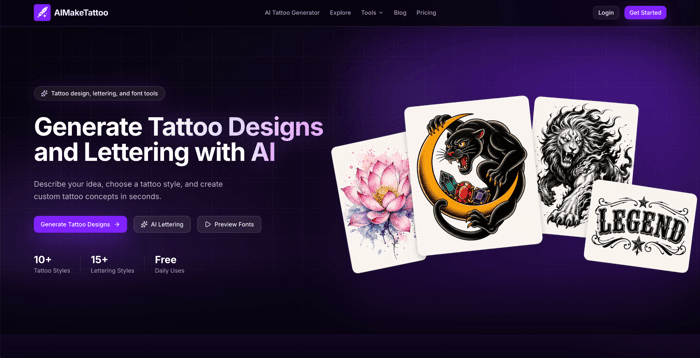
I shared AIMakeTattoo here a few weeks ago as a small AI tattoo idea, lettering, and font preview tool.
Since then I’ve received feedback from a few places that made me rethink the positioning.
Some people focused on image quality and whether the designs looked too AI-generated. Some pointed out that the more useful part might be the handoff to a tattoo artist. Others questioned whether the product is really about generating images, or about helping users make a clearer decision before they talk to an artist.
I also spent more time looking at real tattoo communities. One thing became clearer: complex tattoo references are not automatically useless. A lot of real tattoos are highly detailed, especially larger pieces, Japanese work, realism, black and grey, illustrative tattoos, and game/anime-inspired designs.
So I don’t think the answer is to make every output extremely simple or “safe.”
The direction I’m testing now is:
rough tattoo idea
→ strong visual reference
→ artist discussion brief
→ artist adaptation
That feels more useful than just saying “AI tattoo generator.”
Recent changes:
- improved the visual direction and homepage presentation
- moved the product away from generic AI SaaS styling
- improved the AI tattoo generator around tattoo-style visual references
- added copyable Artist Briefs after generation
- added a Roman Numeral Tattoo Generator for dates, birthdays, anniversaries, and memorial-style ideas
- added a Tattoo Cost Calculator for rough planning ranges
- added Explore pages for tattoo idea references
- added Blog content around artist communication and AI concept vs final execution
- improved SEO/structured data for the main tool pages
The positioning I’m leaning toward is:
AIMakeTattoo helps people turn rough tattoo ideas into visual references and artist discussion briefs.
If someone likes a generated design, they can bring it to a tattoo artist. The artist can then adapt it for placement, size, line work, readability, and final execution.
That feels more honest than pretending every output is ready to tattoo directly, but stronger than treating the image as just a throwaway AI mockup.
Site:
https://aimaketattoo.com
I’d appreciate blunt feedback on:
- whether “visual reference + artist brief” is clear
- whether the homepage still feels too much like a generic AI generator
- whether focused tools like Roman numerals, lettering, and cost planning make the product stronger
- whether this feels more useful as a consumer planning tool or eventually as a shop-facing intake workflow

I think the positioning became much clearer once the artist stayed in the story.
You're no longer competing with tattoo artists or promising a finished design. You're helping people arrive at the consultation with better clarity. That shifts the product from "AI makes your tattoo" to "AI helps you communicate your idea," which feels like a much stronger position.
That’s a really good way to put it.
The image is still useful, but the stronger position is not “AI makes your tattoo.” It’s helping someone show up to the artist with a clearer idea, better references, and fewer vague instructions.
I still need to test whether people actually use the brief in real artist conversations, but this feels much closer to the right direction.
I'm glad it resonated.
Your last sentence is the part that caught my attention.
I have a thought about that test which I'd rather explain in the context of your product than as a generic opinion.
If you're open to it, what's the best email to reach you on?
Sure — you can reach me at hello@aimaketattoo.com
Thanks! I’ve just sent it over.
Looking forward to hearing your thoughts whenever you have a chance.
“Visual reference + artist brief” is clearer, but the missing signal isn’t another opinion on the positioning; it’s whether someone actually uses the brief in an artist conversation. I’d test it with 10 people actively planning a tattoo: give each a reference + copyable brief, then track whether they send it to an artist or ask you to revise it. That result would also tell you whether the consumer-planning path deserves focus before exploring shop intake. Has anyone used one of the briefs with an artist yet?
That’s fair.
I don’t have enough evidence yet that people are actually using the brief in real artist conversations. Right now it’s still a product hypothesis based on the friction I kept seeing: rough idea, unclear style/placement/detail choices, and uncertainty about what to tell the artist.
I think the next useful test is exactly that: give a few people a reference + copyable brief and see whether they send it to an artist, ask for revisions, or ignore the brief.
I’m also considering asking a few tattoo artists to review the brief format directly, to see whether it would make a consultation easier or just add noise.
I’d treat recruiter-reviewed match → employer action as the first test: for one fixed cohort, track matches shown, employers who engage, and interview requests within the same time window. What result would be strong enough for you to call the shortlist promising?
For AIMakeTattoo, I think the equivalent test is:
reference + brief shown
→ user copies or shares the brief
→ artist responds or asks for changes
→ user comes back to refine the idea
I’d call the first version promising if a few users actually send the brief to an artist, and at least one or two artists say it makes the idea easier to understand rather than adding noise.
Yep — that’s the right equivalent chain.I’d just make “a few” explicit before running it: 5 people actively planning a tattoo, with a first-pass win being at least 2 sending the brief and at least 1 artist saying it made the idea clearer.No new features during the test. Do you already have those 5 people, or is recruitment still the blocker?If you run it, post back just four counts: shown / sent / artist said clearer / returned to refine.
That makes sense.
I don’t have the 5 people yet, so recruitment is still the blocker. But I like the four-count test: shown / sent / artist said clear / returned to refine.
I did see one early user go anonymous trial → login → multiple generations around the same tattoo idea, changing placement/proportion from forearm to back to wrist. Not proof of the brief workflow, but it suggests people may use this for comparison/refinement, not just one-off image generation.
Next step is to run the 5-person test without adding new features.
That repeat-generation user is real evidence for comparison/refinement — just not yet for the artist-brief handoff.Since recruitment is the blocker, I’d use that behavior as the filter: contact that user if possible, then the next users who make 2+ versions around the same idea. Ask only whether they plan to contact an artist in the next 30 days, and invite the yeses into the brief test.Could you post back just contacted / qualified / agreed? Even 10 / 2 / 1 would show whether the gap is user access or willingness to run the workflow.
That’s a useful filter. I’ll use repeated refinement around the same idea as a signal, then focus on people who are actually planning to contact an artist soon. I’ll track contacted / qualified / agreed and post back once I have a small sample.
good news