I Rejected a $15K Acquisition Offer for My Multi-Agent IDE — Here's the Full Breakdown
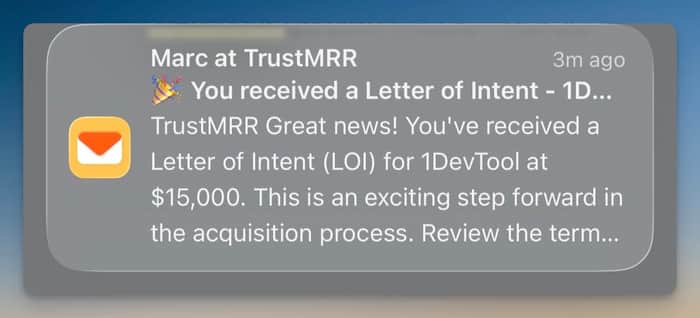
Last month, a CTO offered me $15,000 to acquire 1DevTool, my solo-built desktop app for AI coding agents.
I said no.
This isn't a "follow your passion" post. It's a detailed breakdown of the exact valuation math, the decision framework I used, and the concrete moves I'm making instead — so if you face a similar moment, you have something more useful than vibes.
What is 1DevTool, and What Were the Numbers?
1DevTool is a local-first desktop app that lets developers run multiple AI coding agents — Claude Code, Codex CLI, Gemini CLI, Aider, Cline, local models — from one unified GUI instead of juggling 6 terminal windows across 4 monitors.
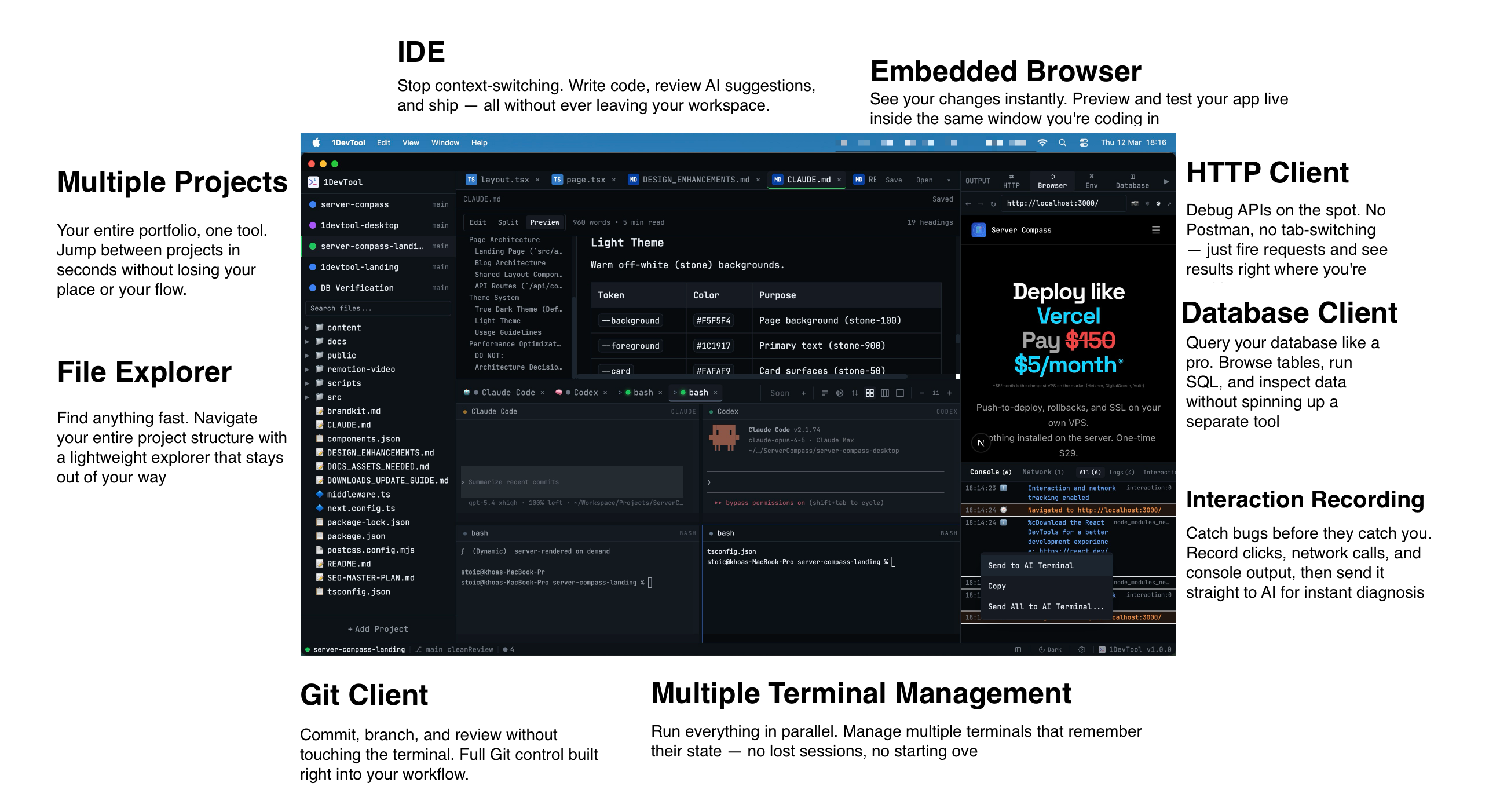
Core positioning: neutral aggregator, one-time purchase, BYOK, data stays on your machine.
Pricing tiers at time of offer: $29 / $69 / $89 (lifetime).
Metrics at the time of the offer:
-
MRR: ~$300/mo
-
Annualized revenue: ~$3,600/yr
-
Active users: ~20
-
Users in close feedback loop: ~10
-
International sales (zero intl. marketing): ~3/month
-
Primary channel: Vietnamese dev communities
-
Age of product: < 12 months
The Offer: Was It Fair?
The buyer — I'll call him Marcus — was a CTO who had actually used the product. He filed real bugs, gave real feedback, and made a clean cash offer: $15,000 at close, full acquisition of code and customer list.
Valuation math:
-
$15K ÷ $3,600/yr ARR = 4.17x ARR multiple
-
Typical range for one-time-purchase desktop software on Acquire.com or MicroAcquire: 1.5x–3x ARR
-
So on a pure multiple basis, this was a fair-to-good offer
But ARR multiples are the wrong lens for an early-stage product with a non-linear growth story. The right question isn't "is this a fair price for today?" It's "what does today's price imply about the ceiling?"
At $15K, Marcus was implying a terminal value roughly equivalent to 4 years of flat $3.6K/yr revenue — with no growth, no upside, and a modest risk discount. That's the bear case priced as the base case.
Why I Almost Said Yes: The Fear Inventory
I want to be honest about what was actually scaring me, because I think most "sell vs. keep" posts skip this.
Fear 1: The big labs are shipping their own IDEs — and they're good
OpenAI launched Codex with native computer use built in. That's not a plugin or a third-party integration — it's first-party, deeply integrated, and ships with the full weight of OpenAI's distribution behind it. Anthropic, Google, and others are moving in the same direction. When a lab ships their own IDE, they're not just a model provider anymore — they're a direct competitor with zero marginal cost to bundle features I charge for.
Fear 2: Competitive intensity is accelerating
Cursor, Windsurf, Claude Squad, and others are all well-funded and shipping fast. I'm one founder in Vietnam.
Fear 3: I was spread thin
At the time I had multiple products in flight — 1DevTool, Server Compass, plus content properties. Selling one felt like buying focus.
These were my reasons to sell. They were real. I wrote them down. Then I wrote the other list.
Why I Said No: The Conviction Inventory (With the Actual Reasoning)
1. The neutral aggregator moat is structural, not temporary
This is the insight that mattered most.
Anthropic optimizes for Claude adoption. OpenAI optimizes for Codex stickiness. Cursor has a financial relationship with Anthropic. None of them have incentive to build a layer that works equally well across competing models.
But power developers don't monoculture their stack. They use Claude for long-context reasoning, Codex for fast completions, Gemini for multimodal, local models for privacy-sensitive work. The AI coding stack is fragmenting, not consolidating, at the model layer — even if individual vendors want it to consolidate at the client layer.
The insight: every new AI CLI that ships is a growth event for 1DevTool, not a threat. Each new tool means one more terminal window that needs to live somewhere.
This structural advantage doesn't depend on beating Anthropic at features. It depends on staying neutral when everyone else is choosing sides.
2. The Vietnam/SEA signal was being misread as a weakness
I had ~3 international sales/month with zero international marketing effort. I was reading this as a low ceiling.
It's the opposite signal.
Anthropic won't write Vietnamese content. They won't engage Vietnamese dev Discord servers. They won't show up in SEA-specific dev communities. The 3 organic foreign sales were happening despite zero supply-side effort — meaning there's demand with no competition for it.
The correct read: There's a market segment that first-party tools structurally cannot serve. I can. That's a durable niche, not a limiting one.
To validate this, I mapped where my organic traffic was actually coming from. The result: developers in Vietnam, Indonesia, and the Philippines — all markets where AI coding tools are popular but localized content is nearly nonexistent.
3. SEO compounds; selling means giving away compounding
I've been building content across three properties with consistent cross-linking. None of those properties were earning meaningfully at the time of the offer. But SEO doesn't pay linearly — it pays on a delay curve with a hockey stick tail.
The keywords I'm targeting aren't high-volume generic terms. They're intent-specific, low-competition terms that larger players ignore:
-
claude code GUI— developers who know the tool but hate the terminal experience -
multi agent IDE desktop— the workflow, not the brand -
BYOK AI workspace— the pricing model as the differentiator -
run Claude Code and Codex together— the exact problem 1DevTool solves
Selling at month 8 would mean handing a compounding SEO asset to a buyer who'd extract the value I planted. That's the equivalent of selling a stock the day before it vests.
4. One-time pricing is a genuine differentiator at this specific moment
Subscription fatigue is real and growing. A developer who runs Claude Max ($100/mo) + GitHub Copilot ($19/mo) + Cursor Pro ($20/mo) is already paying $1,600+/year in AI tooling subscriptions.
1DevTool at $29 one-time
I also believe I'm underpriced. The fact that Marcus — a CTO — offered $15K for the whole company suggests the per-seat value is significantly higher than my pricing.
5. The downside of keeping is bounded
This is the most underrated reason.
Keeping: I use 1DevTool every day. It is my daily driver. The marginal maintenance cost is near-zero because I'm using it regardless. Worst case is I ship no new features and it generates $0 — no capital lost, no time lost beyond what I'd spend on my own workflow anyway.
Selling: I give away all upside. I lose my daily workflow tool. I accept a price that assumes the bear case. And it doesn't even solve the competitive fear — that risk just transfers to the buyer. I'm paying someone else to hold my upside.
The asymmetry is obvious when stated this way. Keeping has a bounded downside. Selling has an unbounded downside (what if it was worth $200K in 18 months?).
The Reframe: This Was a Focus Decision, Not a Sell Decision
When I put the two lists side by side:
-
3 fear-based reasons to sell (features copyable, cost headwinds, competitive pressure)
-
5 conviction-based reasons to keep (structural moat, untapped SEA market, SEO compounding, pricing position, bounded downside)
The honest conclusion was: I was considering selling a growing asset to solve an attention problem. Those are different problems with different solutions.
The right fix for "I'm spread too thin" is to cut ambition from other products, not cut the growing one.
What I Did Instead: The Actual Decisions
The 5 Rules I Locked In
Rule 1: Floor is $15K — but only for a focus decision, never a fear reflex.
I won't sell below $15K. And even above $15K, I only sell if it's a deliberate strategic reallocation — not because I'm scared of Anthropic's roadmap.
Rule 2: Convert the buyer into a power user.
I sent Marcus a free lifetime license and told him I'm holding and growing, revisit in 6 months. This does three things: (a) keeps the optionality alive, (b) turns a potential future buyer into an active feedback source, (c) costs me nothing. Free option on a future $100K exit.
Rule 3: Let 1DevTool ride on daily-use improvements. Reallocate marketing to Server Compass.
Server Compass has less competition and a cleaner niche. I'm shifting active marketing effort there while 1DevTool grows organically through SEO and product quality.
Rule 4: Freeze scope.
I removed the database client from the roadmap. Fewer features = less maintenance surface = lower solo-founder risk. Depth in the multi-agent niche beats breadth into territory that Cursor and Windsurf own.
Rule 5: Pre-define the shelf trigger.
If organic revenue decays 3+ consecutive months AND I stop using it daily, I'll sell or shelve — on my terms, with a real data room, not from anxiety. The trigger has to be pre-defined, or anxiety makes it for you.
The Honest Takeaway
$15K is 4 months of a decent dev salary in Vietnam. It's not life-changing. The regret of handing away a daily-driver project that anchors your professional credibility — and watching someone else extract the value you built — that compounds in the wrong direction.
My goal is a $10K/mo product portfolio. 1DevTool is one tile in that mosaic. You don't sell a growing tile to buy focus. You cut the tiles that aren't growing and let the good ones ride.
The hardest part of this decision wasn't the analysis. It was being honest about whether I was reasoning from conviction or from fear. Once I separated those two lists, the answer was obvious.
One ask: If you're a solo founder who has faced (or is facing) a sell/keep decision, I'd genuinely like to hear how you ran the analysis. The more data points on this, the better the framework gets.
Building 1DevTool — a neutral desktop hub for multi-model AI development. One-time purchase, local-first 1devtool.com
Follow the build-in-public journey on Indie Hackers or X https://x.com/khoa_solo.

The "I was reasoning from fear, not conviction" line is the whole post tbh. Most sell/keep posts skip that step entirely and just rationalize after the fact.
One thing id add from my own (much earlier) journey - the pre-defined shelf trigger is genius. The version most ppl actually do is "ill sell if it stops feeling fun", which is just anxiety with extra steps. Yours is data-bound and that's the whole game.
Respect for sending Marcus the free lifetime license too. Most founders would burn that bridge. Keeping the optionality alive while turning him into a power user is a 3-move chess play disguised as a polite email 🙌
Yes, I feel a little awkward when rejecting him like this. So when he accepted the discount and continue using the app makes me feel better.
Well done!
$15k feels very different depending on where you are.
If the product has real users, clear growth, and you still have conviction, turning it down can make sense.
The interesting part isn't the offer itself.
It's understanding why the buyer thought it was worth acquiring in the first place.
yes, thinking that there is a buyer who offers a good deal actually boosted my confidence for the app
The point I’d add to Rule 4 is to track agent cost and sprawl as a product signal, not just a personal annoyance. If power users are running Claude Code, Codex, Gemini, Aider, and local models side by side, the pain is not only window management. It is losing visibility into which agent is burning tokens, retrying loops, or sitting idle while the bill grows. A neutral hub that shows usage and budget per model could make the aggregator moat feel measurable, not just convenient.
The fragmentation argument is the strongest part of this analysis. When Claude, Codex, Gemini, and Cursor are all optimizing for their own ecosystems, a neutral aggregator makes sense, especially for devs who use the right model for the right task rather than sticking with one.
One thing I've noticed running DictaFlow alongside these tools: the tool fragmentation is real, but so is the input bottleneck. When you're bouncing between Claude for architecture, Codex for implementation, and Cursor for refactoring, the slowest part is often just physically typing the prompts, especially when the thought is clear but your fingers can't keep up. A hold-to-talk dictation tool that drops text into any terminal or IDE window cuts that friction without adding another tab to manage.
Did you notice any delay in your own workflow between knowing what to ask the agent and actually typing it out, or does the thinking time overlap with the typing enough that it doesn't matter?
Useful breakdown. One thing I’d add before deciding “sell vs keep” is whether the distribution channel is repeatable. With Kinetic Override, I’d value the app very differently if “Android no-root macro recorder” searches and communities consistently convert versus if growth depends on one-off launches.
Having been on both sides of acquisition tables, the number that jumps out isn't the $15K, it's that a CTO wanted it at all on $3.6K ARR. That is roughly 4x revenue for a one-time-purchase tool with no recurring lock-in, which is a real offer, not a lowball. So the question I'd push on is what the buyer saw that you're discounting. Usually it's distribution or a roll-up, rarely the code itself. On the sell-or-hold call, conviction inventories tend to smuggle in the endowment effect. The cleaner test: if you had the $15K in cash today and none of the emotional history, would you buy this business back at that price? If you hesitate, that hesitation is your answer. And I'd weight your Fear 1 heavier than the rest. When the platform owner can bundle your core feature at zero marginal cost, you are renting time, not compounding a moat. That doesn't mean sell today, but the window has an expiry date, and the next offer may not be better.
I agree with you I got the best offer in this case. About the future, it's very depend on how I can grow this app, even though it's one time purchase but if I can increase MRR to $2k-$3k, selling at 3x is achievable
Good Work.. All the best.
What great job you've done, keep going mate!
The part that stands out to me: a CTO offering $15k to acquire it is itself a signal. Nobody pays to acquire something they think is worthless — they're usually buying time, a working codebase, or a head start they don't want to build themselves. So the offer is often a floor on the value, not the ceiling. Saying no makes sense if you believe the ceiling is meaningfully higher.
The harder question is the one you can't answer from a spreadsheet: do you actually want to keep carrying this thing for the next 2–3 years? $15k today vs. a maybe-bigger number later is partly a money decision, but mostly a "will I still care about this in 18 months" decision. Sounds like you already know the answer, which is the whole point.
Curious about one thing — was the offer for the product/codebase, or were they really trying to acqui-hire you? Those are very different deals, and it changes how I'd read walking away from it.
The offer for the product and codebase, also he wants me to implement a team feature (not that complex coz he wants to switch to other payment platform for team pricing), definitely not a acqui-hire.
I think I learn from this is how to make decision in this situation and don't look back. If I can exit with higher -> that's good but if can't happen this way, I accept it too
the SEA market read is the most underrated insight in the post and probably deserves more investment than it's getting right now. zero international marketing producing 3 organic sales a month from Vietnam, Indonesia, and the Philippines is a real signal that the content gap is wide open. curious whether you've done anything deliberate for that segment yet, localized content, presence in specific Discord servers or forums, or whether it's still purely organic discovery. that feels like the highest leverage thing in the whole plan and the post mentions it as an insight but Rule 3 reallocates effort to Server Compass instead
I only posted on my Facebook account, most Vietnamese still use FB these days lol.
I also posted on Build in Public VN group too.
Maybe I got some luck
rejecting it with actual math is the move. $15K for a local-first multi-agent tool - that's an acqui-hire price, not product value. curious what MRR multiple you landed on as your floor.
I'm curious what app sent you the notification that you got a letter of intent? Is it a marketplace for early startups?
It's TrustMRR marketplace
Got it. Thanks for sharing!
The "neutral aggregator moat is structural, not temporary" point is the strongest part of this, and it generalizes well beyond coding. The model layer fragments because each vendor optimizes for its own stickiness — none are incentivized to build the cross-model layer power users actually want. That gap widens with every new model that ships.
I'm on the chat side of this same thesis as a user — I run MultipleChat to keep GPT, Claude and Gemini in one place — so point #1 hit home: every new model launch is a growth event for the neutral layer, not a threat. One thing I'd flag from the user side: "neutral" is a position you have to keep earning. The moment a tool takes a vendor relationship or defaults to one model, the value leaks — your BYOK + one-time pricing protects that better than most.
Also a sharp call separating the focus problem from the sell problem. Selling the growing tile to buy attention is solving the wrong variable.
Totally agree coz we are doing the aggregator approach
This framework is exactly what I needed today.
I'm earlier stage — solo founder, just getting started, a few products in various states of done. But the line "I was considering selling a growing asset to solve an attention problem" stopped me cold. That's precisely the trap I was about to walk into.
I'm building a personal OS dashboard — built specifically around my own workflow, which runs on manic sprints, low-day research, and normal-day QA. It's proprietary, it's weird, and there's nothing else like it on the market. I've been pondering selling it once it's ready because that's what I do — I build and package things. But the truth is I need it. It's the backbone of how I operate.
Your conviction inventory reframe is the thing that clarifies it. The fear is "someone will pay good money for this." The conviction is "nothing else does what this does for how my brain works, and I can't replace it."
Keeping it. Thanks for writing this out properly instead of just saying follow your passion.
Thanks for your kind words. I think if you found something you're working on it daily and love using it. You must keep it. I'm working on many projects, but none of them I use daily like this 1DevTool app. So I can be depressed if I sold it too early like this.
I think you will have the same feeling with your OS dashboard
What stood out to me wasn't the $15K offer or even the decision to reject it.
It was how easy it is for a founder to become more certain as the story gets more coherent.
Sometimes the risk isn't selling too early.
It's becoming confident for the wrong reason.
Curious how you'd know the difference six months from now.
I hope I can increase the revenue to $3k/month (10x from now)
Makes sense.
The reason I asked is that revenue growth and confidence don't always move together.
Sometimes six months later the outcome looks right even though the lesson behind it wasn't.
That's what makes these situations interesting to watch.