I Replied to Every Email for 90 Days. It Was a Mistake
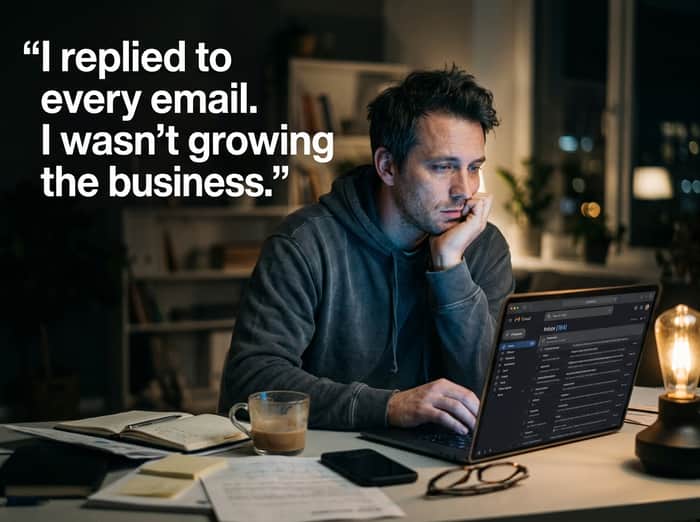
A founder story about good intentions, hidden costs, and what I should have done instead.
For the first 90 days of running Exact Solution, I made a rule for myself.
Reply to every customer email. Same day. No exceptions.
I thought this was what good founders did. I thought it was the difference between a serious business and an amateur operation. Every email got my full attention — the price hagglers, the curious browsers, the buyers comparing six different stores, the "is this still in stock" questions about products that were obviously still in stock because they were listed.
Three months in, I had a healthy inbox response time and a business that wasn't growing.
That's when I realized I'd been working hard on the wrong thing.
What "Reply to Every Email" Actually Looked Like
Let me describe what those 90 days actually looked like, because it's not what I imagined when I made the rule.
I'd start each morning with 15-30 customer emails. I'd answer them carefully — explaining condition grading, walking through warranty terms, comparing products, calculating shipping. Each email took 10-20 minutes to do properly.
Some of these emails were from real buyers. Most of them weren't.
I started noticing patterns:
The price haggler who emailed three times negotiating $20 off a $400 laptop. Who never bought.
The buyer comparing me to a marketplace seller selling untested units for half the price. Who was never going to buy from me.
The "just checking" emails from people who'd already bought from a competitor and were essentially fishing for validation.
The technical questions from people who would have found the answer in 30 seconds on Google.
The "do you have this in red?" questions about products clearly listed in two colors only.
Each email got my best effort. My best effort was being spent on people who weren't going to buy.
What I Wasn't Doing
Here's the part that hurts to admit.
While I was crafting detailed responses to non-buyers, I wasn't doing the things that actually grow a business:
I wasn't fixing the product page issues that were causing real buyers to cancel orders.
I wasn't watching session recordings to understand why people were leaving.
I wasn't reaching out to customers who'd actually purchased to ask what could be better.
I wasn't writing content that would help new buyers find me in the first place.
I wasn't building the operational systems that would let the business scale.
I was answering emails. All day. Every day. For 90 days.
The emails felt productive. They weren't.
The Turning Point
The shift came when I looked at a single number that I'd been avoiding.
Conversion rate from email inquiries.
Of all the people who emailed me in those 90 days, a small fraction actually bought. The vast majority of my email time was going to people who were never going to be customers.
Meanwhile, the people who DID buy mostly hadn't emailed me first. They'd read the product page, checked the warranty, and just placed an order.
The customers I was trying so hard to win through detailed email responses weren't my real customers.
My real customers were the people who didn't need to email me at all.
What I Changed
I stopped treating every email as equal.
I batched email responses to twice a day — once in the morning, once at the end of the day. Not every minute.
I wrote template responses for the most common questions and stopped reinventing them for every inquiry.
I started directing common questions to the FAQ section I'd built but barely used. Instead of writing a 200-word reply about warranty terms, I'd answer briefly and link to the warranty page.
I stopped chasing price hagglers. If someone wanted me to match a price from a seller offering no warranty and no testing, I'd explain the difference once. If they kept pushing, I let them go. They weren't going to be happy customers anyway.
I started focusing on the emails that actually mattered — the customers who had a real problem after purchasing, the questions that revealed something missing from product pages, the feedback that would help me improve.
What Happened After
The change was uncomfortable at first. I felt like I was being a worse founder.
But the data didn't agree.
Sales didn't drop. The customers who would have bought anyway still bought — they didn't need rapid email responses to decide.
The hagglers and tire-kickers stopped consuming my time. Most of them weren't going to buy from anyone — they were just collecting information.
I had time to fix the actual business. I rewrote product pages with the clarity I'd been explaining one-on-one in emails. I watched session recordings and started understanding my real buyers. I made systemic changes that helped every visitor, not just the ones who emailed me.
The business started growing in ways it hadn't been able to grow when I was glued to my inbox.
What I'd Tell Another Founder
Here's what I wish someone had told me on day one:
Every email reply has an opportunity cost. The time you spend on one email is time you're not spending on something else. Most of the time, that "something else" is more valuable than the email.
Most customer questions aren't unique. If you're getting the same question repeatedly, the answer belongs on your product page, in your FAQ, or in a template — not in an individualized response.
Your real customers don't need convincing. People who are going to buy from you mostly don't email first. They read the page, trust what they see, and purchase. The buyers who need extensive convincing usually aren't the ones who will stick around.
Email feels productive. Often it isn't. Be honest about what your time is actually building. An inbox at zero isn't a business metric.
Speed isn't trust. Customers don't trust you because you reply in 5 minutes. They trust you because your product pages are honest, your policies are clear, and your reputation holds up under scrutiny.
What I'm Still Working On
I'm not great at this yet.
I still catch myself drifting into email responses that should be templates. I still sometimes reply to questions that should be in my FAQ. Old habits don't die fast.
But the rule has changed. The new rule isn't "reply to every email." It's "reply when reply is the highest-value thing I can be doing right now."
Most of the time, it isn't.
If you're in your first 90 days of building something — and you're proud of how fast you reply to emails — I'd gently ask: what could you be doing instead?
Exact Solution is where we sell refurbished MacBook Pro, MacBook Air, and other Apple laptops — backed by our 1-year warranty, 30-day return policy, and A+/A/B/C condition grading. We're still figuring out the business side, but we write about what running this store has actually taught us. Visit our Apple collection at exactsolution.com/collections/laptops/apple.

One thing I'd be careful with:
The conclusion may not be that replying to emails was the mistake.
The harder question is whether the emails were actually the bottleneck, or whether they simply made the real bottleneck easier to ignore.
Those sound similar, but they can lead to very different decisions about where to focus next.
I wouldn't assume they're the same thing.