I Run Marketing for 6 SaaS Projects Solo. My "Team" Costs $250/Month.
I'm an engineer. 15 years of writing code, zero years of writing marketing copy.
When I quit my job to go solo, I hit the same wall every technical founder hits: I can build anything, but I can't market anything. The product was great. Nobody knew it existed.
The standard advice? "Just learn marketing." Right. That's a 6-month detour when you're burning savings. Or hire someone -- $3-5K/month for a junior marketer who still needs you to explain your product.
I chose a third option. I built an autonomous marketing team inside Claude Code.
What I Actually Built
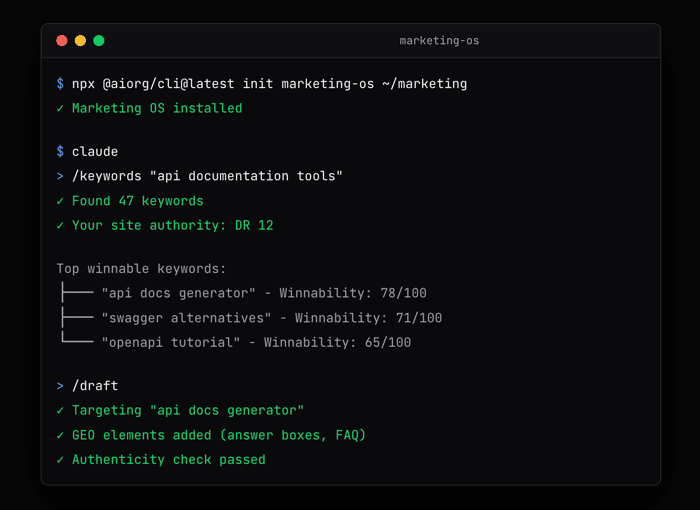
I call it Marketing OS. It's a Claude Code project with 49 slash commands that handles SEO, content strategy, keyword research, outreach, social listening, product marketing, and cold email. The entire marketing stack.
It's not a chatbot I ask questions to. It's a system. I type /next and it tells me the single most important marketing action to take today. I type /draft "keyword" and it writes a full blog post using my brand voice, product context, and SEO data. I type /approve and it creates a PR to my product's repo.
Here's what a typical 30-minute marketing session looks like for me:
- Open terminal, run
/next - It says: "Draft a post targeting 'claude code best practices' -- this keyword has 1,100 monthly searches, KD is low, and you have no MOFU content yet"
- I run
/draft "claude code best practices" - Review the draft, make a few edits
- Run
/approve, it creates a PR - Done. Move on to building product.
That's it. No staring at Google Analytics. No keyword research rabbit holes. No "should I write about X or Y?" The system already figured that out.
The Roles It Replaced
Before building this, I mapped out what a marketing team actually does. Then I built a command for each role:
SEO Specialist -- /keywords finds winnable keywords, /rankings tracks positions from Google Search Console, /opportunities finds quick wins (high impressions, low CTR).
Content Writer -- /draft creates full posts with proper SEO structure, GEO optimization (so AI chatbots cite you too), and my actual brand voice.
Content Strategist -- /setup creates a 90-day content calendar. /next always knows what to prioritize. The system tracks funnel balance (TOFU/MOFU/BOFU) so I don't accidentally write 10 top-of-funnel posts and zero conversion content.
Outreach Manager -- /outreach finds link building opportunities. /listen monitors Reddit, Twitter, and Hacker News for relevant conversations where I can add value.
Product Marketer -- /positioning generates messaging frameworks. /launch plans full Product Hunt campaigns. /changelog turns feature updates into multi-channel announcements.
Social Media -- /social turns blog posts into LinkedIn posts and Twitter threads. Not just "summarize this" -- actually formatted for each platform.
The Honest Part (What AI Can't Do)
Here's where I lose some of you, and that's fine. AI does about 85% of the work. The remaining 15% is irreplaceable.
Creative judgment. The system drafts well, but I still read every post. Sometimes the angle is wrong. Sometimes it's too generic. I rewrite intros, cut fluff, add opinions. The AI gives me a strong B+. I push it to an A-.
Relationships. /outreach finds prospects and writes emails, but I send them from my personal account. I reply to comments myself. I engage on Twitter myself. People connect with people, not systems.
Novel strategy. The system is great at executing known playbooks. It won't invent a new distribution channel. That still requires founder intuition.
Taste. The hardest one to define. Knowing when a headline feels off, when an article is trying too hard, when a CTA sounds desperate. This comes from reading thousands of good posts over 15 years.
I'm not trying to sell you on "AI replaces everything." It doesn't. What it replaces is the grunt work -- the keyword research, the SEO formatting, the content calendar management, the ranking tracking. The stuff that eats hours but doesn't require creativity.
What It Costs
The system runs on four data sources:
- Ahrefs ($99-199/mo) -- keyword data, competitor analysis, backlinks
- Google Search Console (free) -- real ranking data from Google
- ForumScout (~$30/mo) -- social listening across Reddit/Twitter/HN
- Firecrawl ($9/mo) -- scraping JS-heavy competitor sites
Total: roughly $250/month across all 6 of my SaaS projects.
A junior marketer would cost $3-5K/month and handle maybe 2 projects. This handles 6, doesn't take PTO, and remembers every keyword decision it ever made.
The ROI math isn't even close.
What I'd Do Differently
If I were starting from scratch today:
Start with just 5 commands, not 49. I over-engineered early. You really only need /setup, /keywords, /draft, /approve, and /next to get 80% of the value. Everything else is optimization.
Don't skip the product context step. I rushed through /setup initially and the drafts were generic. When I took 30 minutes to properly document my brand voice, target audience, and positioning -- the content quality jumped dramatically.
Invest in Ahrefs from day one. I tried to run keyword research with free tools first. Waste of time. Ahrefs data changed every decision I made. The $99/month pays for itself in the first week.
Track what you publish. The system maintains a content inventory, and that turned out to be more valuable than I expected. It prevents duplicate content, shows funnel gaps, and answers "what should I write next?" without thinking.
How You Can Build This
The core idea is simple: teach Claude Code your marketing domain. The building blocks:
- CLAUDE.md -- Your system prompt. Mine is 800+ lines defining commands, workflows, and marketing knowledge.
- Product context files -- Brand voice, target audience, positioning, what you claim and what you don't.
- Content inventory -- A JSON file tracking every keyword, every post, every ranking. The system's memory.
- Data integrations -- Ahrefs and GSC via MCP servers. ForumScout via API.
You don't need to build all 49 commands. Start with the core 5 and add as you need them.
If you want to skip the building part entirely, I packaged the whole thing as Marketing OS -- one of several AI kits I built for solo founders. It's a complete Claude Code project you install and run against your own product.
The Bigger Picture
I'm not a marketer who learned to code. I'm an engineer who refused to learn marketing the traditional way.
The bet I'm making: in 2026, every solo founder will have AI teammates handling the domains they're weakest in. Marketing. QA. Customer support. Product management. Not as chatbots you ask questions to, but as autonomous systems that know your product, track your progress, and tell you what to do next.
I'm running 6 projects this way. It's working.
If you want the technical deep-dive (architecture, code examples, how the commands work under the hood), I wrote a more detailed version on Dev.to.
I write about building solo with AI as leverage in my newsletter, Engineer to Founder.

Lukas, this is incredible. As a technical founder myself, I relate hard to the "can build anything, can't market anything" wall.
I'm actually taking a similar approach right now with my project, TierWise (PPP pricing automation). I've got an AI agent (inside OpenClaw) handling my lead research and email monitoring so I can stay in "builder mode" longer.
The bit about creative judgment being the irreplaceable 15% is so true. I've found that even with a strong "Marketing OS", you still need to be the one holding the compass.
Checking out Marketing OS now—love the idea of /changelog turning updates into multi-channel announcements. That's a huge time saver!