I sent 10 cold DMs about failed Stripe payments. Here's what actually happened.
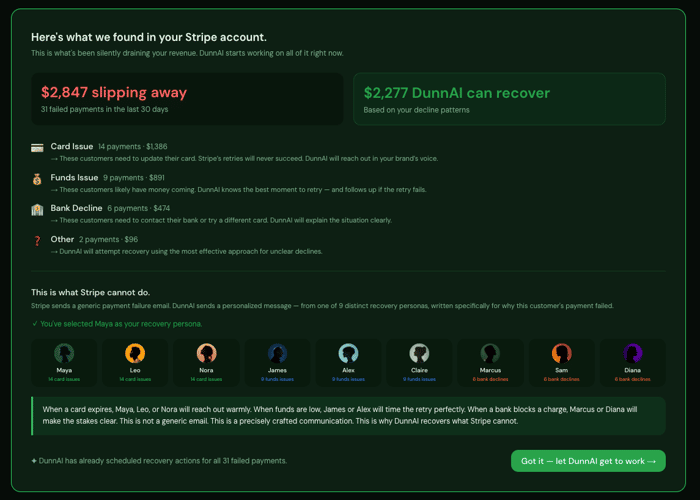
I launched DunnAI two days ago — a tool that recovers failed Stripe payments by handling the communication side that retries alone can't fix.
Then I started reaching out to SaaS founders.
Here's the honest breakdown:
What I sent:
- 10 DMs across X and email.
- Bootstrapped founders, $10K–$70K MRR, all using Stripe.
- What happened:
1 reply:
"I already have my own dunning. Very low failures."
→ fair enough
1 reply: "Sounds interesting!"
→ DM sent, no follow-through yet
8: no response
The real learning:
- Most founders don't think about failed payments until they're staring at the number.
- The only person who replied with real interest was someone who had just posted: "My SaaS would probably be at $10K MRR by now if I could retrieve all of the failed stripe payments."
- He was already feeling the pain out loud. Everyone else wasn't — at least not publicly.
What this means:
- Cold outreach to a list of "SaaS founders who use Stripe" doesn't work well. Outreach to someone who just said "this is costing me revenue" works immediately.
- The lesson isn't about DunnAI. It's about timing. Pain that's already surfaced is a completely different conversation than pain that's dormant.
- Curious — for those of you running subscription SaaS: do you actively track your failed payment breakdown, or is it mostly set-and-forget?
(Building DunnAI — free diagnostic that shows your Stripe failure breakdown in 5 min. The screenshot above is a demo account.)

Full disclosure: I'm Avery Lin (avrlin). I've been packaging a Stripe Dunning Email Pack (failure-reason matrix + retry copy) with AI assistance, so take this as adjacent interest, not neutral advice.
Most involuntary churn isn't "they left" — it's a soft decline that never got a clear, calm retry email. Mapping decline codes to a short ladder recovers more than one generic "update your card" blast.
Curious — do you branch dunning by failure reason, or is it still one template for everything?
10 DMs is a tiny sample but the signal is clear. The one real reply came from someone already talking about the problem publicly. Are you monitoring for those pain signals on X with keyword alerts, or still finding them by hand?
@RirVC Mostly by hand so far — which is exactly as inefficient as it sounds. I've been using Grok to help surface candidates, but the signal-to-noise ratio is rough. The only truly high-quality lead came from stumbling across Zach's post directly.
Keyword alerts are the obvious next step. Are you building something in this space, or asking from a investing/ops angle?
love this. im not making enough money to have failed payments yet but sounds like ur solving a genuine problem dude.
ON the cold outreach front, im sure ur doing it, but genuine human sentence or two about their business is what me in my day job - marketing exec - would actually consider responding too. If it opens with a generic, "love what you" or a cold pitch Im out immediately.
Two responses sayd ur doing somehting right. 1/5 strike rate is good! imagine you had that for every five ppl you asked on a date. big win!
re your screenshot. Doesn't feel super professional TBh (sorry). No one running a business who uses AI is going to trust anything with emojis. Dig into some "aware-winning craft-led art designer" prompts to freshen up the look.
When it comes to income and revenue ppl gotta feel trust. So boost up the trust signals.
@selfservo Appreciate the honest take — especially the trust signals point. That's something I'm actively working on.
Curious which screenshot felt off? Always useful to know what's landing and what isn't from someone with a marketing eye.
yo. just the example you shared.
Really sharp observation. Outreach works way better when it’s aligned with real-time pain signals instead of static targeting.
That’s where intent actually shows up
@youssefessam Exactly — intent isn't in a demographic, it's in a moment. That's the whole reason DunnAI exists: the moment a payment fails is one of those moments where intent to stay is still there, but nobody's meeting it.
Are you running a subscription SaaS yourself?
Yeah, I’m actually building in that space.
Working on a system focused on churn recovery and failed payment flows.
Totally agree with your point, that moment is where most of the real opportunity is
@youssefessam Good to know — sounds like we're working on adjacent problems. Curious what angle you're taking. DunnAI focuses specifically on the communication layer after failure — reading the decline code and sending a message that matches the exact reason. Where are you focusing?
Yeah makes sense. I’m coming at it from a different angle, more focused on post-churn recovery rather than the failure moment itself.
Basically trying to bring users back after they’ve already dropped off
@youssefessam Ah, different moment entirely — you're working downstream of where DunnAI plays. Interesting space. Good luck with it.
Great insight we ran into the exact same thing building ChaChing (a Stripe Billing alternative). Our ICP ended up being companies that had moved out of "growth at all costs" mode and into cost-cutting mode. That was literally our own experience we raised funding (For a previous company), the corporate oversight kicked in, and suddenly every line item was under a microscope. Stripe is great for payments, no doubt. But the smaller stuff dunning, billing logic, subscription management can be done way better and for a lot less. Its tough to get people to realize they have options especially when they have infrastructure built
@isaimeraz The ICP insight is sharp — "moved out of growth at all costs" is exactly when billing inefficiency becomes visible. DunnAI sits on top of Stripe rather than replacing it, so we're solving a slightly different layer. But the "people don't realize they have options" problem is real on both sides.
This is so accurate about timing. I run a Chrome extension SaaS at ~$10K MRR and payment failures were one of those things I completely ignored for months — just assumed Stripe retries handled it. Turns out involuntary churn was quietly eating into my numbers the whole time. Your point about pain that's already surfaced vs. dormant pain is the real insight here — that applies to way more than just dunning.
@FriendFilter Just checking if this landed — happy to walk you through what the diagnostic shows if that's easier than diving in cold.
@FriendFilter That's exactly the pattern — Stripe retries feel like a safety net, so founders stop looking. And then the quiet drain compounds.
At $10K MRR you're probably losing $500–$900/month to failures Stripe won't recover on its own. Expired or changed cards especially — no retry ever fixes those, they need a direct message to the customer.
Would it be useful to run the free diagnostic on your Stripe data? Takes 5 min, shows exactly which type of failures are hitting you — and how much is actually recoverable.
This is a really sharp observation — the difference between targeting a segment vs targeting a moment is huge.
Curious if you’ve thought about detecting this pain before it becomes visible.
Failed payments are happening quietly in most SaaS businesses, but action only happens once it crosses a certain threshold.
Feels like the real opportunity might be in identifying those signals earlier, instead of waiting for founders to express the pain.
@HardikGohil79 That's exactly the right question — and honestly, it points to the next layer of what DunnAI should become.
Right now, DunnAI acts after the failure. But the diagnostic report — showing founders what's already quietly happening in their Stripe account — is the first step toward what you're describing. Most founders connect and say "I had no idea this was happening."
The signal is already there in the decline codes. The question is whether we surface it before the founder feels the pain, or after. I think you're right that before is where the real value is.
Are you building something in this space, or thinking about it from a different angle?
@yoaso That makes sense — especially if the signal is already there in the decline codes.
I’ve been exploring a similar direction, more around how to surface these kinds of signals earlier and turn them into something actionable rather than just visible.
Still figuring it out, but this problem space is definitely more interesting the deeper you go.
@HardikGohil79 Sounds like you're thinking about the layer before the signal becomes obvious — which is genuinely hard. The decline codes give you a reason after the fact, but catching the pattern before it compounds is a different problem.
Would be curious to hear more about what you're exploring. What's the signal you're trying to surface?
@yaoso Yeah — still early, but I’m thinking more in terms of patterns than single signals.
Things like retries, recovery rates, or certain segments drifting over time — nothing urgent on its own, but together it signals something’s about to break.
The tricky part is making that actionable instead of just another dashboard.
@HardikGohil79 "Actionable instead of just another dashboard" — that's the hardest part. The signal is only useful if it tells you what to do next, not just what's happening.
For DunnAI the answer was to make the action automatic — detect the pattern, pick the right response, send it. Less dashboard, more autopilot. Sounds like you're thinking about a similar problem from a different angle.
You found the difference between a list and a signal. "SaaS founders who use Stripe" is a demographic. "Someone who just said this is costing me revenue" is a moment. Outreach works when you meet the pain where it's already loud.
@epopteia "Meet the pain where it's already loud" — that's exactly it. And I'd add: the louder the pain, the more that person needs a human response, not another automated retry. That's the whole reason DunnAI exists.
Saw you're building multiple products solo — are any of them subscription-based? Curious if you've run into this yourself.
Yes, one of them currently is subscription-based.
@epopteia Happy to walk you through what it shows if that's useful — most founders are surprised by the breakdown. getdunnai.com whenever you're ready.
@epopteia Good to know. The reason I ask is that DunnAI started from a belief that the moment a payment fails is actually a relationship moment — and most tools treat it like a bug to be retried away.
The free diagnostic just shows what's quietly happening in your Stripe account. Most founders are surprised by what they see. If you're curious: getdunnai.com
The shift from "bug to be retried" to "relationship moment" is the frame most dunning tools miss. Retries assume the problem is technical. The real problem is usually trust, timing, or a card they forgot existed. That's not a job for another automated attempt.
@epopteia Exactly and "a card they forgot existed" is the key phrase. That customer isn't gone. They're just waiting for someone to remind them in the right way. That's the whole job DunnAI does.
Would it be worth running the free diagnostic on your Stripe data? Takes 5 min, shows exactly what's quietly happening. Feel free to reach out at yo@getdunnai.com if you want to dig into the results together.
Alright, I will reach out to you soon enough. Just got some stuff on my plate right now. Most definitely, I will reach out before the week runs out.
@epopteia No rush at all — I'll be here. yo@getdunnai.com whenever you're ready. Looking forward to it.
been doing something similar but at a much bigger scale — 2,000+ cold emails queued to small businesses offering free SEO audits. the conversion math is brutal at first but it compounds.
your approach of targeting a specific pain point (failed payments) is smart because its actionable and urgent. most cold outreach fails because it leads with "hey i noticed your website could be better" which is vague and ignorable.
one thing i learned from sending hundreds of outreach messages: the ones that reference something specific about the recipients business get 3-4x the reply rate vs generic templates. even just mentioning their city or industry in the subject line made a difference.
did any of those 10 replies turn into actual paying work? thats the part im still trying to crack myself — got the pipeline built but $0 revenue so far.
@vemtraclabs Not yet — still working on that gap myself. "Sounds interesting" is very different from "here's my Stripe key."
Your point about specificity is exactly what I'm learning. The one reply that felt real came from someone who had literally just posted about this pain. Generic list → specific pain moment is the difference.
The pipeline-to-revenue gap is the hardest part. Good luck cracking it.