I shipped background removal this week — and almost let a "nice to have" model eat 1/3 of my server
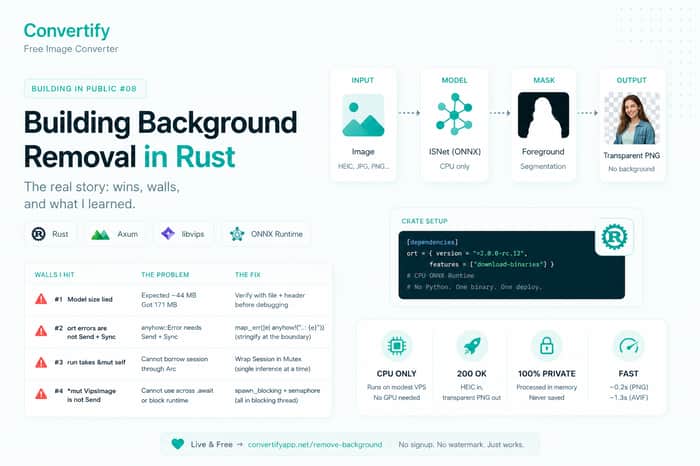
Solo founder, week 17 of building Convertify (a free image converter) in public. This week I added background removal. The build was fine. The interesting part was a decision I almost got wrong.The setup. Every "add background removal" guide says pip install rembg and you're done. But my whole backend is Rust, and rembg is Python a second runtime to deploy, a second thing to crash at 3am. As a solo dev, every extra moving part is a tax I pay forever. So I spent the week running the same ML models natively in Rust instead. One binary, nothing to babysit. That part worked.The decision that almost bit me. The model I picked (ISNet) gives sharp cutouts. But when I finally benchmarked it on my actual VPS instead of trusting vibes, the numbers were sobering:
228 requests, real images
p50 2.4s, p95 9.6s speed was fine
peak RAM: 2.9 GB on a 7.7 GB box that also runs Postgres, Redis, and the web app
That model was quietly claiming a third of my server, permanently, for a feature that has low traffic yet. There's a lighter model (43 MB vs 171 MB) that would've dropped RAM massively. The easy "responsible" move was to swap to it.I kept the heavy one on purpose. Here's the reasoning I made myself write down: the box has headroom today, my target pages (signatures, product shots) are exactly where the heavy model's quality edge matters, and swapping is a 3-line change I can make in 20 minutes the day RAM actually gets tight. So I logged it as a conscious tradeoff with a documented exit, not a thing I'm ignoring. Deciding on real numbers instead of swapping out of vague guilt felt like the actual senior move.The unglamorous win. Doing the backlink pass for the launch, I found that 3 of the 4 directories on my to-do list were already done my own tracking file had them marked wrong. I'd have wasted an evening re-submitting things that already existed. Cleaning up the lie in my own notes was more valuable than any new task that day. Build-in-public lesson: your tracker rots too, audit it.Shipped this week: background removal live on prod (free, no signup, no watermark, image never touches disk), a benchmark widget on the page showing the real numbers above, and a technical write-up as a linkable asset.Next week: turning one tool into use-case pages (passport photos, product shots) without drowning in duplicate content. More SEO grind than code.Question for other solo founders: how do you decide when "it runs fine on my box today" is good enough vs premature optimization you'll regret? I keep landing on "measure, decide, document the exit" but curious how others draw that line.

What I like here is that the decision isn’t framed as “right vs wrong model,” but as a controlled constraint choice with an explicit escape path. That’s usually the missing piece in solo founder infra decisions—people either over-optimize too early or ignore costs until they become emergencies. The “measure, decide, document the exit” approach is basically how you prevent both failure modes while still shipping.
yes, I agree with you, I tried to balance on my little vps and will get maximum from my server.
Glad it resonated.
Your reply made me think there's one strategic decision sitting underneath that approach which becomes much more important as the product grows, but I don't think I can explain the reasoning properly in a thread without oversimplifying it.
If you're interested, what's the best email to reach you on?
Good catch on the server load — easy for these things to sneak in. I do quick performance/security passes on shipped products, recently fixed a live private-key leak in a production repo (GitHub: piush365). Happy to take a pass on your setup if useful.
I have private repo on git hub