I shipped Factcovery in 2 days with Claude — web + API + mobile + CI/CD, 0 lines written by me
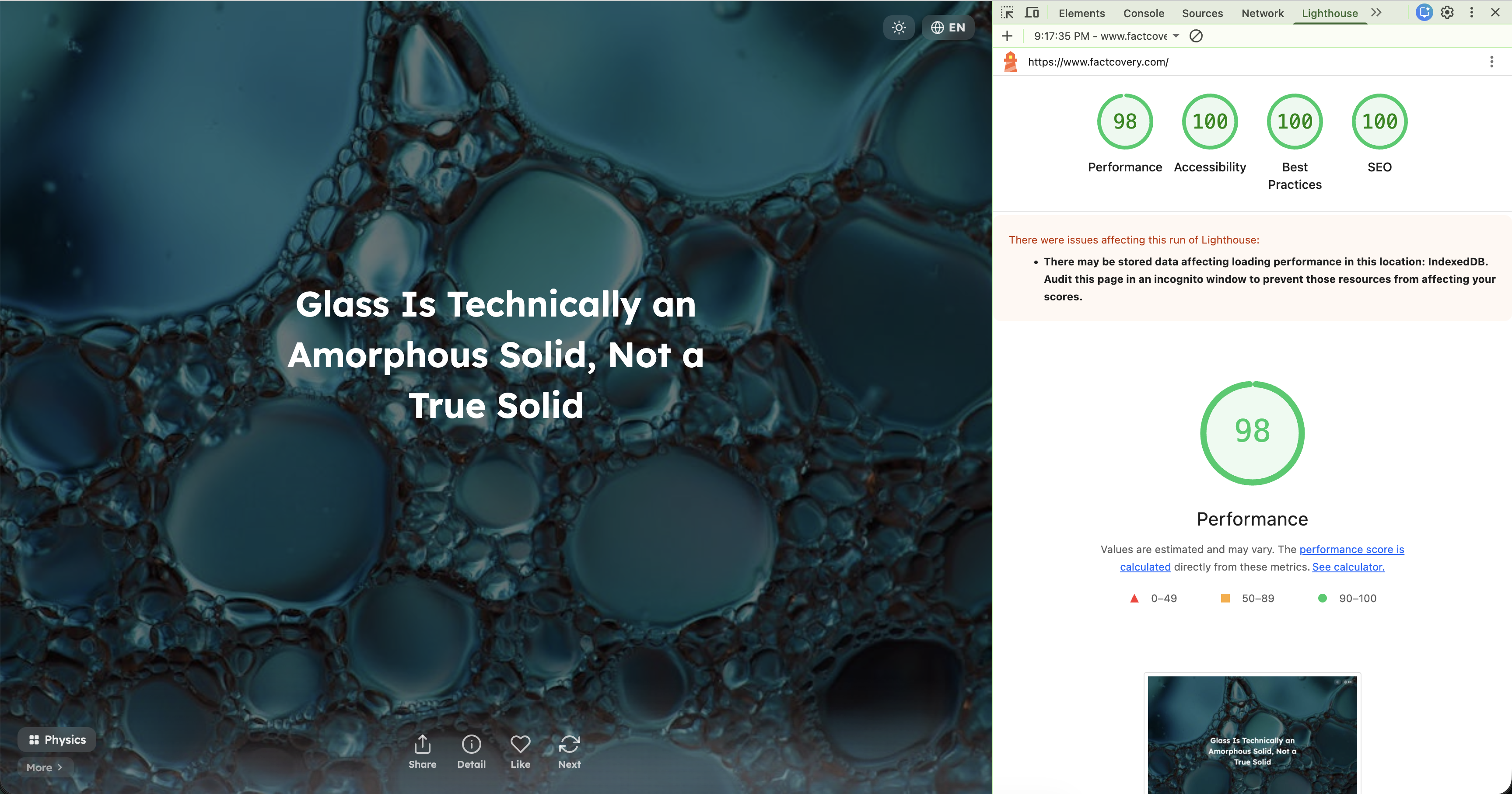
factcovery.com — an app that generates and aggregates interesting facts by topic. Built solo over a weekend.
The approach: AI Agent, not vibe coding
Most people use AI like autocomplete. Prompt → get code → paste → pray. That's vibe coding, and it breaks down fast on anything real.
My rule was simple: plan in plain English first, then let Claude build. Every single feature started as a conversation, not a code request.
What got built and how
Web (NuxtJS) — Started by asking Claude to map out all screens and user flows before touching any code. Then described the UI as a feeling ("modern science magazine, dark with amber accents") rather than pixel specs. i18n and Lighthouse optimization were planned upfront, not bolted on later.
API (Django REST) — Instead of designing the backend first, I fed Claude the finished frontend components and asked it to infer the data models and endpoints. Backend came out perfectly in sync with the frontend on the first pass.
Mobile (Flutter) — Tried React Native first. Performance wasn't right for this, so I pivoted. With Flutter, I asked Claude to propose the full project structure and state management approach with reasoning before writing anything. That context made every subsequent prompt sharper.
CI/CD (GitHub Actions → VPS) — Described the deploy flow I wanted in plain English. Claude wrote the full deploy.yml, the deploy script, and the SSH key setup guide. I just followed it.
The honest numbers
- Time: ~2 days
- Cost: Hit Claude Pro limits ($20/month) building this fast. Had to switch to Claude claude-sonnet-4-20250514 to keep going. Total still far cheaper than any freelancer.
- Code written by me: 0 lines
What actually made the difference
The planning step. Every task started with "don't write code yet — just give me the plan." Five minutes of planning saved hours of fixing. The other thing: using the output of each step as input for the next one. Frontend → backend. Backend → mobile. Everything stayed in sync.
Human judgment still mattered for the pivot call (React Native → Flutter) and reviewing architecture before Claude implemented it. AI executes. You decide.
Mobile app coming soon — currently pending store review. If you have questions about the structure, the prompts, or anything else — drop a comment. Happy to go as deep as you want.

The planning step resonates. I've been building Just One Step the same way — every feature starts as a conversation about what it should do and feel like before any code gets written. The "don't write code yet" instruction is underrated.
The frontend → backend inference approach is clever. I've mostly done it the other way around and the sync issues are real.
This is genuinely impressive.
I'm a marketing lead with 2 yoe, and I'm currently working on collecting UGC cases for my project.
If you’re open to it, I can help you get the first 5 customers via distribution for free.
The 'Plan in plain English' rule is the only thing that separates a messy weekend project from a production-ready ecosystem. 'Vibe coding' is a trap; orchestrating the AI as a project manager is how you actually win.
Since you managed to ship Web, API, and Mobile in 2 days with 0 lines written by you, you should bring that efficiency into the Validation Arena (tokyolore.com).
$19 to enter, 30 days to prove your AI-built product can actually generate revenue.
$0 pool right now, and the winner gets a Tokyo trip! 🏆