I sold $6,773 in 2 weeks, with almost no existing community.
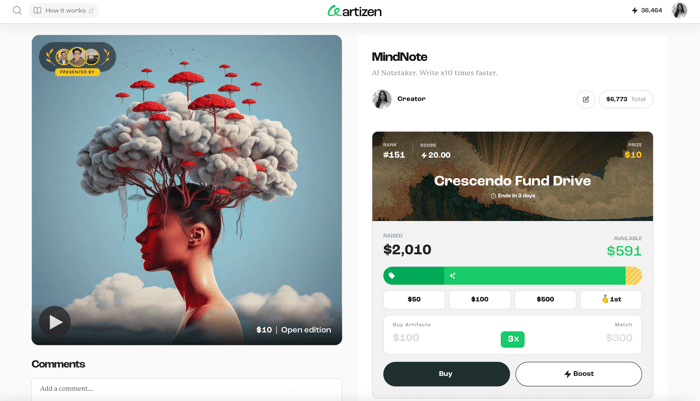
I'm building MindNote, an AI note taker, and recently launched a campaign on Artizen.
I'm sharing this because it may be another channel to consider as you work toward your first $0–10k, $10k–100k, and beyond.
Unlike a traditional campaign, supporters purchase digital artifacts rather than making donations or direct app subscriptions. Because those artifacts are sold rather than donated or transferred, they're treated as sales for tax purposes. Even with that additional complexity, the campaign reached $6,773 in just two weeks, and the experience taught me a lot.
Artizen works differently from other platforms. As you reach funding or artifact sales milestones, Artizen matches contributions with additional funding (typically 2x or 3x, depending on the program). Campaigns also compete on a leaderboard based on community support. The higher you rank, the more matching funds you can unlock, with top projects receiving $20,000–$30,000 or more in additional funding/sales.
Here's the campaign:
https://artizen.fund/index/p/mindnote?season=7
The biggest lesson?
Building the product was easier than finding people willing to support it.
Here are the tactics that actually worked:
-
Start with friends and family.
Think of it as a Friends & Family round. Those first supporters create momentum and social proof. -
Send it to your newsletter.
Even if it's small. Those subscribers already know who you are. -
Post consistently on social media.
Don't post only once. Share milestones, progress, screenshots, lessons learned, and why you're building. -
Support other founders.
Back their campaigns, comment on their posts, and build genuine relationships. Many will support you in return. -
Reach out personally.
Personalized DMs and emails converted much better than generic posts. -
Tell your story, not just your pitch.
People often support founders they connect with, not just products. -
Create urgency.
Posting updates like "50% funded" or "3 days left" encouraged people who had been waiting. -
Ask for introductions.
Someone who can't contribute may know someone who can. -
Share it in relevant communities.
Reddit, Indie Hackers, X, LinkedIn, Discord, Slack communities, Facebook groups, and startup newsletters all helped. -
Thank every supporter publicly.
Gratitude creates momentum and encourages others to participate.
What I'd do differently?
If I could start over, I'd spend weeks or even months building a community before launching.
I'd:
- Collect emails with a landing page.
- Build a WhatsApp or Telegram group of early supporters.
- Reach out through cold emails.
- Share the journey publicly while building.
- Find early users who genuinely love the product.
- Grow a newsletter.
- Ask people ahead of time if they'd be willing to support the campaign on launch day.
Having a community before launching would probably make the campaign 10x–100x more successful.
If you found this helpful, I'd appreciate it if you checked out MindNote, subscribed, or supported the campaign on Artizen.
Happy building!
MindNote website: https://www.mindnote.online
Artizen camapign ( Still live and receiving supporters): https://artizen.fund/index/p/mindnote?season=7

Congrats on the $6,773 — that's real money for two weeks with no existing audience, especially on Artizen where a lot of campaigns just sit there.
The part that jumps out to me is "having a community before launching would probably make the campaign 10x-100x more successful." That's the whole game, and it's also the part almost nobody plans for early enough. Most of us build first, then panic-search "how do I get users" after launch day is already looming.
The cold email + WhatsApp group combo you mentioned is underrated too. People sleep on DMs/groups because it feels less scalable than blasting a list, but it converts way better because you're actually talking to humans who opted in.
One thing I'd add for anyone reading this pre-launch: instead of only building your own list from scratch, it's worth finding people who are already out there describing your exact problem on Reddit, HN, IndieHackers etc. — they're basically raising their hand before you even reach out. I actually built a small tool called Getrive for this exact reason (it watches those platforms for people describing the problem your product solves and drafts a reply for you to approve), because I got tired of cold-pitching into the void with zero signal. Different mechanism than what you did, but same instinct — talk to people who already want this instead of hoping strangers stumble onto your landing page.
Going to check out MindNote now, curious what got people to actually convert on Artizen vs just browsing.
https://getrive.app/r/n-U10y6p
This is such a transparent, actionable breakdown of your Artizen campaign for MindNote—thank you for sharing all the raw wins and hard lessons.The Artizen matching funds mechanic (2x/3x match + leaderboard rewards) is a fascinating alternative to standard Kickstarter or pre-order campaigns, and the tax benefit from selling digital artifacts alone makes this channel worth exploring for indie founders. Hitting $6,773 in two weeks is solid traction, especially with the potential to unlock $20k–30k extra matching capital for top-ranked projects. Your 10 growth tactics are all proven community-building fundamentals, but the biggest takeaway hits home hard: product development is the simpler part; rallying early supporters is the real grind. I fully agree that pre-building an audience, email list, and core fan group pre-launch would multiply campaign results massively. The tip about prioritizing founder storytelling over cold sales pitches and personalized DMs instead of generic social posts resonates deeply. It’s easy to fixate on posting the product feature list, but people back creators they relate to. Also love the reciprocal founder support tactic—cross-promotion with other builders is underrated free momentum. Will definitely check out MindNote and your Artizen campaign. Great real-world case study for anyone chasing their first $10k in revenue!
Thank you! Really appreciate the thoughtful feedback.
This is a useful breakdown.
The biggest lesson for me is your point that building the product was easier than finding people willing to support it.
I especially agree with building community before launch. A lot of people treat launch day as the starting point, but it sounds like the real work starts much earlier: collecting emails, sharing progress, asking people ahead of time, and finding early users who actually care.
The “tell your story, not just your pitch” point also feels important. For early products, people may not fully understand the product yet, but they can understand why the founder is building it.
Thanks, I completely agree.
Nice hustle across all those channels 👏 Honest q that'd help the rest of us judge repeatability — roughly what split was direct supporter money vs the Artizen 2–3× match? Trying to gauge how much was organic. Either way "thank every supporter publicly" is such an underrated tip.
Thanks! I think that Artizen multiplied x2-x3 the value from supporters. So, it is a great deal.
Building the product was easier than finding people willing to support it" — that's the whole game, and nobody believes it until they live it. My only real distribution was blasting my own friend groups on WhatsApp, and that personal, trust-based channel massively outperformed any "proper" marketing post I tried. What I'm chewing on is your last point about pre-building community — did the subscribers who converted come from a list you'd deliberately built earlier, or people you pulled together right before launch? Trying to work out how far ahead of a launch that groundwork really needs to start
Thanks for reading and sharing your insights. Totally!
I think they came mostly for trusted networks, or people with whom I am sharing updates constantly.
I like this - thank you for sharing.
Thanks! I'm glad you found it usefu
This is a useful case because the $6.7k is real, but it seems to answer a very specific question: will people back the vision when there’s urgency, personal trust, and campaign mechanics around it?The next signal I’d want to separate is not “did the campaign work,” but which users still behave like MindNote users after the campaign context disappears.
I’d split the next 7 days into three cohorts:
Then track one simple thing per cohort: how many create a second real note, not just sign up or download.That would tell you whether Artizen was mainly a funding event, or whether it also creates retained product users.
100% agreed.
Glad that makes sense.Would be interesting to see which cohort surprises you most over the next week or two.
Really solid breakdown—distribution is usually the real challenge, not the product.
Did any channel actually stand out as the main driver, or was it mostly a mix?
I think it's definitely been a mix. A lot of the early traction has come from non-scalable tactics, and the results are spread across different channels rather than a single standout source. That said, the channels haven't contributed equally, some have performed much better than others, but no single one has been responsible.
The "almost no existing community" part is what caught my eye - that's the part most people say is impossible. What was your main acquisition channel?
Definitely a Mixture.
For app downloads is easy, nothing beats Google play and Apple Store. It is a matter of calculating your ROI.
Reddit, and startup directories are super for free organic traffic.
LinkedIn if you are on B2B, and maybe twitter and Facebook.
But for this kind of campaigns, posting on groups, talking to your networks, posting on Artizen group, cold emails (even though I started today), are all great tactics.
Hey Tom,
Thanks for sharing this, it seems like there are a lot of parallels between what you experienced and what I'm currently realising. That is to say, actually getting the people to come and use the thing you built is infinitely harder than building it.
However, in terms of the Artizen campaign, I have to admit I'm a bit confused. Is the end goal to raise funds to develop MindAI further, or to raise funds that will help you to build awareness around the platform?
Either way, I really appreciate you taking the time to share your tactic list.
Thanks! Kind of both but I think both ultimately fall under development in the long run. It was also a nice experiment to see that these kinds of campaigns are possible. Glad you found the tactic list helpful!
That matching funds model is smart. You essentially turned social proof into extra capital. Most founders treat launching like a one-time event, but you're right that the real work is building that community queue months before the "buy" button goes live.
The honest tell buried in here: raising $6,773 from friends, family, and matched funds proves people like you, not that they'll pay for MindNote every month. Backing a campaign and renewing a subscription come from two different wallets. Before the next launch I'd track how many of those supporters are still active in 30 days, because that number tells you whether you have a business or just a good launch week.
You have a good point. A successful campaign doesn't necessarily translate into long-term subscribers.
That said, early revenue still matters. I've been validating those metrics through different channels Google Play and Apple App Store downloads, paid subscriptions, and lifetime deal sales rather than through the campaign itself.
The next step is to expand that validation with some B2B pilots.
The line "building the product was easier than finding people willing to
support it" is hitting hard right now — I launched PM OS today with zero
existing audience, and the gap between "I have a working product" and
"someone outside my own head knows it exists" feels much bigger than I
expected going in.
Your point about building community before launching is the one I wish
I'd internalized earlier. I went straight from build to launch without a
waitlist, newsletter, or any warm audience — learning the hard way that
distribution isn't something you bolt on after, it's a parallel track that
should've started months ago. Bookmarking your list of tactics for next
time. Congrats on the $6,773 — that's a real signal, not just a vanity
number.
Thanks! And you're 100% right.
That said, I'd still recommend giving Reddit a try. It's surprisingly effective, even if you don't already have a community there.
Use a compelling product screenshot or demo, then post in subreddits relevant to your niche, as well as broader startup and app communities. For example:
r/GenAiApps
r/androidapps
r/SideProject
r/startups
r/microsaas
The key is to tailor your post to each subreddit instead of posting the exact same message everywhere. If the content feels genuine and provides value, people are much more likely to engage.
Thanks a lot for sharing - your post has a lot of valuable insights!
I have some questions:
Hi,
Sure! For this campaign, I've mainly been doing cold emails rather than DMs. I usually use either Lemlist or Mailjet.
The most important part is building the lead list. Normally, I spend quite a bit of time researching and qualifying leads, but since this campaign only has a week left, I put the list together much faster than I usually would.
Some approaches that have worked (or that I think are worth testing) are:
Personalization also matters. Under normal circumstances, I'd spend more time tailoring each email, but because I'm compressing everything into a week, I'm keeping it to a simple two-email sequence that's casual and gets straight to the point.
For example:
Hey {{FirstName}},
I came across your profile after seeing you supported {{CampaignName}}. Since you've backed projects like that before, I thought you might be interested in MindNote, an AI-powered note-taking and knowledge management tool that's currently live on Artizen.
If it resonates with you, I'd really appreciate your support:
{{CampaignLink}}
I've also shared the campaign in a few Facebook groups. I got one reply so far.
Hope that helps!
Yes, it's insightful, thank you!
I have little experience in cold reach and will definitely confider what you say but also check Lemlist or Mailjet.
Didn't think i'd ever be that guy but this is obviously just an ad for artizen.
Also, what's up with the comments? pure ai slop.
sorry, haven't logged into Indie Hackers in quite some time...
Any humans in this thread?
Haha, yeah! It's definitely free advertising for Artizen, but for founders like me, it's also an underrated channel to experiment with when looking for new ways to reach people, sell or raise funds, etc.
Great breakdown! The shift from 'building product' to 'building community' is often the hardest mental hurdle for technical founders. That line about 'money following trust, not traffic' is the biggest takeaway here—it’s refreshing to see someone break down the 'how' behind earning that trust rather than just giving generic advice. Congrats on the launch!
Thank you so much!
Building a product (Encrypted Cloud Storage) took me two weeks, but geeting a first paying client will certainly take months (and i am in marketing for 15 years)
No necessarily.
I would recommend you to post on Reddit instead. It is seriously great, just be cautious about sharing a link more than once. Reddit tends to ban pretty easily.
I posted once, and got almost 100 download in less than 4 hours (Free and paid). This is the original post: https://www.reddit.com/r/GenAiApps/s/fltr6XRi20
The honest tell here is your own line: building the product was easier than finding people to support it. That's not an Artizen lesson, it's the whole game, and it doesn't disappear once the campaign ends. The number I'd watch now isn't the $6,773, it's how many of those backers opened MindNote a second time, because backer money and retained users are different currencies and only one compounds.
The useful part here is the gap between people liking the idea and people actually paying to support it. For note tools especially, I think demos overperform and daily habit underperforms. If capture feels even a little slower than opening the default notes app, people never stick around long enough to care about the smarter organization layer. That's a big part of why I built DictaFlow. A lot of note systems get better downstream, but the first bottleneck is still getting the thought out fast enough before it disappears.
The part I keep coming back to is #3 and the 'what I'd do differently' section — they're kind of in tension. You hit $6.7k without a community, but in hindsight you'd spend months building one first. Makes me think the tactics that worked weren't really 'no community' — they were 'borrowed community' (friends, newsletter, other founders you'd already backed).
On #3 specifically: how often were you posting on social while the campaign was live? Once a day, multiple times, only on milestones? Trying to figure out where the line is between 'consistent' and 'annoying' when you don't have an audience yet and every post feels like shouting into the void.
Congratulations on the impressive launch! Reaching $6.7k without an existing community is impressive. Which acquisition channel brought your first paying customers, and what would you do differently if you were launching today?
Thanks! This campaign was a bit different because I went straight to my close network for the initial support. For the day-to-day growth of MindNote, though, the biggest acquisition channels have been the Google Play Store, the Apple App Store, and Reddit.
If I were launching today, I'd spend more time warming up and on direct outreach from day one connecting with communities and creators instead of relying primarily on organic discovery. That approach would probably help build momentum much faster.
The real signal: did you nail positioning so tight the right people found you instantly, or was distribution just irrelevant to your problem-solution fit? Those two paths scale very differently.
I'd say it was a mix, but distribution definitely mattered. The value proposition was clear enough that people who found MindNote understood it quickly, but they still had to discover it first. The App Stores and Reddit consistently brought in users who were already looking for a tool like this.
Makes sense — App Stores and Reddit both have built-in intent, so you're not creating demand, just catching it. Did you find one of those two channels compounded over time (word of mouth, reviews, etc.) or did they stay roughly linear the whole way to $6,773?
Very useful! Thanks for sharing!
Glad that you found it useful.
The "what I'd do differently" section is the part I keep coming back to. I'm deliberately doing the community-first thing right now, holding a launch for a few weeks while I post in public and answer questions like this one, specifically because I've watched too many launches spike and vanish with nobody left the next month. It's slower and some days it feels like nothing is happening. But every early reply or comment thread like this is worth more to me than a paid ad would be, because the people in it already showed up once.
Great approach!
A nice community can make your product, when no one else believed on it.
No audience makes this way more impressive imo. What actually drove the sales? Trying to figure out the same thing right now without a following to lean on
I think the strategy that the most successful campaign used was pure cold email outreach, according to an internal email. I initially reached out to my own network and also presented the project a couple of times in their Telegram group. Since there's still a week left before the campaign closes, I'll be sending more cold emails to help increase its reach.
This is really inspiring! I'm a 14-year-old developer launching my first project, and I'm struggling with the same thing - getting that first sale. How did you find your first customer?
Thanks! I am glad it helps.
There are several ways to find your first users. I found reddit amazing for finding leads, but google play and apple App Store are seriously awesome.
I did wrote an article about how to find high intent leads in a short period of time. You can find it here: https://www.indiehackers.com/post/how-to-spot-high-intent-customers-in-5-minutes-for-free-bb3153caa6?commentId=-OtUUU75JErBGNhigdjh
You have provided a comprehensive breakdown transparently, every piece of it is useful for aspiring entrepreneurs.
Thanks! I am glad that it helps.
"Personalized DMs converted much better than generic posts" is the one line that should get bolded for every founder reading this. Most people skip it because it doesn't scale, but it's the only tactic on the list that actually compounds trust instead of just reach.
Definitely! 100%
Great breakdown! The point about community-first resonates — I'm currently trying to sell a fintech project and the hardest part is definitely distribution, not the product itself. Thanks for the transparency.
Thanks! Wishing you the best with your fintech project, I hope you find the right distribution channels and community around it!
Thank you so much for you help I really appreciate it God bless you
Good luck with your project!
Money following trust instead of traffic is the right framing, and it's also why this kind of campaign is hard to replicate as a pure tactic. You can't manufacture the personal outreach and consistent updates part, it has to actually be true that people trust you enough to back something before it's finished.
The 30 day retention question in the comments is the one that actually determines whether this was a funding event or a validation event. $6,773 raised says people were willing to bet on you. Whether they're still opening MindNote a month later says whether the bet was right.
I completely agree. Trust is incredibly hard to manufacture, which is why it becomes such a valuable advantage. You can buy traffic, but you can't buy genuine trust.
I also agree that retention is what ultimately proves the product's value. For that, I'm looking at the Google Play Store and Apple App Store, where people discover, download, and continue using the product without the context of a single campaign.
This campaign was more about validating the vision and securing funding for R&D. I'm happy to see that it is possible, even without a huge community (but that would be the ideal) and I hope to find more opportunities like this in the future. Each milestone answers a different question, and together they help move the product forward.
Each milestone answers a different question is a clean way to think about this. The campaign answered whether people would back the vision. The store will answer whether they actually use it. Those are two separate validations and both matter, just for different things.
The number I'd watch isn't the $6,773, it's how many of those backers are still opening MindNote 30 days later. Campaign sales and matched funding are a one-time spike, and a leaderboard can flatter a product nobody actually retains. You proved people will back you, now find out if they'll pay you again when there's no urgency or matching attached.
You're totally right. Retention matters at lot.
That said, I still think it's a pretty meaningful milestone. Every company has revenue as part of its North Star, and getting those paying customers is an important proof point. Sometimes it's not about having thousands of users, some B2B companies operate successfully for years with just a handful of customers because each one generates significant value. Early revenue isn't the finish line, but it's a strong signal that people are willing to pay.
I just shared a new channel that may not have been considered for some. Let's see how it develops further.
Thanks for sharing this. One line really stuck with me: "Building the product was easier than finding people willing to support it." As an engineer, it's easy to spend all the time building and assume users will come later. Your experience is a great reminder that community and distribution are products in themselves. Wishing you continued success with MindNote!
Thank you so much!
I always recommend starting marketing as early as the ideation stage. Begin building your audience and collecting leads as soon as possible, so that by the time your MVP is ready, you already have a group of potential first users. It definitely makes the launch much easier and gives you valuable early feedback.
One thing that stood out is that the money followed trust, not traffic. Friends, early supporters, personal outreach, and consistent updates all worked because people already had a reason to believe in you. That's a lesson a lot of founders learn much later.
Definitely! I think a good mix of friends, family, and project supporters could easily help you surpass your target in just a few hours.
That's the interesting part to me.
Once a project starts growing beyond people who already trust the founder, the question changes from "Who knows me?" to "What makes complete strangers trust this enough to back it?"
I think that's a much bigger strategic shift than most creators realize.
100% agreed!
Even in traditional investment rounds, the first rounds sometimes is called friends, family and fools.
That said, Artizen can be a strong option when aiming to hit early targets. It also helps to diversify beyond platforms like the Google Play Store and Apple App Store.
That's exactly why I wanted to continue the conversation.
Reading your reply, I think there's one strategic business decision sitting underneath that transition from early supporters to complete strangers that becomes much more significant as a project grows, but I don't think I can do the reasoning behind it justice in a thread.
Happy to explain what I mean if it's useful. What's the best email to reach you?
You can definitely reach out via email at hello@mindnote.online or connect with me directly on LinkedIn: https://www.linkedin.com/in/tomitam.
Just sent it over by email.
Looking forward to hearing your thoughts once you've had a chance to read it.