I Spent 141 Hours Building a POS App Because Most of Them Feel Like Spreadsheets
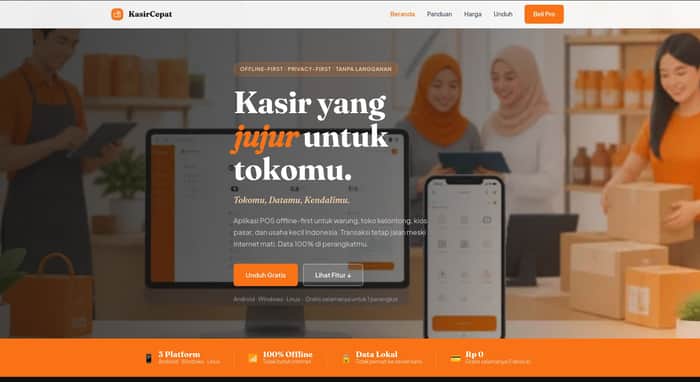
After looking at dozens of POS systems, one thing kept bothering me:
Why do so many cashier apps look and feel like spreadsheets?
Most small business owners don't spend their day analyzing data.
They're serving customers, managing inventory, receiving deliveries, answering calls, and trying to keep their business running.
Yet many POS systems seem designed around dashboards, reports, endless tables, and settings screens.
The software often feels more complicated than the job itself.
Three weeks ago, I decided to see if I could build something different.
Over the last 21 days, I spent roughly 141 hours building KasirCepat, an offline-first POS app for small businesses in Indonesia.
The goal wasn't to build the most advanced POS system.
The goal was to build a POS system that gets out of the user's way.
Some decisions were intentional from day one:
• Works without internet
• No account required
• Data stays on the device
• Unlimited products
• Unlimited transactions
• No ads
• Android, Windows, and Linux support
The hardest part wasn't writing code.
It was saying no.
Every time I wanted to add a new feature, I asked myself:
"Would a small shop owner actually use this every day?"
If the answer wasn't obvious, I left it out.
I realized that simplicity isn't what remains after you've added enough features.
It's what remains after you've removed everything that doesn't matter.
Current status:
• Android version released
• Windows and Linux builds available
• Barcode scanning supported
• Thermal receipt printing supported
• Inventory management implemented
• Daily sales and profit reports available
• Local WiFi sync in development
There is no funding.
No team.
No big launch campaign.
Just building, shipping, listening to feedback, and improving the product every week.
I'm curious:
If you've built software for small businesses, what feature did users ask for that surprised you the most?
Product:
https://flagodna.com/kasir-cepat/

Interesting build.
The thing I'd be careful with is that simplicity is easy to agree with and surprisingly hard to buy.
A lot of owners will say they want something simpler. Far fewer will switch systems because of it.
That sounds like a small distinction, but it tends to become important much earlier than founders expect.
I wouldn't make the actual decision casually in a thread.
Good point.
I'm starting to think simplicity isn't the product. It's the reason onboarding is faster and the learning curve is lower.
Yeah, that's closer to how I'd think about it too.
What makes me hesitate is that I've seen founders correctly conclude that simplicity helps onboarding, then accidentally build the whole product around that conclusion.
Sometimes they're right. Sometimes they end up optimizing for the thing users compliment instead of the thing they actually pay for.
That's why I'd be careful before treating it as settled.
Hard to do that properly in a thread though.
If you're interested, drop your email and I'll send you the longer version.