I spent 6 hours writing 12 mediocre onboarding emails. So I built a system that does it in 45 minutes.
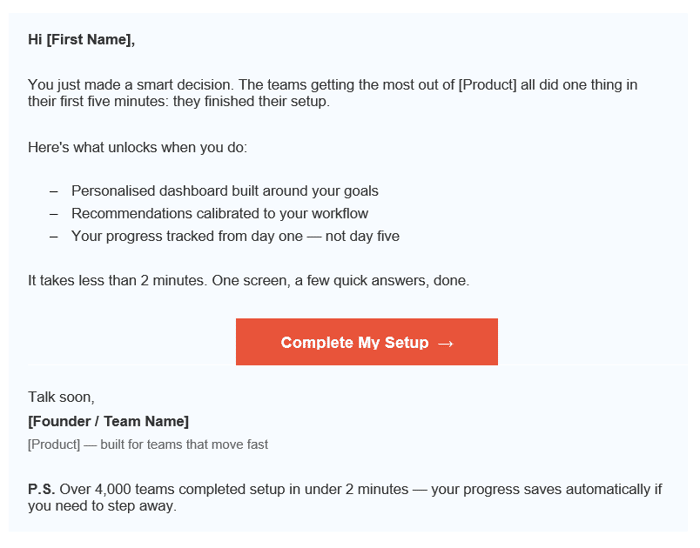
I was writing onboarding emails for my SaaS. 6 hours. 12 drafts. Mediocre result.
So I built a system:
3 prompts → strategy → copy → design brief.
45 minutes. First draft = final draft.
The psychology:
- Day 0: Welcome + quick win (micro-commitment)
- Day 1: Aha moment accelerator (social proof)
- Day 3: Use case mirror (pain agitation)
- Day 6: Results preview (aspiration)
- Day 10: Upgrade value map (scarcity)
- Day 13: Objection handler (risk reduction)
- Day 14: Last call (urgency + choice)
Each email readable in 60 seconds. CTAs escalate progressively.
If you want the full system (all 7 emails + Python automation), it's $27: https://khanfalah.gumroad.com/l/wjebq
But the strategy discussed above is enough to build your own if you prefer.
What's your biggest email sequence challenge?

This is such a familiar problem.
What surprised me when working on onboarding flows is that most of the time the problem isn’t writing the emails — it’s figuring out what signal should trigger them.
The best-performing sequences I’ve seen were tied to user behavior (first key action, inactivity, partial setup), not just time delays.
Curious — is your system behavior-based or mostly time-based sequences?
Great point. You're absolutely right.
The best sequences are behavior-based. Time-based is just the fallback.
My system actually starts with behavior mapping:
The strategy prompt asks you to define behavioral triggers first, then time-based fallbacks. Most people skip this and wonder why their sequences underperform.
What signals are you tracking for your onboarding?
Nice — that’s actually a pretty mature setup.
I like that you start from behavior mapping instead of timelines. A lot of onboarding sequences fail exactly because they’re purely time-based.
One pattern I’ve seen work well is defining a single “activation moment” first and designing the whole sequence around pushing users toward that event.
What counts as activation in your case?
I've actually got two systems running side by side on this.
First one is EXPLICIT activation: first data source connected. That's the moment everything pushes toward. Email #2 only fires if they visited the integrations page but didn't complete the setup. Email #4 triggers 24 hours after a successful import. Behavioral triggers all the way down.
Second one is IMPLICIT activation: no single activation point, just usage patterns. Opened the dashboard twice but created zero projects, that kind of signal. Fuzzier definition of "activated" but it works for products where the aha moment is more distributed.
The explicit version is converting about 2.3x better, which isn't surprising. It just requires decent event tracking infrastructure.
The implicit one is what I use when someone needs the sequence live by Friday and doesn't have analytics setup yet.
Since you're clearly thinking about this deeply — want to test the strategy prompt from the explicit system? The one that forces you to map behavioral triggers before writing a single line of copy. No charge, just looking for someone who understands activation metrics in depth.
That distinction between explicit and implicit activation is really interesting.
It makes sense that the explicit version converts better — when the activation event is clear, the whole onboarding can align around pushing users to that moment.
The implicit model sounds useful when the product has a more gradual “aha”.
Out of curiosity — what threshold do you usually consider enough to define activation confidently?
The threshold I prefer is statistical significance + business logic. find the minimum action that correlates with 60%+ long-term retention.
Run a cohort analysis — users who do X by day 7 have 60% retention at day 30. That's your activation moment.
For new products without data, interviewing 10 customers would help: if 8/10 mention the same moment, that's going to be our hypothesis.
(not "signed up," but "created first project + invited a teammate").
That’s a solid way to approach it.
Looking for the action that correlates with long-term retention usually reveals a much clearer activation signal than just “signed up”.
The interview approach for early products makes sense too — sometimes the qualitative pattern shows up before the data does.
Out of curiosity, have you seen cases where the activation event surprised you compared to the original hypothesis?
One thing I didn’t include in the post:
Most onboarding sequences fail because they are feature-first instead of behavior-first.
Instead of:
Email 1 → Feature
Email 2 → Feature
Email 3 → Feature
Better structure:
Trigger → Emotion → Micro-commitment.
Examples:
• Welcome → quick win
• First usage → reinforce success
• Inactivity → friction removal
• Payment failure → recovery trigger
Once you map the trigger, writing the email becomes much easier.
@falahkhan great question on benchmarks. Industry data from PYMNTS/Baremetrics puts Day 1 open rates at 45-55% (people check email when something just happened), and overall recovery rate at 30-60% of failed invoices depending on price point and customer type — B2B generally recovers better than B2C because the customer cares more about keeping access.
The key variable is time to first email. Waiting 24+ hours drops open rates by ~40%.
For what it's worth, I built RecoverKit specifically because I didn't want to rebuild this plumbing for every product — it connects via Stripe OAuth and runs the Day 1/3/7 sequence automatically. Beta is live if you want to test the benchmarks against real data rather than industry averages: https://recoverkit-frontend.pages.dev/connect
First 20 users get 3 months free. Would be genuinely useful to compare your behavioral system + payment recovery as a combined stack.
Great. the time to first email point is especially interesting. Makes sense psychologically too. when the failure just happened, the intent to keep access is still high.
I also like the framing of recovery as a lifecycle trigger rather than a billing issue. It fits naturally alongside onboarding and activation behaviors.
Curious in the recoveries you have seen . Does the bigger lift usually come from sending earlier, or from reducing friction in the update flow, once someone clicks?
Great system — the 45-minute vs 6-hour delta is real.
One thing worth adding to the sequence: a payment failure recovery email. Most founders treat it as a support issue, but it's actually closer to onboarding — the customer didn't mean to leave, they just haven't noticed yet.
The format that works: Day 1 (informational, no pressure), Day 3 (soft urgency), Day 7 (final notice before cancellation). Keep it short, make the update-card link impossible to miss. Open rates on Day 1 are often 50%+ because the failure is fresh.
The ROI math is different from onboarding emails too — you're not converting, you're retaining. Recovering 5 customers at $50/month is $3k ARR you'd otherwise silently lose.
Worth building into any SaaS email stack alongside the onboarding sequence.
This is such a valuable point — payment failures are absolutely silent revenue leaks.
Great timing actually — I just launched an upgraded behavioral system (https://khanfalah.gumroad.com/l/ytsay) and your suggestion is already going into the roadmap as a dedicated payment recovery module. Really appreciate you calling this out — it's exactly the kind of behavioral trigger most people overlook.
Out of curiosity — do you track recovery rates separately? Would be curious what benchmarks you're seeing.
Love this approach! Breaking down the psychology by day and keeping emails under 60 seconds is super practical. Definitely gives me ideas for my own onboarding sequences