I spent months chasing clients who already had a webmaster. So I built something that only finds the ones who don't.
Real talk — for a long time, finding clients felt like cold-calling people who already had what I was selling.
I'd pitch a business, get excited, do my research... and find out they already had a website, already had someone fixing it, already had it covered. I wasn't bringing value. I was just another person in their inbox.
That happened so many times that I started wondering — what if I could know that BEFORE I reached out? What if there was a way to only talk to the businesses that actually need help right now?
So I built that.
The first version was completely different (and it died fast)
Originally I wasn't building this at all. I spent about 3 weeks building a tool that monitored Reddit and Indie Hackers for people complaining about problems — classic "listen for pain points" approach.
Then I watched a much bigger competitor — 140k users — shut down overnight because Reddit locked their API for commercial use.
I didn't sit on that news. I scrapped the whole thing and rebuilt around a different question: not "who's complaining online," but "who actually needs help right now, and how do I prove it to them in the first message?"
That became SignalsHunt.
What it actually does
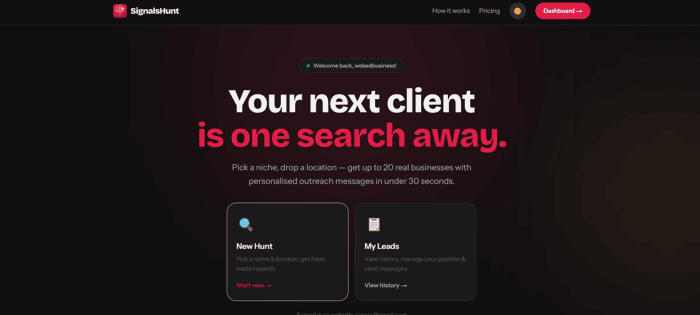
You paste your website. The AI reads it, figures out exactly who your ideal client is, then goes and finds real local businesses through Google — but here's the part I'm most proud of: it visits each business's website too, and checks things like outdated copyright years, missing features, slow load times.
Then it writes you a personalized first message (+ two follow-ups) that references something specific and real about that business — not "Hey, I help businesses like yours" generic spam, but stuff like "noticed your site still shows 2019 in the footer, and there's no online booking option..."
You get businesses worth contacting, and a message worth sending. No guessing.
Who this is for
Freelancers and small agencies — web designers, SEO folks, copywriters, marketers — basically anyone whose biggest problem isn't doing the work, it's finding who to pitch.
I want 10 honest opinions before I do anything else
If this resonates — drop a comment with what kind of clients you're trying to land right now (genuinely curious what people are working on). Then DM me your signup email and I'll give you a full month of Pro, free. No card, no catch.
All I want back is your honest take — did it find you real prospects? Did the messages feel worth sending? Tear it apart if you need to.
Link's in the first comment. 👇

The first 10 users get 30 days of PRO VERSION!
https://signalshunt.com/login?promo=ih1
Nice)
Love this idea
Thank you!
I just joined this platform. Please help as much as possible, and thank you very much
Sure! Get a 1-month PRO plan for free - https://signalshunt.com/login?promo=ih1 and email me!
smart pivot — building your whole funnel on someone else's API (Reddit) is exactly the trap, good instinct killing it fast. one signal worth adding: businesses actively running Google/Meta ads to a weak site. "no website" can mean they don't want one, but "spending money to send traffic to a slow/broken site" means they already believe in growth AND have an obvious gap — much higher intent than an outdated footer year. that's the buyer who actually replies.
I added this feature from Google Ads! Now you can actually tell your clients that they're wasting their budget!
That's a cool idea! We'll definitely try to make it happen! Also, regarding the point that (if a company doesn't have a website, this could lead to finding a client here)—it all depends on the price!
This is a good example of narrowing the market by negative signal.
A lot of prospecting starts with “who might need this?” which creates huge lists and weak outreach. Your angle starts with “who is missing the thing that creates obvious pain?” That is a much better wedge.
The same pattern works in other markets too: find the missing setup, the broken workaround, the repeated complaint, or the public request for alternatives. Then the conversation starts from evidence, not a guess.
The risk is false positives, so I’d track which signal actually converts: no webmaster, old site, slow page, bad mobile UX, missing forms, etc. The winning signal becomes the positioning.
I completely agree with you! That's exactly what we're monitoring right now so we can offer our users better service! We'll have more detailed information coming soon!
I do a similar signal-based motion for my own outreach and one thing I'd flag: an outdated site isn't the same as an owner who cares. That 2019 footer has been there six years, they've made peace with it. I'd trust fresh signals way more, new hire, half-shipped redesign, anything that shows they're spending on the problem right now.
I agree! The fact that the footer is from 2019 isn't a deal-breaker, but there's an important detail! I pay attention to these little things, and more often than not, they lead to much deeper problems on the website!
This is a really useful pivot. The part that stood out to me is the shift from “who is complaining online?” to “who actually needs help right now?”
I’m learning something similar while building my own product. Broad pain signals can be noisy, but visible need signals are much stronger.
I also like that you’re not just finding leads — you’re giving the first message a real reason to exist. Cold outreach feels much less cold when it references something specific and true about the business.
Curious how you handle false positives though — for example, when a site looks outdated but the owner doesn’t actually care or already has someone working on it?
Thanks for your messages! To answer your question: It all depends on the content you include in your message! I’ve personally had cases where a website already had a webmaster, but I found real problems that made it clear to the client that their webmaster wasn’t up to the task!
love that you actually shipped the ads-signal one, thats the highest intent bucket by far. the "youre wasting budget on a broken site" framing is gonna land way harder in outreach than "you have no website"
Thank you! That feature has already been implemented!
This is the lead qualification problem every B2B founder faces. I've been through the exact same cycle — spent weeks DMing agency owners on LinkedIn, only to find half were solo freelancers, some were competitors who build software themselves, and a few had already solved the problem with existing tools. The 'research before DMing' lesson cost me real time and a few awkward rejections. Your approach of filtering before outreach is the right one. I've started doing it manually — checking company size, team count, and whether they already use a competing tool — before every connection request. Cuts my outreach time in half but doubles my reply rate. Would love to see this concept applied to B2B SaaS prospecting, not just web services.
Thanks for the messages! That's an interesting idea!
The visible, verifiable problem approach works because it flips the pitch from selling capacity to pointing at a specific broken thing. That's how I landed my first Henson Group clients in 2002: I offered free migrations to businesses that were clearly hurting, and they hired me to run everything afterward. One caution as this scales: once every freelancer's tool flags the same 2019 copyright footer, that signal becomes the new spam, so your durable edge will be the signals competitors' scrapers can't see.
I agree with you! That's why there will be new features in the future.)
Honestly, what stood out to me is that this doesn't just pull in leads,
it actually helps you filter them before you even hop on a call.
I build websites for a living and if there's one thing I've figured out, it's that landing the right client matters way more than having some slick pitch.
I'd genuinely rather have one solid conversation with someone who needs my help than blast out 50 emails and hear nothing back. Interested to see how this holds up in the long run.
Thanks for your message! I completely agree with you! That's why I'm going to focus more on quality than quantity with this platform! I'll be writing a second article soon, where I'll share how I've already managed to find my first client!
The Reddit API story hit close to home. Watched a few people get completely wiped out when that happened overnight. Building on signals you actually control is the right move. Genuinely curious though, does the outdated copyright year actually convert into paying clients? Would love to know if that signal holds up in real outreach.
Thanks for the message! I'll be writing a second article soon where I'll share how I've already found my first client through my platform!
"This is such a sharp reframe. Most SaaS chases the market that exists and fights for share. You're doing the inverse: targeting the unmet demand (SMBs without a tech person) instead of competing for the attended market.
That's distribution leverage hiding inside product design. You've essentially pre-filtered your TAM to 'people who desperately need this solution.' The sales process gets easier because you're not convincing someone with an existing solution — you're solving a void. And the churn risk is lower because switching costs include finding another person to hire, not just swapping tools. Smart move turning a sales problem into a product feature."
Thank you for your review!
Smart pivot. The Reddit API lockdown killed a lot of monitoring-based tools last year — glad you caught it early instead of doubling down.
The "visit each website and check for problems" angle is interesting. I've been doing something similar but from the other side — monitoring my own sites for outdated pages, broken links, expired certificates. Same concept, different use case.
One question: how do you handle false positives? Like a copyright year showing 2023 doesn't always mean the site is neglected — some businesses just don't update the footer. Do you weigh multiple signals together or is one red flag enough to surface a lead?
Thanks for your comment! Our platform takes into account about 10 indicators that show the site really needs help! It all depends on your profession! (You select it right on the site.)
I relate to the pain you described. I've spent hours researching agencies only to realize they already had everything covered. The biggest challenge isn't sending outreach—it's knowing who's actually worth reaching out to. Curious to see how accurate your website analysis is in practice. If it delivers on that, it could save a ton of wasted time.
Thanks for your comment! You can message me, and I'll give you a PRO plan for ONE MONTH so you can try it out!
This comment was deleted 2 months ago
The pivot after watching a competitor die from a rented API is the sharpest decision in this post: never build your core on data someone else can turn off. On the outreach itself, the outdated-footer detail is the product, because proof you did homework earns the reply, not the pitch. My first company grew by doing free IT migrations for businesses that were visibly struggling, and "I can see the problem from here" beat every cold script we ever wrote.
Great comment!
The "checks the actual website, not just the listing data" step is the part I'd lean into hardest. I built something with a similar shape recently — a Shopify app that scans a store's live theme for leftover code from apps that were installed and later uninstalled — and the whole value is in verifying ground truth instead of trusting a directory/API. A listing can say a business "has a webmaster," an app store can say an app is "installed," but neither tells you what's actually still running. Once you're willing to go fetch the real page and check it yourself, you catch the stale entries everyone else's leads-lists are full of.
Curious how you're handling false positives — sites that look outdated (old copyright year, no booking widget) but are intentionally simple by choice rather than neglect. That distinction seems like it'd matter a lot for how warm the lead actually is.
We identify genuine potential customers based on 10 indicators; if a website is truly in good shape, it won't appear on your list!
the underrated lesson in your own story isn't the targeting — it's that you moved off a rented API onto signals you crawl yourself. that 140k competitor didn't die from a bad idea, they died because their whole business sat on Reddit's terms, and Reddit changed them overnight. that's the real thing you built here: the day someone can flip a switch and kill your data source, you don't have a company, you have a feature on their platform. owning the pipeline end to end beats any single signal running through it.
Thanks for your comment!
This tool is very, very interesting. I'm wondering if it only works for B2B or if it also works for B2C, even if not now, in the near future. Could you clarify this for me? Thank you and good luck on your journey ahead.
Right now, it's more like a B2C platform, but that's just for now! We haven't had an official launch yet, but all the main features are working!
the "qualify before you pitch" shift is the whole game, nice work. one thing i'd watch: "no website" on its own is a weak signal. a plumber with a full book from word of mouth doesn't want a site, and pitching them is the same dead end as pitching someone who already has one.
the strong signal is "no website AND visibly trying to get customers": running ads, a barely-updated facebook page they clearly care about, a gmb listing they're actively managing, posts like "we're taking new clients." absence of a site plus evidence of demand-chasing is the actual buyer. if SignalsHunt can layer even one intent signal on top of the filter, your reply rate probably jumps, because you stop pitching people who are deliberately offline.
Thanks for the message! I agree with you! From now on, we'll only be focusing on improving data quality!
This resonates — the "just another person in their
inbox" feeling is exactly why generic outreach
fails. Love that you rebuilt around "who needs help
right now" instead of "who's complaining." The
detail about checking outdated copyright years and
missing booking options is smart — that's the kind
of specific signal that makes a first message
actually land.
The pivot story hits home too. I'm building in a
different space (checkout/fintech) and had the same
experience — my first version was something I ended
up scrapping almost entirely once real users told me
what was actually broken. Watching that competitor
get killed by the Reddit API change is a brutal
lesson in platform risk.
Curious — when the AI writes the personalized first
message, how often do you find people still tweak it
before sending vs. sending as-is? Wondering how close
to "ready to send" it actually gets.
Thanks for the feedback! To be honest, I can't say with 100% certainty whether users are editing the AI-generated messages, but the very fact that they've found a potential customer means they might already be manually browsing the site, noticing something about the design, and so on!
thats good
This resonates hard. I'm a solo dev who built a macOS app (Emdee) and now
trying to find my first paying client projects.
My ideal clients: indie SaaS founders who need a desktop layer, export
system, or AI workflow — not local businesses who need websites.
The "filter out people who already have help" insight is underrated.
I wasted time on communities before realizing I should look for founders
who posted "need a dev" in the last 48 hours, not everyone building something.
Would love to try it — trying to land clients in the dev/services space,
not web design. Curious if that works with your tool.
That's an interesting idea, and I completely agree! Send me a message, and I'll give you access to the PRO PLAN!
I really like the idea. However, when I pasted my website and recieved 20 leads, most of them were pin pointing on technical issues and not so much issues that I would try to solve with my app.
Thanks for your comment! Technical signals appear if you've chosen a career related to websites!
The insight of "only pitch the ones who don't already have it" is one of those things that sounds obvious in retrospect but almost nobody executes on. Most cold outreach tools optimize for volume; yours optimizes for relevance. Curious — what's the false-positive rate looking like? i.e., how often does the AI flag a site as "needs help" when actually the business already has someone in-house who just hasn't updated the footer?
You really need to write your messages correctly here! In my previous comment, I already replied, “That’s what happened to me when I was hired—the previous webmaster couldn’t handle the job!” I just wrote the right email, and things got moving!)
i think the "who not to contact" filter is one of the biggest levers in outbound. Most campaigns fail because they're optimized for volume instead of relevance. The better your exclusion criteria, the higher the quality of every conversation.
Thank you!
Smart — most outreach dies on targeting, not the pitch. Filtering out the ones who already have the solution is exactly the trigger-signal that turns a cold list warm; the "who NOT to contact" filter is underrated. Curious how you detect the absence at scale — tech-stack detection, or manual checks?
Let's look at some simple methods! Take this, for example: If a business responds to comments on Google, it's more likely that it will respond to us, too! And it works!
How are you handling false positives on the "needs help" detection?
An outdated footer year or slow load doesnt always mean they're unhappy with their current setup, plenty of businesses know their site is old and just dont care. Curious if you found a signal that actually correlates with them being ready to switch vs just having a rough site
The year in the footer is just one of the 10 indicators we look at!
Good
Thank you!
The pivot after watching that 140k user competitor get wiped by an API change is such a good instinct honestly, most people would've kept building on the same shaky ground.
The "outdated copyright year, no booking option" detail in the personalized message is a smart way to actually earn that first reply.
Thank you!
Painful pattern — hunting people who are actually in-market vs everyone who could theoretically buy. Curious which channel surfaced the "already have a webmaster" vs open prospects — cold outbound, communities, or something else?
We focus more on the quality of posts than on the quantity!
curious what yours "10 signals" are in practice — recency, workaround language, buying-moment phrasing, something else?
the quality-over-quantity point matches what i've seen: wrong thread + perfect comment still reads as parachute spam.
I don't quite understand the question! If you've read the many comments about what I wrote regarding the 10 signals, you'll find the answers there! Have you tried our product?
The shift from “pain signals” to “clear underserved intent” is the real unlock here. That’s also where most tools either get too noisy or too confident.
Curious how you’re validating that a site is actually worth pitching vs just looking outdated.
We look at about 10 signals to help us make decisions!
Strong idea — this solves a real pain: wasted cold outreach. Curious to see how accurate the “needs detection” is in real client scenarios. 👍
Thank you for your review!
The strongest part here isn't the prospecting logic—it’s the shift from “finding people who have a problem” to “finding people who are demonstrably underserved right now.” That second framing is closer to intent than interest, and I think that's what actually makes outreach feel relevant instead of intrusive.
I completely agree! That’s exactly why, for example, if you’re a web designer, you’ll come across clients who really need a design and a website! We take all of this into account and show it to potential clients! Of course, no one can be 100% sure that a client is the right fit.
Glad it resonated.
Your reply made me think there's one strategic decision sitting underneath that approach which becomes much more important as the product grows, but I don't think I can explain the reasoning properly in a thread without oversimplifying it.
If you're interested, what's the best email to reach you on?
You can check out my profile!
Thanks! I’ve just sent it over at info@dricomm.com
Looking forward to hearing your thoughts whenever you have a chance.